.png)
Construction Company Succession Plan: A Strategic Guide for AEC Leaders

If you walked away from your $12 million AEC firm for 90 days starting tomorrow, would the operations continue to scale or would the revenue stagnate? For many leaders, the uncomfortable truth is that the business relies entirely on their personal involvement and reputation. You've built a legacy through years of hard work, but without a robust construction company succession plan, that legacy remains a fragile asset. It's frustrating to feel like the primary bottleneck in your own success, especially when you've earned the right to enjoy the financial rewards of your labor.
We agree that your firm should be a vehicle for freedom, not a source of perpetual stress. You deserve a business that operates with precision whether you're in the boardroom or on a flight to a well-earned vacation. This guide will transform your transition strategy into a high-level growth framework that increases your company's valuation and empowers your next generation of leaders. We'll outline the strategic roadmap to move from a founder-dependent model to a scalable enterprise that delivers significant results and lasting value.
Key Takeaways
- Shift your mindset by treating your exit strategy as a strategic operational roadmap that drives growth long before you retire.
- Break the "Hub and Spoke" cycle to reduce owner dependency, making your firm more valuable and capable of producing significant results without your constant presence.
- Establish a clear 3-to-5-year timeline to execute a professional construction company succession plan that ensures a seamless leadership transition.
- Discover how to productize your AEC services to create predictable revenue streams and a scalable business model that attracts high-level buyers.
- Utilize a formal value assessment to identify strategic gaps, allowing you to focus on the improvements that lead to true financial and personal freedom.
Table of Contents
- Why Your Construction Company Succession Plan Is a Growth Strategy
- Maximizing Firm Value by Reducing Owner Dependency
- Executing Your AEC Transition Framework for Significant Results
Why Your Construction Company Succession Plan Is a Growth Strategy
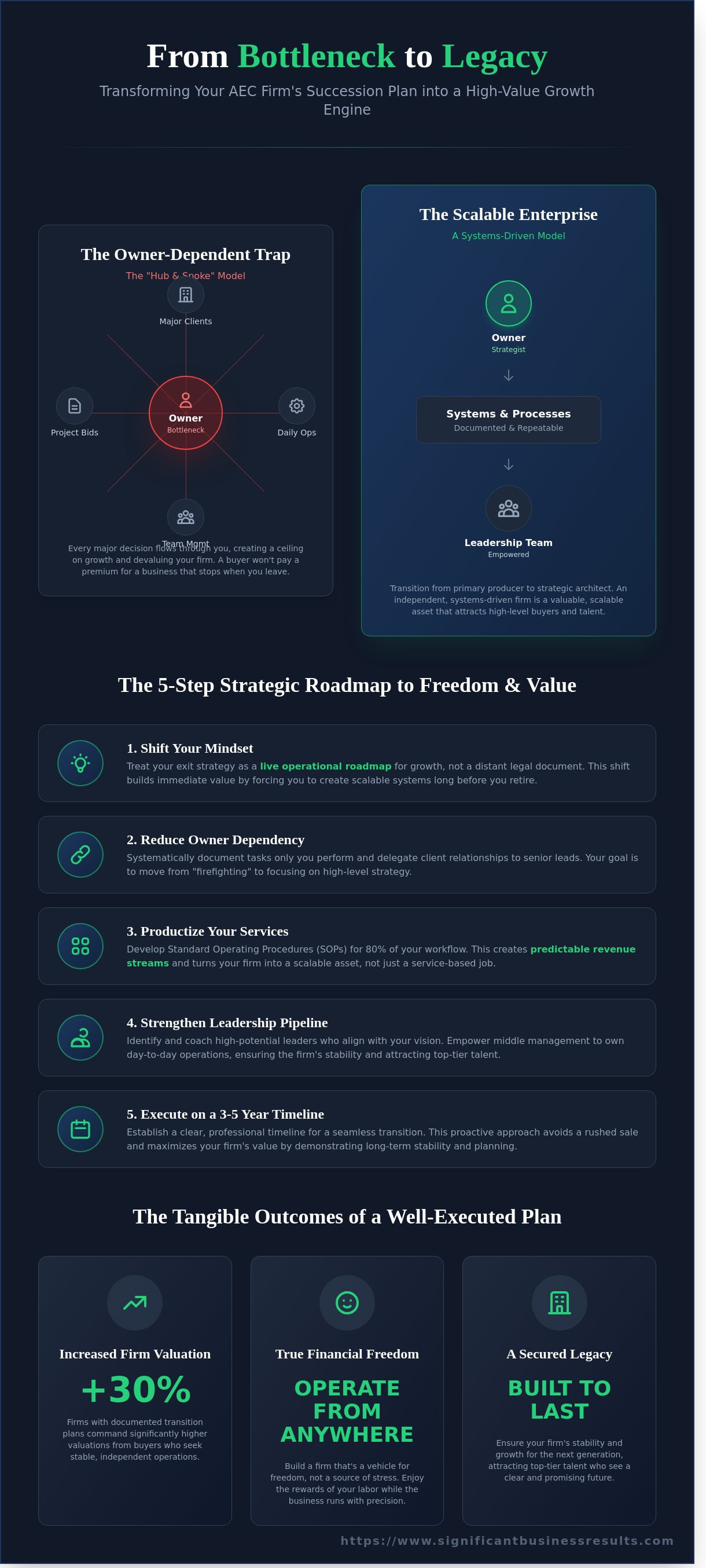
A construction company succession plan isn't a final chapter; it's a strategy for long-term operational excellence. Many AEC owners view succession as a distant legal hurdle, but treating it as a live operational roadmap builds immediate value. When you document processes and delegate authority, you aren't just preparing to leave. You're building a business that can scale beyond your personal bandwidth. This shift from an owner-centric model to a systems-driven structure is what allows a firm to grow from $5 million to $20 million in revenue without the owner burning out.
Waiting until you're ready to retire to start this process is a costly mistake that reduces your firm's market value. Data shows that firms with a documented transition plan often command a 30% higher valuation than those sold in a rush. A buyer or a successor looks for a machine that works independently, not a job they have to fill. If you're still the primary point of contact for every major client, your firm's value drops significantly because the risk to a new owner is too high. Developing a robust construction company succession plan allows you to step away from the daily grind while your revenue continues to climb.
Transition readiness also serves as a magnet for top-tier AEC talent. Senior project managers and engineers with 12 or 15 years of experience look for stability and clear career horizons. They want to know the firm won't dissolve when you decide to step back. By showing potential hires a clear path for the company's future, you secure the high-level leaders needed to sustain growth. You can learn more about building this kind of transferable value by reviewing the 8 key drivers of company value.
Identifying Your Primary Transition Objectives
You must first decide if you're aiming for an internal leadership transition or an external sale to a competitor or private equity group. These paths require different preparations. An internal transition focuses on mentoring and long-term buy-ins, while an external sale prioritizes clean financial statements and "transferable" value. Evaluate your current daily tasks; if you spend more than 5 hours a day on "firefighting" operations, your firm isn't sustainable without you yet. Setting measurable goals for your financial freedom ensures your legacy is preserved while you achieve the personal liberty you've earned.
Maximizing Firm Value by Reducing Owner Dependency
Many AEC firm owners fall into the 'Hub and Spoke' trap. You're the center of the wheel. Every decision, from project bids to site disputes, requires your approval. This dependency creates a ceiling on your growth and devalues your firm. A buyer won't pay a premium for a business that stops when you leave. Building a robust construction company succession plan requires you to step back so the business can move forward. You must transition from being the primary producer to the strategic architect of the organization.
You can increase your multiple by productizing your services. Instead of treating every project as a unique, manual challenge, develop standard operating procedures for 80% of your workflow. This creates predictable revenue and measurable outcomes. When your processes are repeatable, your firm becomes a scalable asset rather than a job you happen to own. We use The Value Builder System™ to identify value-killing bottlenecks that stall your progress and limit your personal freedom.
- Identify the tasks only you perform and document the steps.
- Delegate client relationship management to senior project leads
- Shift focus from billable hours to project-based value.
Strengthening Your Leadership Pipeline
Identify high-potential leaders who demonstrate strategic alignment with your vision early. Technical skill doesn't always translate to management capability. You can use executive leadership coaching to bridge this gap. This ensures your team leads by systems rather than just effort. When results are measured by clear data, accountability follows naturally. It's about empowering middle management to own the day-to-day operations.
Leveraging the 8 Key Drivers of Value
Operational efficiency directly impacts your firm's valuation multiple during a sale or transition. Diversifying your client base so no single project accounts for more than 15% of annual revenue reduces risk significantly. You can download the 8 Key Drivers of Company Value eBook to see how your firm ranks. Focusing on these drivers helps you achieve sustainable scaling while preparing for your eventual exit.
Executing Your AEC Transition Framework for Significant Results
Succession isn't a single event; it's a deliberate process. To secure the future of your firm, you need a realistic 3-to-5-year timeline. This window provides the necessary runway to transfer knowledge, mentor successors, and stabilize operations. A rushed exit often results in a 20% to 30% loss in potential company value because the business remains too dependent on the founder's daily input. You want a legacy that lasts, not a firm that falters the moment you step away.
Start with a formal value assessment. You can't reach your destination if you don't know your current coordinates. This assessment identifies gaps in your operational structure and highlights areas where you can increase your multiple. Once the path is clear, communicate the plan to your key stakeholders. Transparency eliminates the "key person risk" and ensures your team remains aligned with the long-term vision. Focus on refining operations so the business thrives even when you're not in the room. Results come from systems, not just individual effort.
Evaluating Your Firm’s Exit Readiness
Financial audits are essential, but they only tell half the story. A clean balance sheet doesn't prove that your firm can survive without your personal relationships or technical expertise. You should review case studies of successful AEC transitions to see how other $5 million to $15 million firms handled these hurdles. Modeling your path after proven results reduces uncertainty and prevents common pitfalls.
Strategic planning sessions are the anchor of a successful construction company succession plan. These meetings move beyond daily project management to focus on high-level strategy. When your leadership team is aligned on the future vision, the transition becomes a natural evolution rather than a disruption. Aim for a business structure where systems drive the outcomes. This shift creates the financial and personal freedom you've worked decades to achieve, ensuring your firm remains a valuable asset for years to come.
Securing Your AEC Legacy and Future Growth
A successful AEC firm shouldn't collapse if the owner takes a month off. Building a robust construction company succession plan means shifting from daily operations to high-level strategy. This transition can increase firm value by up to 71% when owner dependency is minimized. For leaders managing $1 million to $20 million in annual revenue, the goal is clear: create a self-sustaining asset. We've spent years refining this process as an authorized Value Builder System provider. Our expertise is rooted in the specific challenges of the architecture, engineering, and construction sectors. You can achieve both financial freedom and operational excellence by focusing on measurable outcomes today. It's about more than just an exit; it's about creating a legacy that delivers significant results long after you've stepped back from the front lines. Your journey toward a more valuable and efficient business starts with a single strategic step. We're here to help you navigate that path with confidence.
Schedule a Strategic Planning Session to build your firm's future

Article by
Franne McNeal
Franne McNeal, President, Significant Business Results LLC has helped 885+ small business owners collectively create 15,000 jobs and nearly $11 billion in revenue. We help architecture, engineering, and construction industry business owners with $1M-$20M in annual revenue, improve revenue, performance and long-term value. We help owners build a business that runs without them & creates financial & personal freedom. Our clients focus their energy for action to achieve significant business results.