.png)
Construction Company Succession Plan: A Strategic Guide for AEC Leaders

For many leaders in the architecture, engineering, and construction (AEC) industry, a succession plan feels like a distant, complex task—a document to be dealt with years from now. But this perspective misses a critical opportunity. A well-designed construction company succession plan is not an exit document; it is a strategic framework to build a more valuable, resilient, and self-sufficient business today. It’s the key to transforming your firm into an asset that thrives with or without your daily involvement.
Why Your Construction Company Succession Plan Is a Growth Strategy
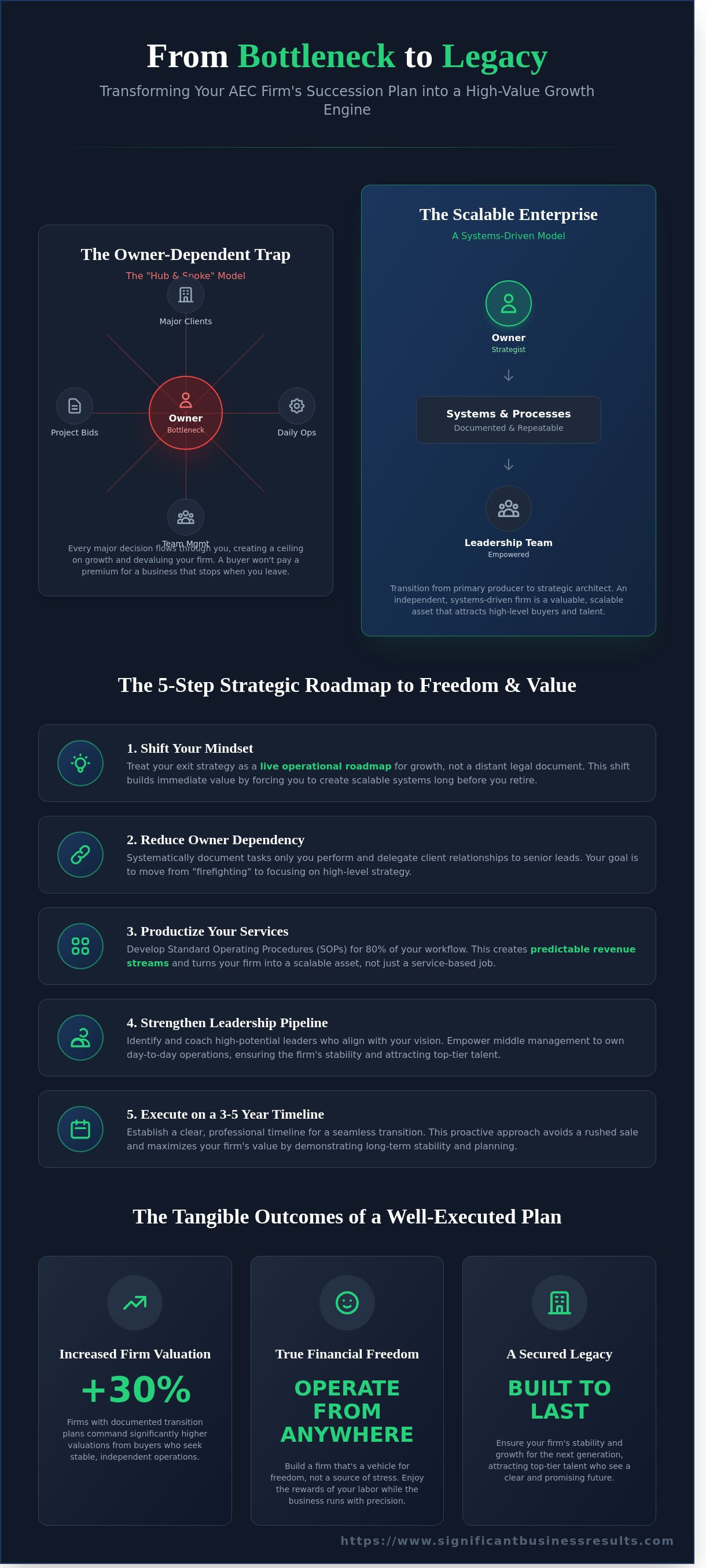
Viewing succession planning as a future event is a mistake that can significantly reduce your firm's market value. The process of preparing for a transition forces you to address operational weaknesses, strengthen your leadership team, and create scalable systems. This isn’t about planning your exit; it's about building a business that’s ready for any future. By shifting from an owner-centric model to a systems-driven structure, you not only prepare for a smooth handover but also attract high-level talent eager to join a company with a clear path for growth.
Identifying Your Primary Transition Objectives
Before diving into logistics, you must clarify your strategic goals. Are you planning an internal transition to the next generation of leaders, or are you preparing for an external sale? Each path requires a different approach. Define what financial freedom and legacy preservation mean to you in measurable terms. A critical first step is to honestly evaluate how your current role impacts the firm's long-term sustainability. If every major decision and client relationship depends on you, the business's value is fundamentally limited.
According to Succession planning, this is a well-documented area of ongoing research and practical application.
Maximizing Firm Value by Reducing Owner Dependency
Many AEC firms with revenue between $1M and $20M fall into the "Hub and Spoke" trap, where the owner is the central hub for all critical operations. While this may have been necessary for initial growth, it becomes a major bottleneck that devalues your company. To achieve significant results, you must systematically remove yourself from the center. This involves empowering your middle management to handle day-to-day decisions, client relationships, and project oversight, freeing you to focus on high-level strategy.
- Systematize Operations: Document key processes to ensure consistent project delivery and client satisfaction, regardless of who is leading the team.
- Empower Your Team: Delegate genuine authority and responsibility to your project managers and department heads.
- Focus on Scalable Services: Define your core service offerings so they can be delivered consistently and profitably without your direct input.
Strengthening Your Leadership Pipeline
A business that can run itself needs capable leaders. Your succession plan's success hinges on identifying and developing high-potential individuals within your existing teams. These are often your best technical experts who need to develop strategic management skills. Investing in executive leadership coaching bridges this gap, transforming skilled practitioners into visionary leaders. This creates a culture of accountability where performance is measured by outcomes, not just the owner's presence.
Research published by Modern Succession Strategies shows that this is a well-documented area of ongoing research and practical application.
Leveraging the 8 Key Drivers of Value
To build a truly sellable company, you must focus on the specific factors that buyers and investors value. The Value Builder System™ identifies eight key drivers that directly impact your firm’s valuation multiple, including financial performance, growth potential, and customer satisfaction. By focusing on these areas—such as diversifying your client base to reduce risk—you systematically increase your company's worth. Understanding these drivers gives you a clear roadmap for achieving your long-term goals.
Actionable Tip: Assess your firm's current value and identify areas for improvement by downloading the 8 Key Drivers of Company Value eBook.
Executing Your AEC Transition Framework for Significant Results
A successful transition doesn't happen overnight. It requires a deliberate, multi-year strategy focused on operational excellence. By implementing a clear framework, you can ensure strategic alignment and build trust among your team, clients, and other stakeholders. The objective is to refine your business operations so completely that it continues to thrive long after you step back.
- Establish a Realistic Timeline: Set a 3-to-5-year timeframe to systematically implement changes and prepare your team.
- Conduct a Formal Value Assessment: Understand your starting point with a professional business valuation to set a clear baseline for growth.
- Communicate the Vision: Share the high-level plan with key stakeholders to get their buy-in and ensure a cohesive effort.
- Refine and Iterate: Continuously monitor progress against your goals and adjust your strategy as needed to ensure the business is ready for the future.
Evaluating Your Firm’s Exit Readiness
True readiness for a transition goes far beyond clean financial audits. It involves assessing your operational independence, the strength of your management team, and the sustainability of your revenue streams. Strategic planning sessions are essential for aligning your leadership team around a shared vision for the future. By studying case studies of successful AEC transitions, you can model your path on proven strategies and avoid common pitfalls.
Research published by Construction Executive on succession planning shows that this is a well-documented area of ongoing research and practical application.
Building a self-running construction company is the ultimate achievement for any founder. A strategic succession plan is your blueprint for getting there, enabling you to secure your legacy while achieving the financial and personal freedom you've worked so hard for.
Ready to build a firm that runs without you? Schedule a Strategic Planning Session to build your firm's future and achieve significant results.
Frequently Asked Questions (FAQs)
When should a construction company owner start succession planning?
You should start succession planning at least 3-5 years before your intended transition. The ideal time is now, as the process of planning directly increases your company's current value and operational efficiency.
What is the difference between an exit strategy and a succession plan?
An exit strategy is a high-level goal (e.g., selling the company). A construction company succession plan is the detailed, operational roadmap that makes that exit successful by developing leaders, systematizing processes, and increasing firm value.
How do I value my construction company for a succession transition?
Valuation is based on more than just revenue and assets. It includes factors like owner dependency, recurring revenue streams, customer diversity, and the strength of your management team. A formal assessment based on the 8 Key Drivers of Value provides the most accurate picture.
Can a $1M-$20M AEC firm really run without the owner's daily involvement?
Absolutely. By implementing robust systems, empowering a strong leadership team, and shifting your role from operator to strategist, it is entirely possible to build a profitable firm that thrives independently of your daily presence.

Article by
Franne McNeal
Franne McNeal, President, Significant Business Results LLC has helped 885+ small business owners collectively create 15,000 jobs and nearly $11 billion in revenue. We help architecture, engineering, and construction industry business owners with $1M-$20M in annual revenue, improve revenue, performance and long-term value. We help owners build a business that runs without them & creates financial & personal freedom. Our clients focus their energy for action to achieve significant business results.