.png)
How to Prevent AEC Business Owner Burnout by Reducing Firm Dependency

For successful owners of architecture, engineering, and construction (AEC) firms, burnout often feels like an unavoidable cost of doing business. Yet, this exhaustion is not a sign of personal failure or a lack of stamina. It is a structural failure of business design. AEC business owner burnout is a direct result of a firm that is too dependent on its founder. The solution isn't to work harder; it's to build a firm that can thrive without your constant, hands-on involvement.
This guide provides a strategic framework to help you transition from an exhausted operator to a visionary leader, reducing your firm's dependency on you and, in the process, increasing its value and restoring your freedom.
Recognizing the Structural Causes of AEC Business Owner Burnout
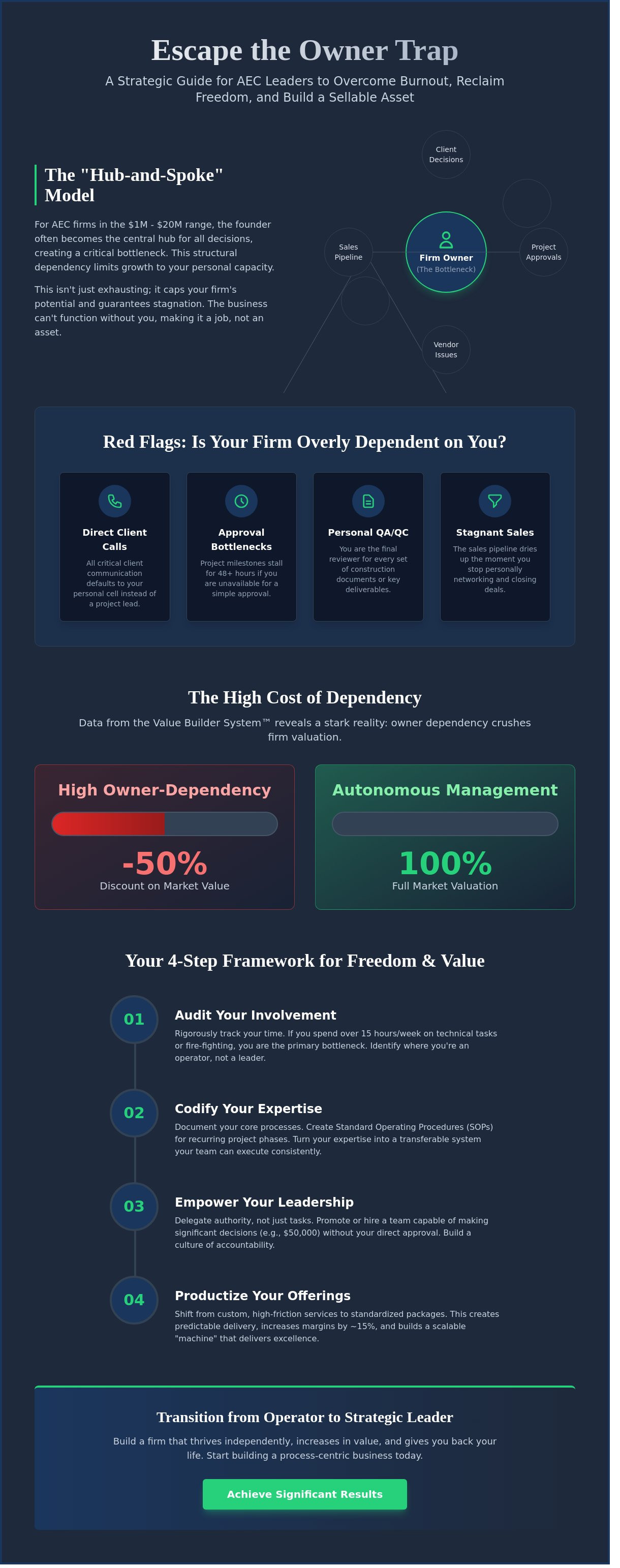
For AEC firms in the $1M-$20M revenue range, growth often creates a paradox. You're successful enough to have complex projects and a growing team, but not yet large enough for a deep middle-management layer. This places you, the owner, at the center of everything. You become the primary rainmaker, the lead technical expert, and the chief problem-solver. This is the "Owner Trap," and it sacrifices long-term strategy for daily operational fire-fighting.
The "Hub-and-Spoke" Model in Design and Construction
The most common design flaw leading to burnout is the "hub-and-spoke" model, where you are the hub and all clients, projects, and team members are the spokes. Every critical piece of information and every key decision must pass through you. While this model may feel necessary for quality control, it creates crippling bottlenecks and makes it impossible for you to step away. If projects would halt or key client relationships would suffer the moment you took a two-week vacation, your firm is overly dependent on you.
According to Occupational burnout, this is a well-documented area of ongoing research and practical application.
Symptoms of this dependency include:
• You are the only person who can approve major proposals or close significant contracts.
• Your team constantly asks for your input on technical or client-facing issues they could handle.
• Your vacation time is spent checking emails and taking calls to prevent project delays.
• You feel like you're working in the business more than you're working on it.
A Strategic Framework to Reduce Dependency and Restore Freedom
Dismantling the hub-and-spoke model requires a deliberate, systematic approach. It’s about building a self-sustaining organization through systems and people, allowing you to reclaim your role as a strategic leader.
Audit Your Involvement
For one week, track every task you perform. Categorize them into four areas: tasks you love and are great at, tasks you are great at but don't love, tasks you are good at, and tasks you are not good at. This audit will reveal exactly where you are the bottleneck.
Systematize Key Processes
Identify the recurring phases in your AEC projects—from initial client intake to final project delivery. Develop and document standard operating procedures (SOPs) for these phases. Systems, not people, should run the day-to-day operations.
Empower a Leadership Team
Delegate responsibility, not just tasks. Identify key team members who can own client relationships and technical execution. Provide them with the training, authority, and accountability to make decisions without your constant oversight. For more on this, read about building leadership team alignment.
Productize Your Services
Transition from offering completely custom, one-off solutions to developing standardized service packages. For an architecture or engineering firm, this could mean creating tiered design packages or a repeatable feasibility study process. Productized services are easier to delegate, price, and deliver efficiently.
Increasing Firm Value While Reclaiming Your Personal Time
The journey to reduce owner dependency does more than just prevent burnout; it directly increases the financial value of your business. A firm that can run successfully without its owner is a valuable, sellable asset. An acquirer buys a business for its systems and its team, not for the opportunity to buy its founder a job. Therefore, every step you take to make yourself less essential makes your company more attractive to a potential buyer.
Leveraging the 8 Drivers of Company Value
The Value Builder System™ identifies eight key drivers that determine a company's value. One of the most critical for AEC firms is "Hub & Spoke"—the extent to which your business relies on you personally. By reducing this dependency, you fundamentally strengthen your company's valuation. Personal freedom and financial growth are two sides of the same coin. To see how your firm measures up across all eight drivers, you can download the free eBook, The 8 Key Drivers of Company Value.
Preventing burnout isn't a luxury; it's a fiduciary duty to your firm's future. By systematically reducing your company's reliance on you, you build an enduring enterprise that provides you with both financial and personal freedom. If you're ready to accelerate this transition, exploring AEC leadership coaching can provide the structure and accountability needed to achieve significant results.
Frequently Asked Questions (FAQs)
How do I know if my AEC firm is too dependent on me?
If you can't take a two-week, disconnected vacation without projects stalling or major issues arising, your firm is too dependent on you.
Can an architecture or engineering firm really run without the founder?
Yes. With the right systems, a capable leadership team, and a shift in the owner's role from operator to visionary, any AEC firm can become self-sustaining.
What is the first step to take when I feel on the verge of burnout?
The first strategic step is to audit your time for one week to identify exactly where you are the bottleneck. This data provides the roadmap for delegation and systemization.
How does reducing my involvement in the firm increase its sale price?
A business that runs independently of its owner is a turnkey asset with lower risk for a buyer. This operational independence significantly increases its market valuation and makes it more attractive to a wider pool of acquirers.
Article by
Franne McNeal
Franne McNeal, President, Significant Business Results LLC has helped 885+ small business owners collectively create 15,000 jobs and nearly $11 billion in revenue. We help architecture, engineering, and construction industry business owners with $1M-$20M in annual revenue, improve revenue, performance and long-term value. We help owners build a business that runs without them & create financial & personal freedom. Our clients focus their energy for action to achieve significant business results.