.png)
Architecture firm pricing models: A strategic framework for scaling and firm value

For many owners of architecture, engineering, and construction (AEC) firms, growth leads to a frustrating paradox: the more the business expands, the more it depends on them personally. Your pricing model is often the root cause. It’s time to transition from restrictive billing habits to strategic pricing models that increase profitability and enhance the long-term value of your firm.
Pricing is not just an accounting exercise; it is the primary lever for reducing owner dependency and maximizing your firm’s valuation. By shifting your focus from selling hours to selling outcomes, you can begin building a business that is not only more profitable but also a sellable asset.
Table of Contents
• Beyond the Billable Hour: Why Your Pricing Model Might Be Stalling Your Growth
• Selecting the Right Framework: The Four Dominant AEC Pricing Models
• Aligning Your Fee Structure with Exit Readiness and Firm Valuation
Beyond the Billable Hour: Why Your Pricing Model Might Be Stalling Your Growth
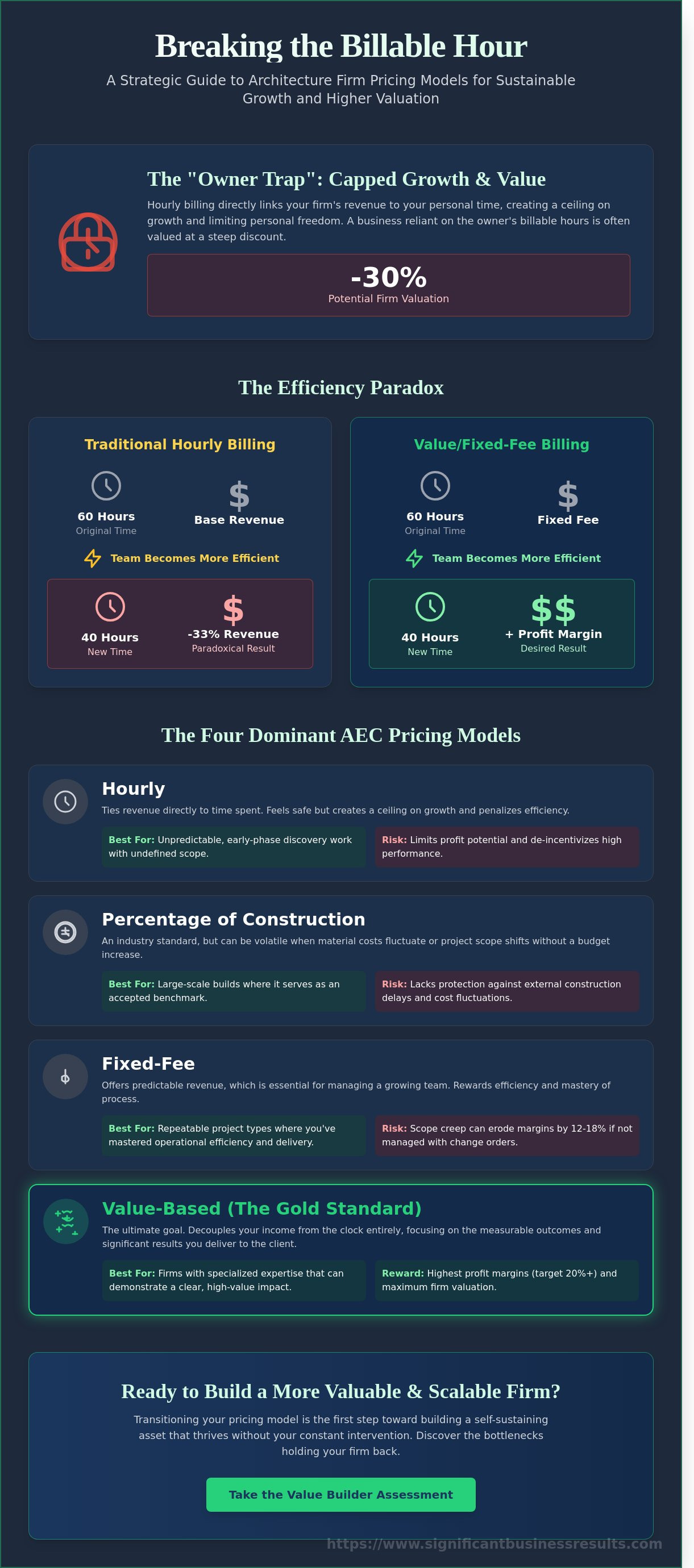
An architecture firm's pricing model is more than a way to bill for services; it's a strategic framework that dictates project profitability and firm scalability. For many AEC leaders, the default model—hourly billing—inadvertently creates an "Owner Trap." This approach directly ties your firm's revenue to the owner's time and direct involvement, making it impossible to scale beyond your personal capacity. You remain central to every proposal and project, feeling less like a CEO and more like your firm's most overworked freelancer.
The necessary shift is psychological. You must move from justifying your time to demonstrating the significant business results your expertise delivers. When clients see the value you create—not just the hours you spend—your fee structure aligns with your long-term goal: building a business that can thrive without you. To see how a boutique firm implements creative and practical design solutions in practice, you can discover ArchEvolve.
The Efficiency Paradox in AEC Firms
In a firm that bills by the hour, becoming more efficient is a penalty. When your team innovates and completes work in less time, your revenue decreases. This "Efficiency Paradox" discourages process improvement and can damage team morale, as hitting billable targets becomes more important than delivering outstanding project outcomes. This is a classic inhibitor to growth that can be identified and corrected by evaluating your business's core drivers. A Value Builder Score assessment can help pinpoint exactly where these operational weaknesses are stalling your firm's value.
Selecting the Right Framework: The Four Dominant AEC Pricing Models
For AEC firms in the $1M-$20M revenue range, choosing a pricing model is a strategic decision that impacts cash flow, risk, and scalability. While dozens of hybrid models exist, most fall into four main categories.
Hourly Billing
Simple to track but the least scalable. It caps earning potential, punishes efficiency, and anchors the firm to owner involvement. It offers low risk but also low reward and makes cash flow unpredictable.
Percentage of Construction Cost
Once an industry standard, this model is becoming less reliable due to volatile material costs and unpredictable construction timelines. It disconnects your fee from the actual design value you provide.
Fixed-Fee
This model offers predictable cash flow for both you and your client. It incentivizes efficiency, as higher margins are achieved by completing work under budget. The primary risk is scope creep, which must be managed with exceptionally clear contracts and a structured change order process.
Value-Based Pricing
The most profitable and strategic model. Fees are based on the perceived or calculated value your work delivers to the client. This model completely detaches your revenue from your time, positioning your firm as a high-value partner and maximizing margins. It requires a sophisticated understanding of your client's business goals.
Transitioning to Value-Based and Fixed-Fee Structures
Moving away from hourly billing requires a systematic approach. The first step is to "productize" your services—packaging your expertise into clearly defined offerings with standardized processes. This allows you to develop fixed fees based on scope and outcomes, not time estimates. Communicating this shift is crucial; you must confidently explain to clients that they are paying for your expertise and the guaranteed result, not just the labor involved. This strategic transition is a core component of effective AEC business coaching for leaders committed to sustainable growth.
Aligning Your Fee Structure with Exit Readiness and Firm Valuation
Your pricing model has a direct and significant impact on your firm’s sellability. Potential buyers and investors prize predictability. Firms with recurring revenue streams and standardized, non-hourly pricing models command higher valuation multiples because their future income is easier to forecast. This directly impacts the "Financial Performance" driver, one of the eight key factors that determine your company's value.
By implementing fixed-fee or value-based models, you create systems for pricing and proposal generation. This standardization is critical for reducing owner dependency. When your team can confidently price and sell projects without your constant oversight, you have started building a business, not just a job.
Building a Business That Runs Without You
Standardized pricing models empower junior principals and other team members to lead business development. When the "rules" for pricing are clear, the founder is no longer the bottleneck for every new proposal. This operational independence is a hallmark of a truly valuable and sellable company. Understanding how your pricing strategy fits into the larger picture is the first step toward building a firm that can run without you. The 8 Key Drivers of Company Value ebook provides a comprehensive framework for assessing and improving your firm's overall exit readiness.
Frequently Asked Questions (FAQs)
What is the most profitable pricing model for an architecture firm?
Value-based pricing is typically the most profitable because it links your fee directly to the significant value and results you deliver to the client, rather than the hours you work.
How do I transition my existing clients from hourly to fixed-fee pricing?
Introduce the new model with new projects first. Clearly communicate the benefits to the client, such as cost certainty and a focus on outcomes. For long-term clients, explain the shift as part of your firm's evolution to deliver more strategic value.
Does a percentage-of-construction-cost model still work in 2026?
While still used, its effectiveness is declining due to unpredictable material costs and construction schedules. It can expose firms to risk and de-link their fee from their actual design contribution.
How can my pricing model help me sell my AEC business in the future?
Models that create predictable revenue, like fixed-fee or retainer agreements, are highly attractive to buyers. They demonstrate financial stability and reduce the perceived risk of the business being dependent on the owner, which significantly increases your firm's valuation.

Article by
Franne McNeal
Franne McNeal, President, Significant Business Results LLC has helped 885+ small business owners collectively create 15,000 jobs and nearly $11 billion in revenue. We help architecture, engineering, and construction industry business owners with $1M-$20M in annual revenue, improve revenue, performance and long-term value. We help owners build a business that runs without them & create financial & personal freedom. Our clients focus their energy for action to achieve significant business results.