.png)
Beyond the Balance Sheet: Why Your AEC Firm Needs a Business Value Assessment

If you stepped away from your AEC firm for 90 days starting tomorrow, would your revenue continue to climb or would your project delivery grind to a halt? For many owners of firms generating between $1 million and $20 million, the honest answer is uncomfortable. You've built a successful practice, but you've also become its greatest bottleneck. This is where a formal business value assessment becomes a critical strategic tool. It moves beyond the simple numbers on your balance sheet to reveal whether your organization is a self-sustaining asset or merely a collection of contracts tied to your personal reputation.
It's common to feel that your personal involvement is the only way to maintain quality and client trust. You likely agree that while top-line growth is steady, your profit margins feel inconsistent and your eventual exit remains an undefined goal. This article promises to uncover the specific drivers that make your firm truly sellable and independent of your daily oversight. We'll explore how to achieve measurable outcomes by shifting your focus from technical execution to strategic alignment and sustainable scaling.
Key Takeaways
• Understand why standard financial statements fail to capture the full picture and how to evaluate your firm’s true operational health.
• Leverage a business value assessment to identify the hidden drivers that dictate your firm's market attractiveness and sellability.
• Master the core drivers of financial performance and growth potential specifically tailored for AEC firms in the $1M to $20M revenue range.
• Transition from a hands-on operator to a strategic owner by building a business designed to thrive without your constant involvement.
• Learn to align your daily energy with high-impact actions that ensure significant growth and deliver measurable results.
What is a Business Value Assessment for AEC Firms?
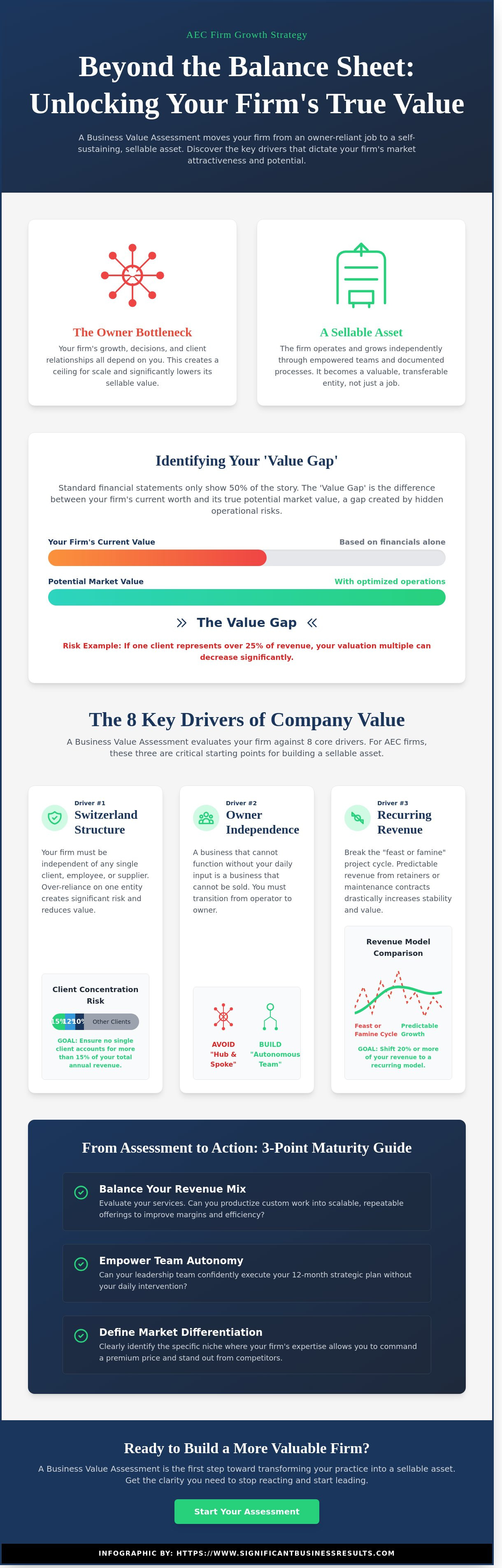
Architecture and engineering firm owners often find themselves trapped in a demanding cycle of project delivery. A business value assessment breaks this cycle by providing a strategic evaluation of your firm's operational health and market attractiveness. While your standard financial statements track historical cash flow, they only tell 50% of the story. They don't account for the structural risks that influence what a buyer or successor is actually willing to pay. You need more than a balance sheet to understand your true position.
A traditional Business valuation typically focuses on your past assets, but our assessment prioritizes the concept of Significant Business Results. This means moving your firm from being a high-intensity job for the owner to a valuable, independent asset. This process is distinct from a simple appraisal or a software ROI calculation. It's a high-level diagnostic of your firm's leverage and its capacity for sustainable scaling. We focus on building a business that operates with precision, regardless of your personal involvement.
Identifying the 'Value Gap' in Your Operations
Most AEC leaders face a discrepancy between what they believe their firm is worth today and its potential market value. This difference often arises from hidden leaks in performance and revenue. For instance, 2023 industry benchmarks suggest that firms with high client concentration, where one client represents over 25% of revenue, see a marked decrease in their valuation multiples. The business value assessment identifies these vulnerabilities before they impact your bottom line. The Value Gap is the distance between your current reality and your ideal exit price.
The 8 Key Drivers: How to Evaluate Your Firm's Health
A rigorous business value assessment begins with the Value Builder System™, a methodology that provides a quantitative benchmark for AEC firms. For organizations generating between $1M and $20M in annual revenue, the primary focus often rests on Financial Performance and Growth Potential. These metrics serve as the baseline for any acquisition or internal transition. They reflect the historical stability and the future scalability of your operations.
One of the most critical metrics for long-term health is the Switzerland Structure. This principle demands that your firm remains independent of any single entity. If a single client, employee, or supplier holds too much leverage, your risk profile increases. You should review your client ledger immediately; ensure no single project accounts for more than 15% of your total revenue. Diversification isn't just a safety net; it's a value multiplier.
Measuring Owner Dependency and Operational Efficiency
The "Hub and Spoke" model is a common bottleneck in engineering and design firms. If you're the primary decision-maker for every technical detail, you've created a ceiling for your firm's growth. Being the smartest person in the room often kills your firm's value because the business cannot scale without your direct oversight. High-value firms demonstrate team autonomy through documented processes and leadership alignment. Use this three-topic guide to evaluate your operational maturity:
1. Revenue Mix
Balance high-margin custom work with scalable, repeatable services.
2. Team Autonomy
Ensure your leadership team can execute the 12-month strategic plan without your daily input.
3. Market Differentiation
Identify the specific niche where your firm commands a premium price.
The Role of Recurring Revenue in AEC
Many AEC leaders accept the "feast or famine" cycle as an industry standard. However, top-tier firms break this cycle by implementing recurring revenue models. For a civil engineering firm, this might look like long-term municipal maintenance contracts or asset management services. For design firms, it could involve retainer-based consulting for repeat property developers. Shifting even 20% of your revenue to a predictable model significantly stabilizes your business value assessment results. To deepen your understanding of these mechanics, you can download the 8 Key Drivers Ebook.
Building a firm that functions independently is the most direct path to significant results in your growth journey. It transforms a practice into a valuable asset.
From Assessment to Action: Building a Sellable Asset
A business value assessment provides the clarity needed to stop reacting and start leading. It isn't the finish line. It's the starting block for a more profitable future. You'll need to align your daily energy with actions that actually move the needle on your company's worth. Many AEC owners get stuck in the technical weeds of project delivery. This prevents the strategic alignment necessary for sustainable scaling. Engaging with high-level AEC Coaching Services helps you pull back from the day-to-day and focus on the levers that drive significant results. Peer learning and expert guidance ensure you're not making decisions in a vacuum.
Leveraging Your Value Builder Score
Your Value Builder Score Assessment delivers more than just a number. It provides a 12-month roadmap based on 8 key drivers of value. This data allows you to prioritize strategic planning sessions with surgical precision. Instead of guessing which operational fix matters most, you'll have a quantifiable baseline to track measurable outcomes. Use this score to filter out distractions. If a project or initiative doesn't improve your score, it likely isn't serving your long-term goals. It's about working on the business, not just in it.
Achieving Personal and Financial Freedom
The ultimate goal for any firm with revenue between $1M and $20M is to transition from founder-led to system-led operations. You want a business that provides freedom of time and capital. When your operations rely on repeatable systems rather than your personal presence, you've created a sellable asset. This shift requires a disciplined approach to delegation and process. You can see how other AEC leaders have successfully navigated this transition by reviewing our AEC Case Studies. Building a business that runs without you is the only way to secure true professional and financial independence.
Architecting Your Strategic Exit
Your firm represents years of intellectual capital and technical precision. However, true enterprise value only exists when the business thrives independently of its founder. By conducting a business value assessment, you move beyond simple accounting to measure the eight drivers that institutional buyers actually prioritize. This strategic alignment ensures your $1M to $20M firm isn't just a job you own; it becomes a scalable asset that generates significant results. You've spent your career designing structures for others, so it's time to apply that same rigor to your own organizational health.
As an Authorized Value Builder System™ Provider, we specialize in helping AEC leaders transition from daily operations to high-level strategy. Whether you're refining your current performance or preparing for an eventual exit, our AEC Mastermind offers the peer-to-peer insights necessary for sustainable growth. It's time to stop being the bottleneck and start building for personal and financial freedom. We're ready to help you navigate the complexities of scaling with quiet confidence and a focus on measurable outcomes.
Take the first step toward freedom with your Value Builder Score
You've built something remarkable; let's ensure it's built to last for the long term.
Frequently Asked Questions
How is a business value assessment different from a business valuation?
A business value assessment identifies the operational drivers and risks that dictate your firm's worth, while a valuation provides a static price for a specific point in time. While a valuation relies on past tax returns, the assessment analyzes 12 to 15 key performance indicators to find where you're losing money. It focuses on how to increase your firm's worth before you decide to sell.
My AEC firm is growing rapidly; why should I care about an assessment now?
Growth often masks deep operational inefficiencies that eventually cap your revenue. Conducting a business value assessment during a growth phase ensures your systems can handle 20 percent more volume without your constant oversight. It's about building a firm that functions independently. This proactive approach prevents the 15 percent profit margin erosion that often occurs when scaling is disorganized, yielding significant results.
What are the most common value-killers for engineering and architecture firms?
High owner dependency and low project diversification are the primary factors that slash firm value. If you're responsible for 70 percent of new business development, a buyer sees high risk rather than a sustainable asset. Firms with a single client representing over 25 percent of annual revenue also face valuation discounts. Shifting these responsibilities to a capable leadership team preserves your significant results.
How long does a professional business value assessment typically take?
A comprehensive assessment usually requires three to five weeks to complete. This timeframe allows for the deep analysis of five years of financial data and intensive interviews with key staff members. You'll receive a roadmap that prioritizes three specific strategic shifts to improve your firm's performance. It's a structured process designed to yield significant clarity without disrupting your daily project deadlines.

Article by
Franne McNeal
Franne McNeal, President, Significant Business Results LLC has helped 885+ small business owners collectively create 15,000 jobs and nearly $11 billion in revenue. We help architecture, engineering, and construction industry business owners with $1M-$20M in annual revenue, improve revenue, performance and long-term value. We help owners build a business that runs without them & create financial & personal freedom. Our clients focus their energy for action to achieve significant business results.