.png)
How to Improve Team Accountability in Your AEC Firm

Why AEC Firms Struggle with Accountability: The Hub-and-Spoke Trap
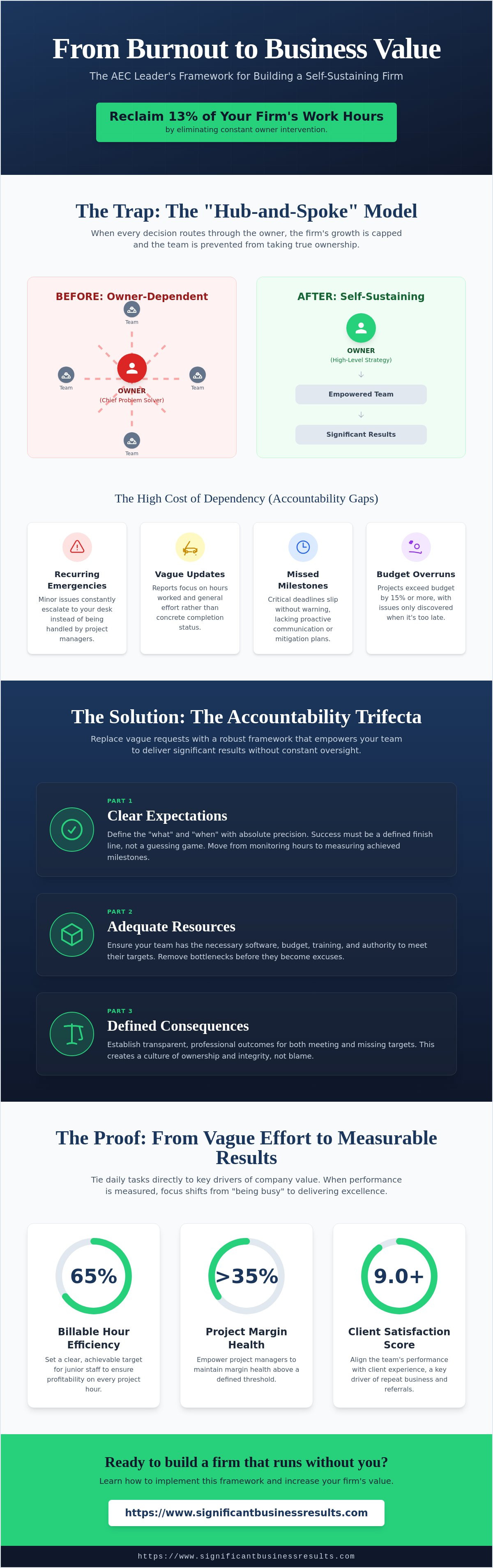
For many architecture, engineering, and construction (AEC) firm owners, the day is a relentless cycle of solving problems, checking work, and chasing updates. You feel like the bottleneck, and you’re right. This common frustration stems from a structural issue known as the "Hub-and-Spoke" model, where all decisions and approvals flow through you, the owner. While it feels like control, it’s actually a trap that stifles team initiative and makes genuine accountability impossible.
Accountability isn't about assigning blame when things go wrong; it’s a commitment to deliver on an expected outcome. In the complex, project-driven world of AEC, where technical silos and long timelines are the norm, this model quickly breaks down. Instead of managing results, you find yourself managing activity—a path that leads directly to burnout and stalled growth. The core problem is owner dependency, and it carries a significant cost.
According to accountability, this is a well-documented area of ongoing research and practical application.
The High Cost of Owner Dependency
When you are the firm's Chief Problem Solver, you are not its strategic leader. Every moment you spend correcting a drawing, intervening in a client issue, or approving a minor expense is a moment you aren’t focused on high-level strategy, business development, or scaling the firm. This dependency not only limits your personal freedom but also severely caps your firm’s value. A business that cannot function without its owner is not a sellable asset; it’s a high-stress job. Breaking this cycle is the first step toward building a self-sustaining firm that generates significant results, with or without you in the office.
Identifying Your Firm’s Accountability Gaps
The signs of poor accountability are often mistaken for everyday business challenges. Do you find yourself in constant "emergency" meetings to get projects back on track? Do your project managers provide vague updates that lack concrete data? Are billing milestones frequently missed, impacting cash flow? These are symptoms of an accountability gap—the space between expected results and actual performance. Closing this gap requires moving from a culture of oversight to one of ownership.
The Framework for Strategic Team Accountability
To improve team accountability, you must replace ambiguous expectations with a clear, systematic framework. Shifting from "do your best" to a results-based approach requires radical clarity, especially in project-based environments where success depends on hitting precise milestones. This systematic approach can be visualized as the Accountability Trifecta, a framework built on three non-negotiable pillars:
Clear Expectations
Every team member must know exactly what success looks like for their role and for each project. This means defining measurable outcomes, not just listing tasks.
Adequate Resources
You must provide your team with the necessary tools, training, budget, and authority to meet those expectations. A lack of resources makes accountability impossible.
Defined Consequences
There must be a clear, consistent, and predetermined outcome—both positive and negative—for performance. This includes rewards for exceeding goals and corrective action for failing to meet them.
Setting Measurable Performance Drivers
True accountability is tied to measurable results that align with the firm's overall strategic goals. Instead of tracking activity, focus on Key Performance Indicators (KPIs) that directly impact your firm's value. For an AEC firm, this could mean moving beyond simple project completion to tracking metrics like billable hour efficiency, project margin health, and client satisfaction scores (Net Promoter Score). By connecting individual performance to these high-level drivers, you give each team member a clear understanding of how their work contributes to the firm’s success. For more on this, see our strategic guide to KPIs for construction companies.
Research published by Hold Your Team Accountable Without Micromanaging shows that this is a well-documented area of ongoing research and practical application.
The Feedback Loop: Professionalism Over Emotion
Micromanagement is the enemy of accountability. It creates a culture of fear and signals a lack of trust, encouraging employees to wait for instructions rather than take initiative. The solution is a structured feedback loop. Replace ad-hoc interventions with consistent, scheduled check-ins focused on progress toward the established KPIs. These conversations should be direct, data-driven, and professional, not emotional. The goal is to coach and remove roadblocks, reinforcing that accountability is a supportive process designed for collective success, not individual reprimand.
Building a Firm That Runs Without You
Ultimately, a culture of high accountability is the foundation of your long-term exit strategy. It is the system that transforms your firm from an owner-dependent practice into a valuable, sellable business. When your team operates with autonomy and a clear understanding of their goals, the firm’s performance becomes consistent and predictable—two qualities that significantly increase its value to a potential buyer. This requires a fundamental mindset shift from "doing the work" to "leading the strategy." Your role becomes designing the systems that produce results, not producing the results yourself.
Leveraging Executive Coaching for Cultural Shifts
Breaking long-standing hub-and-spoke habits is incredibly difficult from within. An external perspective is often required to identify blind spots and guide the necessary cultural change. AEC business coaching provides a structured process for owners to transition from day-to-day manager to high-level strategist. A coach can help you implement the accountability framework, align your leadership team, and hold you accountable to your own goal of building a firm that thrives without you.
Designing for Sustainable Scaling
The freedom you desire as a business owner is directly linked to the autonomy and accountability of your team. By investing in a culture of accountability, you are not just improving project outcomes; you are designing a business that can scale sustainably. This allows you to focus your energy on significant results and strategic growth, rather than extinguishing daily fires. The result is a more profitable, valuable, and resilient firm—and the personal freedom you set out to achieve.

Article by
Franne McNeal
Franne McNeal, President, Significant Business Results LLC has helped 885+ small business owners collectively create 15,000 jobs and nearly $11 billion in revenue. We help architecture, engineering, and construction industry business owners with $1M-$20M in annual revenue, improve revenue, performance and long-term value. We help owners build a business that runs without them & create financial & personal freedom. Our clients focus their energy for action to achieve significant business results.