.png)
KPIs for Construction Companies: A Strategic Guide to Building a Valuable Firm in 2026

For many owners of architecture, engineering, and construction (AEC) firms, the daily reality is a constant cycle of putting out fires. You have a full pipeline and your teams are busy, but you feel trapped in the day-to-day operations. The business relies on you for every critical decision, leaving you with a high-paying job rather than a valuable, independent asset. The key to breaking this cycle lies not in working harder, but in working smarter with the right data.
Strategic Key Performance Indicators (KPIs) are more than just project-level metrics; they are the vital signs of your firm's health and the steering wheel for your long-term vision. They provide the clarity needed to transition from being the central hub of your company to the strategic leader of a self-sustaining business. By focusing on the right metrics, you can create a bridge between daily tasks and your ultimate goal: building a firm that is not only more profitable but also more sellable.
Beyond the Job Site: Why Strategic KPIs are the Steering Wheel for AEC Owners
In the construction industry, it’s easy to confuse activity with achievement. A full schedule and a healthy bank balance can mask underlying issues with profitability, efficiency, and owner dependency. Relying solely on your bank account to gauge success is like driving a car by looking only in the rearview mirror—it tells you where you’ve been, but not where you’re going or what obstacles lie ahead.
Strategic KPIs shift your focus from past results to future performance. They are the essential instruments on your leadership dashboard, allowing you to proactively guide your company toward sustainable growth. This is the critical transition from manual, personal oversight to strategic leadership. By defining and tracking the metrics that truly matter, you begin to build systems and empower your team, laying the groundwork for a business that can thrive without your constant intervention. This strategic alignment—the synchronization of your metrics with your long-term vision—is the first step toward achieving significant results.
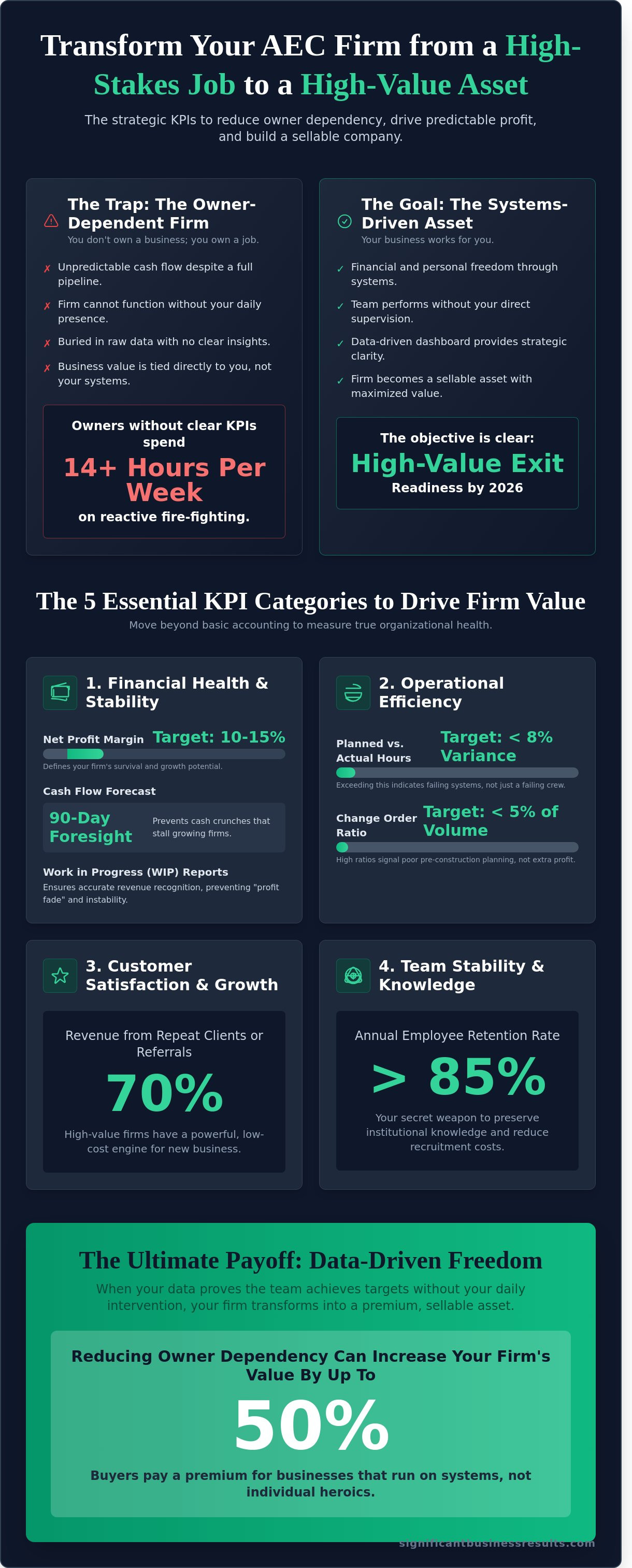
The 4 Essential KPI Categories to Drive Performance and AEC Firm Value
To build a comprehensive view of your firm's health, you need to look beyond simple revenue and project completion rates. A balanced dashboard should include metrics across four critical areas. These KPIs for construction companies provide a holistic picture, enabling you to make informed decisions that enhance both immediate performance and long-term value.
Financial Metrics That Actually Matter
True financial health goes deeper than top-line revenue. To understand your firm's stability and potential, you must focus on profitability and cash flow.
•
Gross Profit Margin vs. Net Profit: Gross margin tells you how profitable your projects are, but net profit reveals the true health of your entire business after all overhead and administrative costs are paid. A healthy gross margin with a weak net profit often points to bloated overhead that needs to be addressed.
•
Cash Flow Forecast: This is your early warning system. A 90-day cash flow forecast helps you anticipate capital needs, manage expenses, and avoid the cash crunches that can cripple even profitable firms. It allows for strategic financial planning rather than reactive crisis management.
•
Work in Progress (WIP) Report: Your WIP report is crucial for accurate monthly financial statements. It ensures you recognize revenue in the correct period, providing a true and fair view of your performance and preventing unpleasant surprises at the end of a quarter.
Operational Performance and Owner Dependency
How efficiently does your team execute without your direct input? These metrics measure your firm’s ability to deliver projects on time and on budget, which is fundamental to scaling and reducing your daily workload.
•
Planned vs. Actual Hours: This simple yet powerful KPI is a direct measure of your team's efficiency and the accuracy of your estimating. Consistently high variances signal issues in your planning or execution processes that are eroding your profit margins before you even realize it.
•
Change Order Ratio: While some change orders are inevitable, a high ratio can indicate scope creep, poor initial planning, or communication breakdowns. Tracking this helps you identify which projects or clients are driving unplanned work, allowing you to tighten your processes and protect your profitability. Improving these operational metrics is a key step to reduce owner dependency and reclaim your freedom.
Building a Sellable Asset: Leveraging Data to Reduce Owner Dependency
Ultimately, the purpose of tracking KPIs is to build a more valuable company. A potential buyer isn't just acquiring your client list and equipment; they are buying your systems, your profitability, and your future cash flow. Clean, consistent historical data from your KPIs is the proof that your business is a well-managed, low-risk investment.
High-performing KPIs directly increase the valuation multiple a buyer is willing to pay. They demonstrate that your success is systematic and repeatable, not solely dependent on your personal relationships and effort. This is how you transition from an owner who is the business to an owner who has a business.
The 8 Drivers of Company Value
KPIs are the raw data that fuels the eight core drivers of company value. For example, consistent net profits improve your Financial Performance score. Strong operational KPIs show that your business is not a "Hub & Spoke" model revolving entirely around you. A buyer sees this data as evidence of a resilient, scalable operation that will continue to perform after you exit.
How to Implement a Dashboard Without Overwhelming Your Team
The goal is clarity, not complexity. Many owners hesitate to implement KPIs because they fear creating a culture of micromanagement or getting bogged down in data entry. The key is a focused and strategic rollout.
•
Choose the "Vital Few": Start with just 3-5 key metrics that have the biggest impact on your firm's goals. Don't try to track everything. Focus on the KPIs that give you the most insight with the least amount of noise.
•
Communicate the "Why": Frame the implementation of KPIs as a tool for team success, not top-down surveillance. Explain that these numbers help everyone understand how their work contributes to the company's goals, enabling better decision-making and celebrating shared wins.
•
Assign Ownership: Give a team member complete ownership of tracking and reporting on a specific metric. This fosters accountability and empowers your team to take an active role in the firm's performance.
By implementing a simple, strategic dashboard, you create a culture of accountability and continuous improvement that is essential for building a truly valuable and independent firm.
Frequently Asked Questions
What are the most important KPIs for a construction company with $5M-$10M in revenue?
For a firm of this size, focus on a balanced set of metrics: Net Profit Margin (overall business health), 90-Day Cash Flow Forecast (financial stability), Planned vs. Actual Hours (operational efficiency), and a simple Customer Satisfaction Score (future revenue indicator).
How often should a construction company principal review their key performance indicators?
Establish a rhythm. Review operational KPIs like job progress and hours weekly with your project managers. Review financial KPIs like profit & loss and cash flow monthly. Hold a quarterly strategic review with your leadership team to assess progress against your long-term goals.
Can KPIs really help reduce my daily workload as a business owner?
Absolutely. KPIs allow you to manage by exception. When metrics are on track, you can trust your team and systems are working. When a metric slips, you know exactly where to focus your attention. This shifts you from being a micromanager to a strategic problem-solver.
What is the difference between a leading and a lagging indicator in the AEC industry?
A lagging indicator measures past performance, like your Net Profit for the last quarter. It's a result. A leading indicator helps predict future outcomes, such as your bid-hit ratio or the value of your qualified sales pipeline. Strong leading indicators suggest future success.
Ready to build a business that works for you? Explore how Significant Business Results helps AEC owners scale and exit.

Article by
Franne McNeal
Franne McNeal, President, Significant Business Results LLC has helped 885+ small business owners collectively create 15,000 jobs and nearly $11 billion in revenue. We help architecture, engineering, and construction industry business owners with $1M-$20M in annual revenue, improve revenue, performance and long-term value. We help owners build a business that runs without them & creates financial & personal freedom. Our clients focus their energy for action to achieve significant business results.