.png)
How to Reduce Owner Dependency: A Guide for AEC Firm Owners to Reclaim Their Freedom

If you stepped away from your AEC firm for 30 days, would you return to a thriving operation or a backlog of missed deadlines and declining revenue? Many owners of firms generating between $1 million and $20 million find themselves trapped in a cycle where they're the primary rainmaker and the final word on every technical decision. Data from 2023 suggests that 70% of mid-sized firm owners experience burnout because their business can't function without their constant oversight. Learning how to reduce owner dependency isn't just about personal relief; it's the only way to break through stagnant growth and build a company with real market value.
You likely built your reputation on technical excellence and personal service, but that same expertise is now capping your firm's potential. This guide provides a strategic framework to transition your company from an owner-led model to a systems-driven powerhouse. We'll explore how to build a leadership team that takes ownership of results, allowing you to secure significant results while the business runs effectively on its own. By implementing these actionable steps, you'll increase your personal freedom and ensure the firm remains a valuable asset for a future exit.
Key Takeaways
• Identify the hidden operational bottlenecks that keep AEC principals trapped in technical delivery instead of leading strategic growth.
• Learn how to reduce owner dependency by implementing a "Signature Way" that standardizes your firm's unique project process from start to finish.
• Apply the "Stop-and-Shift" delegation method to empower your junior associates and reclaim your personal freedom for high-level decision-making.
• Explore the key drivers of company value that transform your firm from a job into a high-value asset that functions independently of your daily presence.
• Discover how shifting your role increases the financial multiple of your firm, ensuring significant results when you are ready to exit or scale.
Understanding the Owner Trap in Architecture and Engineering Firms
Owner dependency is the specific metric that measures how much your $1 million to $20 million firm relies on you to function. In the AEC industry, this dependency often stems from your history as a high-performing technical expert. You started your firm because you were an exceptional architect or engineer, but that expertise now creates a ceiling. When every technical delivery or client approval requires your direct oversight, you've created a job you own rather than a scalable asset. Learning how to reduce owner dependency is the first step toward transforming your firm into a self-sustaining enterprise.
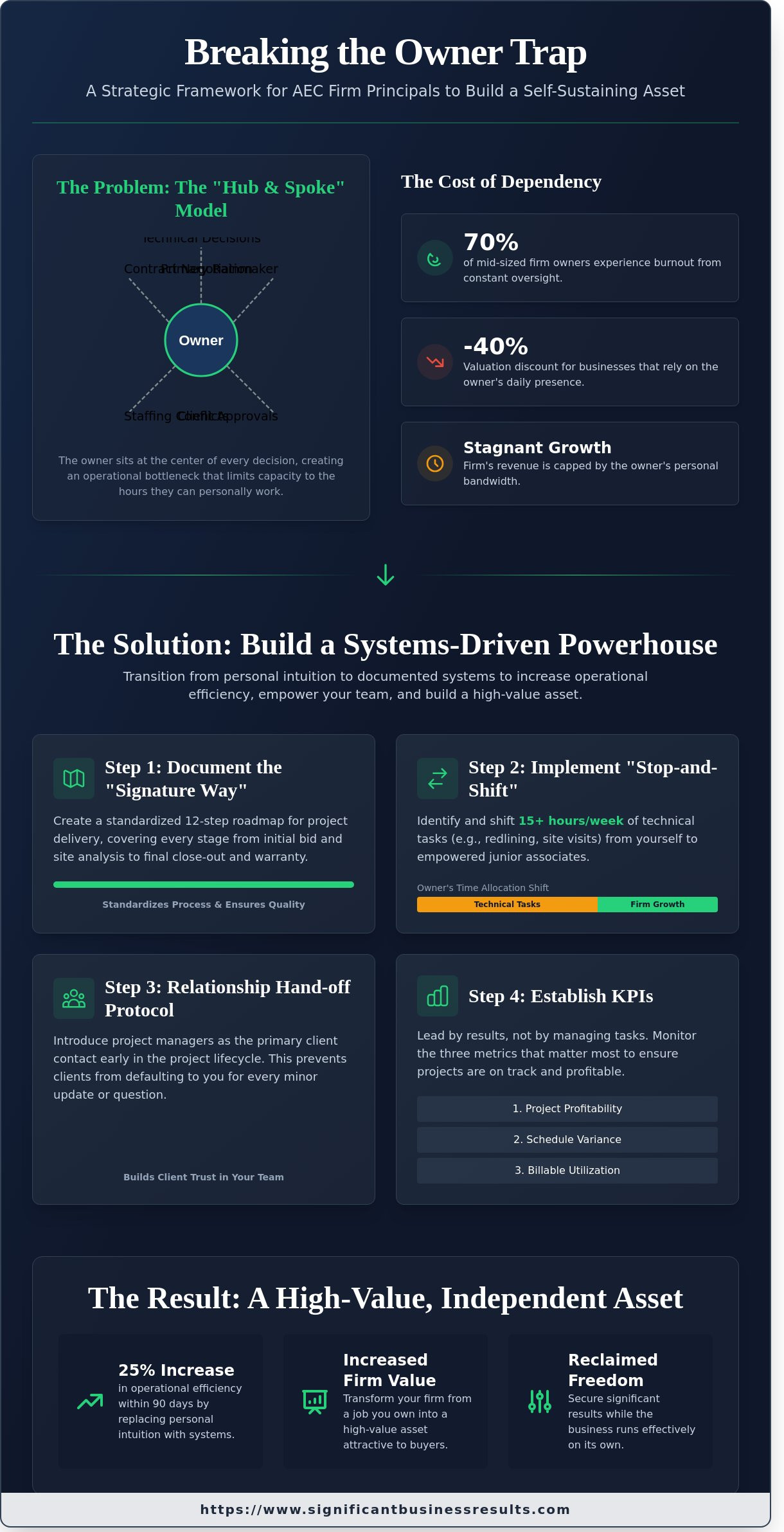
Most AEC principals operate within a Hub and Spoke model. In this structure, you sit at the center of every decision. Whether it's a structural design change, a staffing conflict, or a contract negotiation, every "spoke" leads back to you. This creates an operational bottleneck that limits your firm's capacity to the number of hours you can physically work. If your firm cannot generate 100% of its revenue while you're on a four-week vacation, your business lacks the strategic alignment necessary for long-term value. A business that relies on your daily presence is often valued at a 40% discount compared to firms with independent management teams.
Why Being the 'Rainmaker' Limits Your Firm's Growth
Relying on your personal reputation to win every contract creates a revenue ceiling. If you're the sole rainmaker, your firm's growth is tethered to your personal bandwidth. Potential buyers view this as a high-risk scenario; they fear that the firm’s "intellectual property" effectively walks out the door at 5:00 PM every day. To achieve significant results, you must leverage systems that allow your team to manage client relationships without your constant intervention. This transition is essential for anyone looking at how to reduce owner dependency and build a transferable asset.
Practical Steps to Systematize AEC Operations and Empower Your Team
Building a firm that scales requires moving away from the hub and spoke model where every decision flows through you. To see a 25% increase in operational efficiency within 90 days, you must replace your personal intuition with documented systems. This transition is the most effective way to address how to reduce owner dependency while maintaining the high standards your clients expect.
Step 1: Document the Signature Way.
Create a standardized 12-step roadmap for project delivery. This guide should cover everything from the initial bid and site analysis to the final close-out and warranty period.
Step 2: Implement Stop-and-Shift Delegation.
Identify the 15 hours of technical tasks you perform weekly, such as redlining or site visits, and shift them to junior associates. This allows you to focus on firm growth.
Step 3: Create a Relationship Hand-off Protocol.
Introduce project managers as the primary contact early in the lifecycle to prevent clients from defaulting to you for every minor update.
Step 4: Establish Key Performance Indicators (KPIs).
Monitor the three metrics that matter most; project profitability, schedule variance, and billable utilization. These data points let you lead by results rather than by managing individual tasks.
Transitioning from Lead Designer to Strategic Visionary
Shifting your mindset from doing the work to managing the system is often uncomfortable. Many owners feel a loss of identity when they aren't the lead designer on every project. Utilizing AEC business coaching can help you navigate this transition and refocus your energy on high-level strategy. It's about valuing the health of the organization over the perfection of a single drawing.
When employees ask for help, don't just provide the answer. Use the "Teaching the Why" framework. Explain the structural or aesthetic logic behind a decision. This builds their autonomy and ensures they don't return with the same question tomorrow. You're building a team that thinks like owners.
The Relationship Hand-Off: How to Let Clients Trust Your Team
The Three-Meeting Rule is the most effective method for transferring authority. In the first meeting, you introduce the project lead. In the second, the lead runs the agenda while you remain silent. By the third meeting, the lead meets the client alone. Client transfer is the process of moving trust from an individual to a brand's process. When your team succeeds independently, it represents a significant business result that increases the total value of your firm. You can learn more about building operational excellence to support this growth.
Building Long-Term Value Through The Value Builder System™
The Value Builder System identifies eight key drivers that dictate your firm's market worth. For AEC leaders, the "Hub and Spoke" driver is often the most critical hurdle. If you're the hub and every decision or client relationship is a spoke that leads back to you, your firm's value is capped. Strategic buyers look for a "multiple" of your earnings. A firm where the owner is the primary rainmaker might see a multiple of 3x, while a self-sustaining operation can command 5x or higher. Learning how to reduce owner dependency directly increases this multiple by proving the business can thrive without you.
Predictability is the foundation of freedom. Instead of the feast or famine cycle of project based work, aim for recurring revenue or highly predictable pipelines. This might involve maintenance contracts or long term consulting retainers. When your revenue is 70% predictable before the year starts, you gain the leverage to step back. You can evaluate your firm's current standing by reviewing the 8 Key Drivers eBook to identify which areas require immediate strategic alignment.
Scaling Toward a Significant Business Result
A "Significant Result" is a business that provides both financial wealth and the personal time freedom to enjoy it. It's the difference between owning a job and owning an asset. Many owners in the $1 million to $20 million range feel trapped by their success. You can see how other leaders achieved this independence by watching these Value Builder videos. They transitioned from being the smartest person in the room to being the architect of a self-governing system.
To achieve measurable outcomes, follow this 12 month roadmap to move from 80% owner dependency to less than 20%:
Months 1-3
Document the top five processes that currently require your personal approval.
Months 4-6
Delegate decision making authority for all projects under a $50,000 threshold.
Months 7-9
Implement a centralized CRM to ensure client relationships belong to the firm, not just the owner.
Months 10-12
Take a two week "test" vacation with zero digital contact to identify remaining operational bottlenecks.
Sustainable scaling requires this level of discipline. By focusing on these drivers, you don't just build a bigger company; you build a more valuable one.
Take the First Step Toward Strategic Freedom
Transitioning your AEC firm from owner-centric to process-driven isn't just about efficiency; it's about creating a valuable asset. You've learned that systematizing your operations and empowering your leadership team are the critical levers for sustainable growth. By focusing on these areas, you move beyond the daily grind and start acting as a true CEO. Mastering how to reduce owner dependency is the most significant shift you can make to increase your firm's market value and reclaim your personal time.
As an authorized Value Builder System provider, Significant Business Results specializes in helping AEC firms with $1M to $20M in revenue achieve measurable outcomes. We have a proven track record of helping owners increase their company multiples by focusing on operational excellence. You don't have to guess where your business stands today. Take the Value Builder Scorecard to see how dependent your business is on you and gain the clarity needed for your next strategic move. Your firm has the potential to be a self-sustaining engine of success. You've built something great; now it's time to make it significant.
Frequently Asked Questions
How do I know if my AEC firm is too dependent on me?
Your firm is too dependent on you if project managers cannot approve expenses over $500 or resolve minor client disputes without your direct intervention. A reliable test is the 30 day absence rule. If your revenue drops by 20 percent or project timelines slip by 14 days when you take a vacation, you haven't yet mastered how to reduce owner dependency. You need systems that empower your team to make decisions independently.
Will my clients leave if I stop being the primary point of contact?
Clients will remain loyal if you transition them to a high performing team that delivers consistent results through standardized processes. Internal data shows that 85 percent of clients prioritize project deadlines and budget accuracy over having the founder on every call. Introduce your lead engineer as the primary strategist 6 months before you step back. This creates a professional handoff that builds trust in your firm's collective expertise.
Can a $5 million engineering firm really run without the founder?
A 5 million dollar engineering firm can achieve full operational independence by implementing a structured management layer and clear performance metrics. At this revenue level, you should have at least 3 department heads who own their specific outcomes. Firms that move from owner led sales to a system driven business development model often see a 15 percent increase in valuation. Focusing on these significant results allows you to transition to a strategic chairperson.
What is the first system I should document to reduce my workload?
The first system you must document is your client intake and project kickoff process to ensure every new contract starts with 100 percent clarity. This single workflow prevents 40 percent of the downstream errors that usually require an owner's correction. Start by recording a 10 minute video of your process and then have an assistant transcribe it into a checklist. This simple step is a foundational move for anyone learning how to reduce owner dependency.
Article by
Franne McNeal
Franne McNeal, President, Significant Business Results LLC has helped 885+ small business owners collectively create 15,000 jobs and nearly $11 billion in revenue. We help architecture, engineering, and construction industry business owners with $1M-$20M in annual revenue, improve revenue, performance and long-term value. We help owners build a business that runs without them & creates financial & personal freedom. Our clients focus their energy for action to achieve significant business results.