.png)
How to Scale an Architecture Firm: From Owner-Dependency to Sustainable Growth

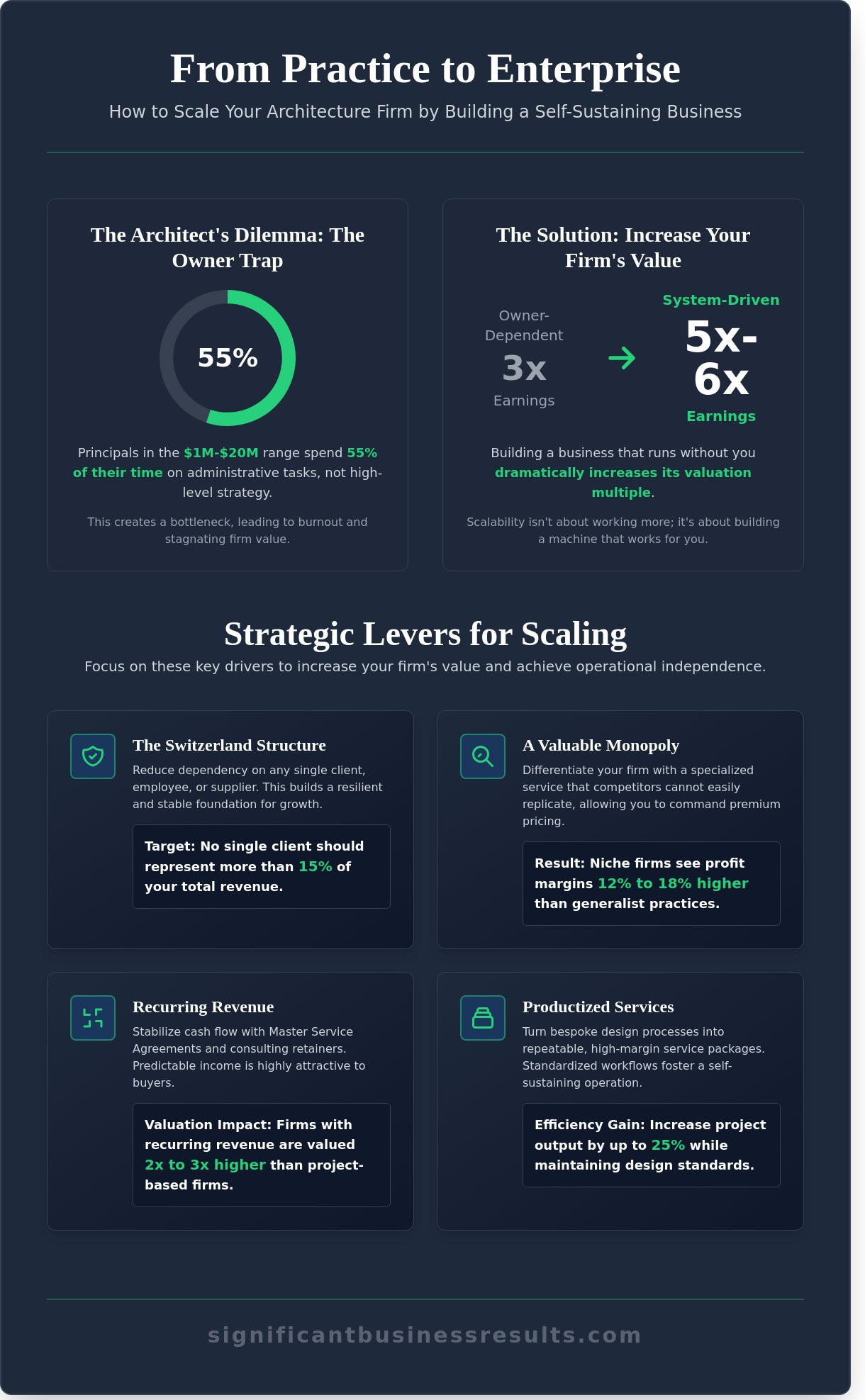
For many architecture firm owners, growth feels like a paradox. You’ve successfully navigated the early stages and built a firm generating between $1M and $20M in revenue. Yet, instead of feeling free, you feel trapped. Every major decision, client relationship, and project deadline still lands on your desk. This is the challenge of scaling an architecture firm: moving from a successful practice that depends on you to a valuable business that runs on its own.
The key isn't to work harder or hire more people into the existing structure. It's to fundamentally redesign your firm's operating system to reduce owner dependency. This guide provides a strategic framework to break through the growth plateau, increase your firm's long-term value, and reclaim your time.
The Architect’s Dilemma: Shifting from a Practice to a Scalable Business
Most architecture firms begin as a professional practice, built around the founder's talent, reputation, and relationships. This model works well initially, but it has a built-in ceiling. As the firm grows, it creates the "Owner Trap"—a situation where the principal becomes the primary bottleneck, and the business cannot function or grow without their constant involvement.
If you feel personally exhausted despite your professional success, you’re likely caught in this trap. The crucial first step is a mindset shift: you must evolve from being the firm's chief architect to its strategic CEO. A practice is dependent on a person; a business is dependent on systems. A business is sellable, a practice is not.
This transition starts with understanding how reliant the firm is on you.
The Risks of the "Rainmaker"
When you are the sole source of major projects, the firm's pipeline is volatile and its future is uncertain.
The Decision Bottleneck
If your team cannot confidently make decisions about design, finances, or client management without your approval, growth will always be limited by your personal capacity.
Actionable Tip: Conduct a simple "decision audit." For one week, track every question or decision that comes to you. Then, ask yourself: "What system, process, or training could I create so my team could have handled this?" This reveals the first steps toward building operational independence.
Strategic Levers for Scaling Your Firm
To effectively scale an architecture firm, you need to focus on strategies that build transferable value. It’s about creating a company that is attractive to a potential buyer, even if you have no immediate plans to sell. A business that is ready for a transition is also a business that is a joy to run.
This process is guided by improving the eight core drivers of company value, which are the universal metrics used to assess a company’s health and scalability. While all are important, two areas offer the most immediate leverage for AEC firms stuck in the Owner Trap.
1. Create a "Switzerland Structure"
This principle focuses on de-risking your business by ensuring it isn't overly dependent on any one client, employee, or supplier. Many firms in the $1M-$20M range rely on a few major clients for a significant portion of their revenue. This creates cash flow anxiety and puts the firm in a weak negotiating position. Diversifying your client base and empowering a leadership team to manage key relationships makes your firm more resilient and inherently more valuable.
2. Build Recurring Revenue
Architecture is traditionally a project-based industry, but the most valuable firms build predictable, recurring revenue streams. This is the single most effective way to stabilize cash flow and dramatically increase your firm’s valuation multiple. Buyers pay a premium for predictable future income.
Look for opportunities to productize your services. Can you offer feasibility study packages, zoning analysis retainers, or ongoing site management contracts? These agreements transform one-off projects into long-term partnerships.
Actionable Tip: Identify one service your firm already provides that could be converted into a recurring retainer or subscription model. Propose it to your next three clients as a value-added option.
Executing the Scale: Building for Your Future Exit
Shifting your firm from owner-dependent to system-driven requires a deliberate execution plan. This is where you transition from "doing" the work to designing the business that does the work.
Step 1: Define Your Future State
Create an organizational chart for the company you want to have in three years. Define the roles and responsibilities needed to operate without your daily input, regardless of who is on your team today. This becomes the blueprint for your hiring and professional development plans.
Step 2: Manage with a Dashboard
You cannot effectively delegate what you do not measure. Implement a handful of Key Performance Indicators (KPIs) that give you a clear, at-a-glance view of your firm's financial health, project pipeline, and operational efficiency. This allows you to manage by the numbers and coach your team on outcomes, not tasks.
Step 3: Empower Your Leadership Team
True scaling happens when you empower your mid-level associates to own project outcomes. This involves transitioning your role from director to coach. Provide them with the authority to make decisions and the accountability to see them through. This frees you to focus on high-level strategy, business development, and steering the ship.
Actionable Tip: Create a "Stop Doing" list for this quarter. Identify three to five tasks you currently handle that could—and should—be delegated to someone else on your team. Then, commit to letting them go.
Scaling your architecture firm is not just about getting bigger; it's about getting better and building a sustainable asset that serves your life, not consumes it. By focusing on systems, empowering your team, and reducing dependency on yourself, you create a business with significant value and a future independent of its founder.
Ready to see how scalable your firm is today?
Take the Value Builder Scorecard to get your score and a personalized report.

Article by
Franne McNeal
Franne McNeal, President, Significant Business Results LLC has helped 885+ small business owners collectively create 15,000 jobs and nearly $11 billion in revenue. We help architecture, engineering, and construction industry business owners with $1M-$20M in annual revenue, improve revenue, performance and long-term value. We help owners build a business that runs without them & creates financial & personal freedom. Our clients focus their energy for action to achieve significant business results.