.png)
Recurring Revenue Models for AEC Service Businesses: Beyond the Project Cycle

The traditional project-based model in the AEC industry is a sophisticated trap that limits your firm's ultimate valuation. You likely understand the exhaustion of the "feast or famine" cycle, where a healthy pipeline today offers no guarantee of stability six months from now. It's frustrating when 90% of your business value depends on your personal presence in every client meeting. Transitioning toward recurring revenue models for service business success allows you to replace this volatility with strategic alignment and professional peace of mind.
You've worked hard to build a reputable firm over the last 10 years, yet the lack of predictable income often keeps you tethered to the daily grind. This article demonstrates how to break that cycle by implementing high-leverage frameworks that secure your cash flow and your freedom. We'll examine how to transform your expertise into scalable assets that can increase your company's exit multiple by as much as 35% compared to traditional project-only firms. You'll discover a direct path to building a business that operates with excellence, whether you're in the office or not.
Key Takeaways
• Identify how moving beyond project cycles stabilizes cash flow and significantly increases your firm’s market valuation.
• Discover how to implement recurring revenue models for service business success by leveraging advisory retainers and technology-driven monitoring.
• Learn the essential systems required to build a self-sustaining operation that delivers consistent results without constant owner intervention.
• Master the transition from selling one-off projects to securing high-value, long-term contracts that ensure predictable growth.
• Uncover the strategic alignment necessary to position your specialized expertise as a monthly necessity for your most valuable clients.
The AEC Valuation Gap: Why Project Revenue Limits Your Growth
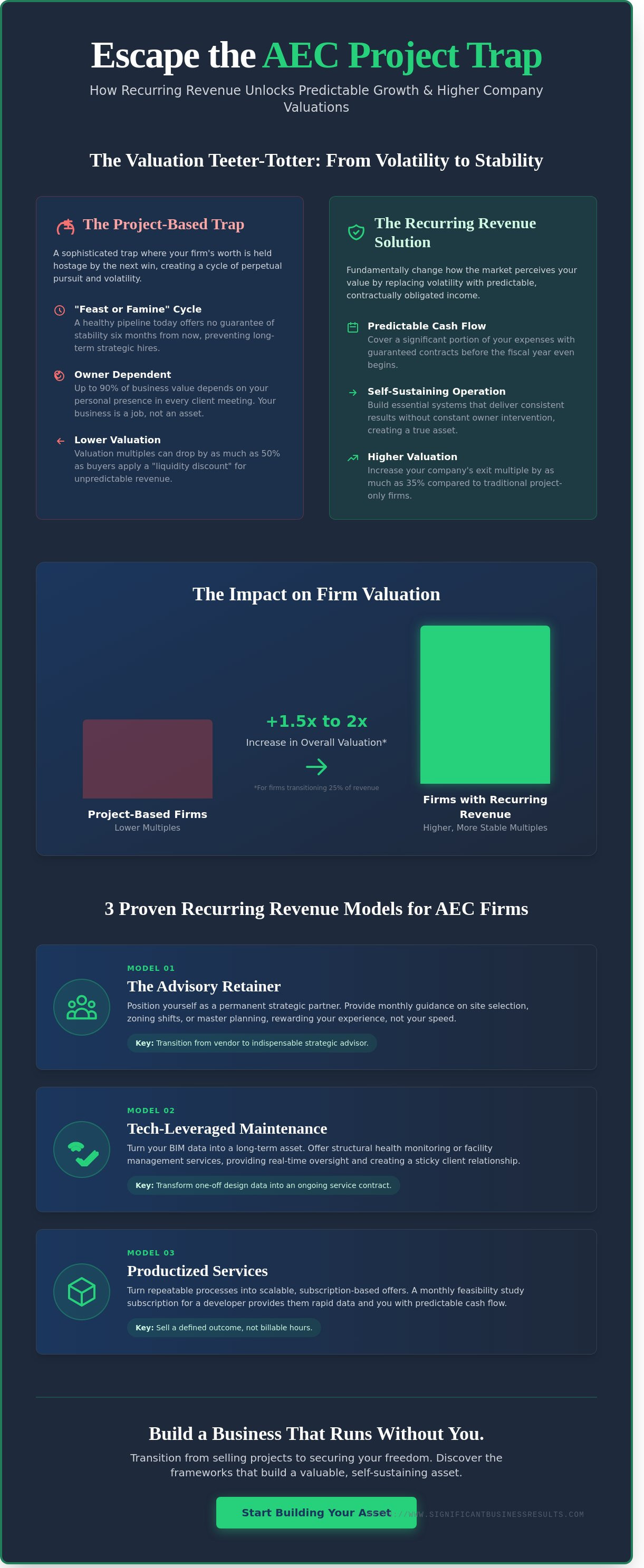
Most AEC firms operate within a cycle of perpetual pursuit. You win a contract, execute the work, and eventually reach the end of the billing cycle. This project-based trap creates a precarious "Valuation Teeter-Totter" where your firm’s worth is held hostage by the next win. In professional services, true recurring revenue is defined as predictable, contractually obligated income that arrives without a fresh sales pitch. It's the difference between being a vendor and being a strategic partner.
When you implement recurring revenue models for service business, you fundamentally change how the market perceives your value. Investors and buyers prioritize stability. A firm that starts the fiscal year with 40% of its expenses already covered by contracts is far more valuable than one starting at zero. This stability allows for strategic alignment and sustainable scaling that project-based firms simply can't achieve. By diversifying your Revenue stream, you move from the role of a "service provider" to a "solution partner." This evolution turns clients into "Automatic Customers," a primary driver for achieving significant business results.
The Risk of the Project-Based Grind
Lumpy cash flow isn't just a stressor; it's a structural weakness. It prevents you from making long-term strategic hires because you lack the visibility to guarantee a salary twelve months out. Potential buyers often apply a "liquidity discount" to firms that can't forecast revenue. If your income relies entirely on winning competitive bids, your business is a job, not an asset. According to recent industry data, firms with high project dependency see their valuation multiples drop by as much as 50% compared to those with stable contracts.
Measuring Your Current Predictability
To fix the gap, you must first measure it. Calculate your current recurring percentage by dividing your total annual contractually obligated revenue by your total gross revenue. If this number is below 15%, your growth is likely limited by your personal output. Benchmarking your firm is essential for long-term planning. You can determine your current standing by completing the Value Builder Score assessment, which provides a data-driven look at your firm's marketability and identifies where you can gain the most leverage.
3 Strategic Recurring Revenue Models for Design and Construction Firms
Developing recurring revenue models for service business owners in the AEC sector is less about changing what you do and more about changing how you package your expertise. Moving away from the billable hour allows you to capture the full value of your strategic insights. Firms that transition 25% of their revenue to recurring streams often see a 1.5x to 2x increase in their overall company valuation. This shift provides the financial stability needed to scale without the owner's constant involvement in every project detail.
The Advisory Retainer for AEC Principals
A "Seat at the Table" model positions you as a permanent strategic partner for developers or municipal leaders. Instead of waiting for a Request for Proposal, you provide monthly guidance on site selection, zoning shifts, or master planning. This model rewards your experience rather than your speed. To prevent scope creep, establish clear boundaries. Define a set number of monthly meetings or specific deliverables. Use tiered access levels where a base tier provides email access and a premium tier includes on-site presence. This ensures you remain a high-level advisor without becoming a full-time employee on a part-time fee.
Leveraging Technology for Maintenance Revenue
Your Building Information Modeling (BIM) data is a valuable asset that provides utility long after construction ends. You can transition from a one-off designer to a long-term asset manager by offering structural health monitoring or facility management services. By 2026, the global smart building market is projected to reach $148 billion, creating a gap for firms that can interpret complex data. You provide the client with real-time oversight of their building systems, ensuring 100% operational reliability. This creates a sticky relationship that makes you indispensable. To explore specific firm-level implementation, you may find value in AEC Coaching services to audit your current digital assets.
Productized Services and Performance Contracts
Turn repeatable processes into subscription-based "pre-flight" services. A monthly feasibility study subscription for a developer looking at 10 to 15 sites per year provides them with rapid data and you with predictable cash flow. You can also implement performance-based contracts. These align your firm’s incentives with the client’s outcomes, such as meeting specific energy efficiency targets or reducing lifecycle costs by 15%. When you share in the long-term value you create, the project cycle stops being a constraint and starts being a platform for growth.
Implementing the Shift: Building a Business That Runs Without You
Transitioning to recurring revenue models for service business success requires a fundamental shift from owner heroics to rigorous systemization. Many AEC founders with revenues between $1M and $20M find themselves trapped in the "expert" role, where every project requires their personal oversight. To break this cycle, you must codify your intellectual property into repeatable processes that your team can execute without your intervention. Your business development strategy must also evolve. Train your team to prioritize retention and long-term partnerships over the adrenaline of the next one-off project win. This ensures your income isn't tied strictly to your personal billable hours.
Reducing Owner Dependency
A business that cannot function without its founder is a liability, not an asset. Recurring services serve as the ultimate litmus test for operational independence. When you implement recurring revenue models for service business growth, you shift the focus from your individual talent to the company's collective process. By delegating the fulfillment of these services to a high-level leadership team, you create a self-sustaining engine. This principle of automation is shared by other professional sectors; for example, law firms can learn more about Retainer Engine to see how specialized intake systems streamline client acquisition. This allows the business to thrive independently, giving you the freedom to focus on high-level strategy rather than daily fire-fighting. It's about building a structure where significant results are a product of the system.
Preparing for a Profitable Exit
Recurring revenue fundamentally alters your company's valuation. Acquirers are often willing to pay a premium for "contractual" income because it reduces their risk. Data indicates that companies with a high percentage of recurring revenue can command valuations up to 2 times higher than those dependent on project-based work. This predictable cash flow makes your firm an attractive target for acquisition or a smooth leadership transition. To see how your revenue model impacts your overall worth, explore the 8 Key Drivers of Company Value eBook for deeper strategic alignment.
The journey toward a recurring model isn't just a financial decision; it's a commitment to building a legacy of value. By focusing on systems and retention, you create a resilient organization capable of generating significant outcomes for years to come. Start building the freedom you deserve by prioritizing long-term value over short-term project cycles.
Transforming Your AEC Firm Into a High-Value Asset
Transitioning your firm from the constant pressure of the project-to-project cycle into a predictable engine requires a deliberate shift in strategy. You now understand how the AEC valuation gap limits your long-term options and how specific subscription or maintenance models can stabilize your cash flow. Implementing recurring revenue models for service business operations ensures your firm generates significant value even when you aren't personally managing every detail. This shift moves you from being the primary producer to the strategic architect of your company’s future.
For AEC owners managing $1M to $20M in annual revenue, the goal is to build a business that functions independently of its founder. As an Authorized Value Builder System provider, we leverage a proven framework to reduce owner dependency and maximize your firm’s market value. You've built the structures that define our world; now it's time to build a business that provides you with genuine financial and personal freedom. Your path to a more sustainable and profitable future starts with a single strategic decision.
Build a more valuable, predictable AEC firm with Significant Business Results
The transition to a more scalable model is within your reach, and the results will redefine what your business can achieve for you.
Frequently Asked Questions
Can an architecture firm really have recurring revenue?
Architecture firms generate consistent income through post-occupancy evaluations, facility management consulting, and BIM maintenance updates. Industry analysis from 2023 shows that firms incorporating non-project services see 12% more stability in their annual cash flow. This strategic alignment ensures your business produces significant results even when new construction starts slow down. It's a shift from being a one-time vendor to a long-term strategic partner for your clients.
How do I price a monthly retainer without losing money on hours?
You price retainers by shifting from hourly billing to a value-based framework that focuses on measurable outcomes. Data from professional service benchmarks indicates that firms using fixed-fee recurring revenue models for service business achieve 22% higher profit margins than those tracking every minute. It's about selling the result, not the clock. You must define the scope clearly to ensure the relationship remains profitable and sustainable for both parties.
Will recurring revenue models make my AEC firm less "creative"?
Financial stability actually fuels creativity by removing the pressure of the feast or famine project cycle. A 2022 survey of 500 design leaders revealed that firms with predictable revenue dedicate 25% more resources to research and development. When you leverage a stable foundation, your team has the mental space to pursue excellence. Strategic foresight allows you to choose projects based on creative merit rather than immediate financial necessity.
What is the best way to transition existing project clients to a recurring model?
The most effective transition involves identifying a specific, high-value problem your client faces after a project ends. Research shows that 65% of existing clients are open to ongoing advisory roles if the service prevents operational friction. Focus on delivering significant value through strategic oversight rather than just reactive tasks. You'll find that clients appreciate the reduced risk and the steady expertise you provide throughout the entire building lifecycle.

Article by
Franne McNeal
Franne McNeal, President, Significant Business Results LLC has helped 885+ small business owners collectively create 15,000 jobs and nearly $11 billion in revenue. We help architecture, engineering, and construction industry business owners with $1M-$20M in annual revenue, improve revenue, performance and long-term value. We help owners build a business that runs without them & create financial & personal freedom. Our clients focus their energy for action to achieve significant business results.