.png)
Recurring Revenue Models for AEC Service Businesses: Beyond the Project Cycle
The AEC Valuation Gap: Why Project Revenue Limits Your Growth
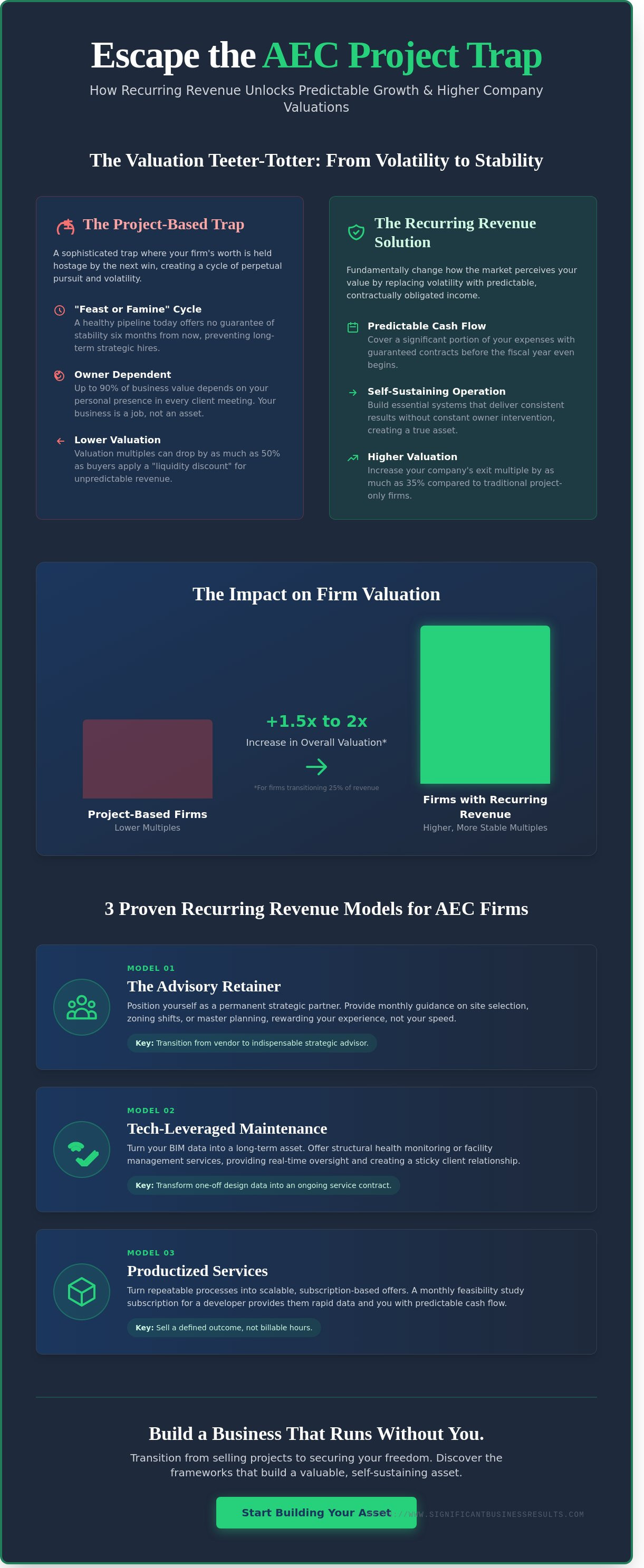
In professional services, recurring revenue is contractually obligated, predictable income that arrives automatically at regular intervals. It’s the difference between starting every year at zero and starting with a significant portion of your revenue already secured. This predictability is the foundation of a highly valuable business. Potential buyers and investors heavily discount firms that rely solely on a constant stream of new project wins. This dependency creates a "Valuation Teeter-Totter"—the more your firm’s stability relies on the next big contract, the lower its market multiple. Lumpy cash flow makes it difficult to invest in strategic hiring or new technology, trapping you in a reactive cycle. Firms with a high percentage of recurring revenue, however, are viewed as de-risked, scalable operations with a proven future. This commands a significantly higher valuation. Adopting this model requires a psychological shift from being a "service provider," who completes a task, to a "solution partner," who provides ongoing value.Measuring Your Current Predictability
The first step is to understand your baseline. Calculate what percentage of your total annual income is currently predictable and recurring. Is it 0%? 5%? This simple metric reveals your firm's dependency on new sales. To see how this and other factors impact your company’s value, you can benchmark your firm with a confidential assessment.Find out how your firm scores on the eight key drivers of company value by taking the Value Builder Score™ assessment.
According to recurring revenue, this is a well-documented area of ongoing research and practical application.
3 Strategic Recurring Revenue Models for AEC Firms
Moving to a recurring model doesn't mean you have to become a software company. It means productizing your expertise in ways that create ongoing client relationships. Here are three models well-suited for the AEC industry.1. The Advisory Retainer
Your most valuable asset is your strategic expertise. An advisory retainer packages this expertise as a monthly subscription. Instead of billing for hours spent on a specific project, clients pay a flat monthly fee for guaranteed access to your strategic counsel. This "seat at the table" model is ideal for serving developers who need ongoing zoning insights, municipalities requiring long-term planning advice, or large facility owners who need regular capital expenditure guidance. The key is to clearly define the scope, deliverables, and communication channels to prevent scope creep and ensure you are rewarded for your wisdom, not just your time.2. The Maintenance & Monitoring Model
A project’s completion is not the end of the client's need—it’s the beginning of the building’s life. You can leverage technology like Building Information Modeling (BIM) to offer ongoing services. After designing a facility, you can provide a subscription for managing its digital twin, monitoring structural health with sensors, or overseeing preventative maintenance schedules. This transitions your firm from a one-off designer to a long-term asset manager, creating a valuable, sticky relationship that generates predictable income for years.3. The Productized Service
Many AEC firms have a highly effective, repeatable process for an early-stage service like site selection analysis, feasibility studies, or energy audits. Instead of quoting this as a custom project each time, you can package it as a fixed-scope, fixed-price product with a subscription option. For example, a client could subscribe to a "pre-flight" package that includes a set number of feasibility studies per quarter. This standardizes your delivery, simplifies the sales process, and creates a predictable revenue stream from a service you have already perfected.Implementing the Shift: Building a Business That Runs Without You
Recurring revenue is more than a pricing strategy; it’s an operational model that requires robust systems. Unlike complex, one-off projects that rely on owner heroics, recurring services must be delivered consistently and efficiently by your team. Systemizing the fulfillment of these services is the key to reducing owner dependency. This shift also requires training your business development team to sell long-term retention instead of just the next project. Their incentives and conversations should focus on the lifetime value of a client who subscribes to your ongoing services. Ultimately, the financial stability created by recurring revenue gives you the freedom to work *on* the business, not just *in* it. It’s the litmus test for a business that can thrive independently of its founder.Preparing for a Profitable Exit
When the time comes to consider an exit, a high percentage of recurring revenue fundamentally changes the conversation with potential acquirers. It provides proof of a stable customer base, predictable future earnings, and a scalable operational model. This is what transforms your practice from a job into a sellable asset. A predictable business isn't just easier to run—it's significantly more valuable to sell.To learn more about building a valuable and sellable company, download the free 8 Key Drivers of Company Value eBook.
Frequently Asked Questions
Can an architecture or engineering firm really have recurring revenue?
Absolutely. While the core deliverable is often a project, the expertise, data, and strategic guidance surrounding that project have ongoing value. By packaging this value into retainers, monitoring services, or productized offerings, any AEC firm can build predictable, recurring income streams that complement its project work.
How do I price a monthly retainer without losing money on hours?
The goal of a retainer is to sell access to your expertise, not to pre-sell a block of hours. Price it based on the value of the outcome you provide—the risk you mitigate, the opportunities you uncover, or the strategic clarity you deliver. Set clear boundaries in your contract about what is included (e.g., two strategy calls per month, one annual review) and what constitutes a separate project.
Will recurring revenue models make my AEC firm less "creative"?
On the contrary, the financial stability provided by recurring revenue can fuel creativity. When you aren't worried about next month's payroll, you have the freedom and resources to invest in innovation, pursue passion projects, and be more selective about the large-scale projects you take on. It allows your core creative work to be driven by vision, not just necessity.

Article by
Franne McNeal
Franne McNeal, President, Significant Business Results LLC has helped 885+ small business owners collectively create 15,000 jobs and nearly $11 billion in revenue. We help architecture, engineering, and construction industry business owners with $1M-$20M in annual revenue, improve revenue, performance and long-term value. We help owners build a business that runs without them & create financial & personal freedom. Our clients focus their energy for action to achieve significant business results.