.png)
The AEC Leader’s Guide: Business Decision Making Framework that Builds Value

For leaders in architecture, engineering, and construction (AEC), the role of "Chief Problem Solver" is a familiar one. You’re the final say on everything from project-level technicalities to firm-wide strategy. But this constant demand creates a bottleneck, capping your firm’s growth at your personal bandwidth. If you're exhausted by making every single decision and want to build a business that can run without your constant input, it's time to shift your focus. The solution isn't making better decisions yourself; it's implementing a structured business decision making framework that empowers your team to make them for you.
The AEC Owner’s Decision Trap: Why Your Firm’s Growth Has Stalled
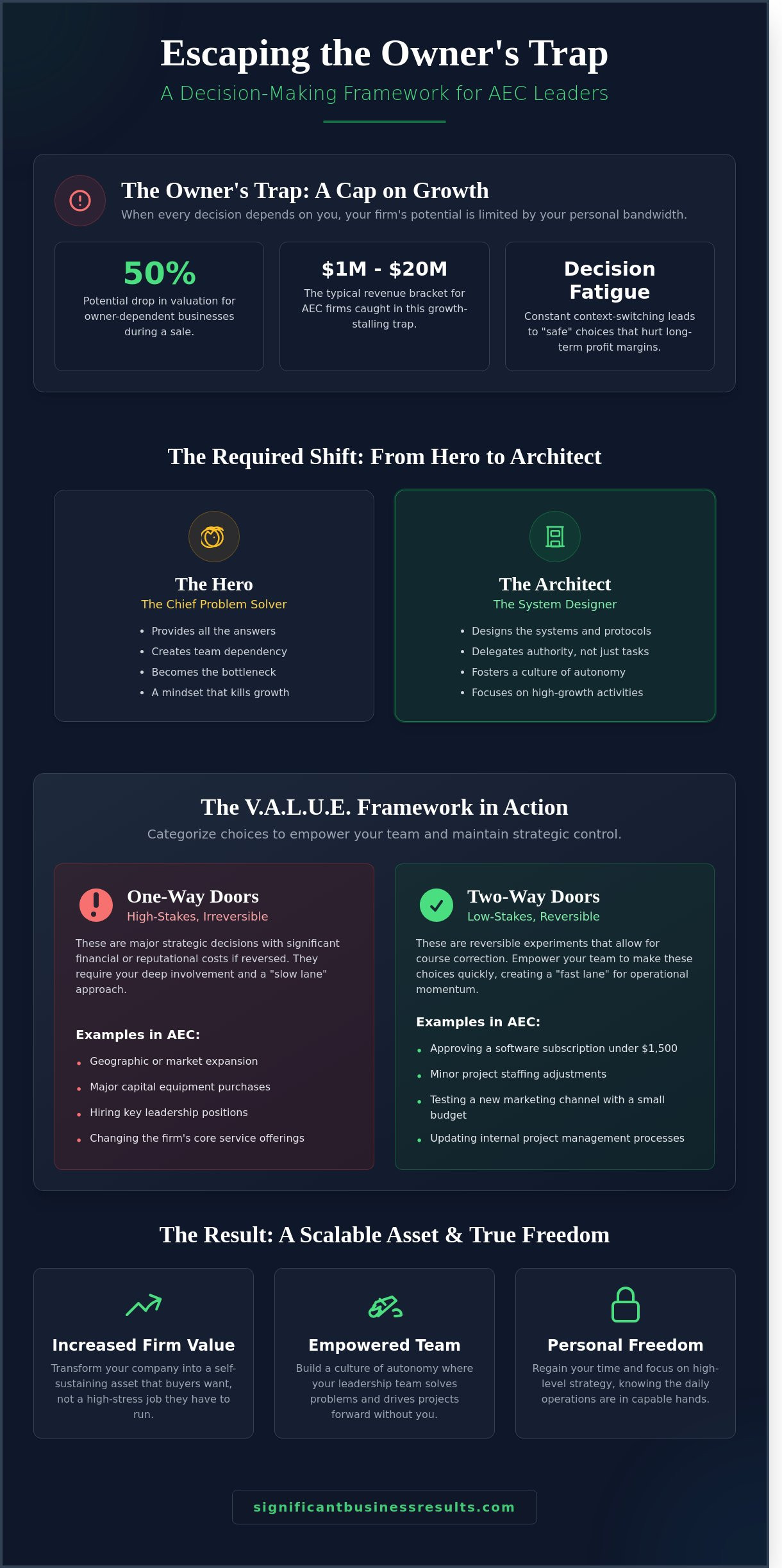
Many AEC leaders fall into the "Owner's Trap," a cycle where the business is so dependent on their personal involvement that it can't scale or be sold. Every choice, big or small, funnels back to you. This not only leads to decision fatigue, where the sheer volume of choices degrades their quality, but it also severely limits your firm's valuation. A business that cannot function without its owner is not a sellable asset; it’s a high-stress job.
The key is to move from a "Hero" mindset, where you swoop in to solve every problem, to an "Architect" mindset. As an architect of your business, your primary role is to design the systems that allow others to succeed. When your team knows you will always provide the answer, they stop trying to find it themselves. Your most significant results will come from the decisions you no longer have to make.
Categorizing Choices: One-Way vs. Two-Way Doors in AEC
Not all decisions carry the same weight, yet many firms treat them as if they do, creating organizational paralysis. Amazon founder Jeff Bezos uses a powerful mental model: distinguishing between "one-way" and "two-way" doors. Applying this to the AEC industry can unlock your team's potential.
•
One-Way Doors: These are high-stakes, nearly irreversible decisions. For an AEC firm, this could include a merger, a major geographic expansion, or changing your core service offering. These choices require a slow, deliberate process with your deep involvement.
•
Two-Way Doors: These are reversible decisions with limited consequences. Examples include project-level staffing, selecting a vendor for a specific job, or adopting a new software tool. These choices are ideal for delegation.
By explicitly labeling decisions as one-way or two-way, you give your team a clear signal of when they have the autonomy to act. This empowers them to move quickly on two-way door decisions, fostering a culture of ownership and speed.
The V.A.L.U.E. Framework: A Decision Logic for Scaling Firms
To equip your team to make sound judgments, you need a shared logic—a consistent business decision making framework. The V.A.L.U.E. framework is tailored for AEC leaders focused on building transferable value. Before proceeding with a significant choice, you or your team should ask:
•
V - Vision Alignment: Does this move us closer to our 3-year strategic goal?
•
A - Autonomy Impact: Does this decision make the firm more or less dependent on the owner?
•
L - Leverage: Does this choice allow us to do more with the same resources?
•
U - Upside vs. Risk: Is the potential margin worth the professional liability?
•
E - Exit Readiness: Would a future buyer see this decision as a value-add?
This framework shifts the conversation from "what feels right" to a structured analysis of strategic impact. Use your firm’s core values and strategic alignment as the initial filter. Then, run the decision through the "Hub & Spoke" test: if you disappeared for a month, would this decision still be sound and would the systems support it? This lens forces you to evaluate choices based on their ability to build a resilient, self-sustaining firm.
Building a Culture of Autonomy: How to Delegate the ‘Decide’
True delegation isn't about offloading tasks; it's about transferring authority. To do this safely, you must establish clear guardrails—the financial, ethical, and strategic boundaries within which your team is free to operate.
A simple way to start is by creating a "Level of Authority" matrix. This document clearly defines who can approve what, based on dollar amounts or project risk profiles. For example, a Project Manager might have the authority to approve change orders up to $5,000, while anything above that requires a Director's sign-off.
For more complex, multi-disciplinary decisions, a model like RAPID (Recommend, Agree, Perform, Input, Decide) is invaluable. By formally assigning the "D" (Decider) to a project lead or department head, you remove ambiguity and empower them to own the outcome. This structure, combined with clear guardrails, creates "safe to fail" zones where your team can develop their judgment without putting the firm at risk. For more guidance on developing your leadership team, explore our additional resources.
Strategic Foresight: Turning Better Decisions into Significant Business Results
A systematic business decision making framework transforms a firm from a chaotic, owner-centric entity into a valuable, scalable asset. The goal is to build a business that runs without you, providing both financial and personal freedom. Each decision made through this new lens becomes a building block for your long-term exit goals.
By auditing your processes through a system like the Value Builder System™, you connect daily operational choices to the multiple a buyer will one day pay for your firm. Significant results are found at the intersection of profit and autonomy. Breaking the "Owner's Trap" cycle often requires an outside perspective to challenge ingrained habits. A strategic partner can help pressure-test your frameworks and hold you accountable for building a truly independent company.
Ready to build a firm that runs without you? Explore our Strategic Coaching services.
Frequently Asked Questions (FAQs)
What is a business decision-making framework?
A business decision-making framework is a structured process or set of criteria that guides individuals and teams in making choices that are consistent, strategic, and aligned with company goals. It helps remove emotion and bias, ensuring decisions support long-term value.
How do I know if I'm the bottleneck in my AEC firm's decision-making?
You are likely the bottleneck if projects stall while waiting for your approval, your team frequently asks for your opinion on minor issues, and you cannot take a vacation without being contacted constantly for decisions.
What is the RAPID decision-making model and can it work for construction?
RAPID is a framework that assigns five key roles in any decision: Recommend, Agree, Perform, Input, and Decide. It is highly effective for construction and other AEC projects as it clarifies roles and accountability in complex, multi-stakeholder environments, reducing friction and speeding up progress.
How can a decision-making framework increase my firm's valuation?
A framework reduces owner dependency, which is a key driver of business value. When a firm can operate and make high-quality decisions without the owner's constant involvement, it proves to a potential buyer that the company is a sustainable, low-risk asset with established systems for success.
What are the most common decision-making mistakes architecture firm owners make?
The most common mistakes include treating all decisions with the same level of urgency, relying solely on gut instinct instead of data, failing to delegate decision-making authority, and making choices that increase owner dependency rather than building scalable systems.
How do I start delegating decisions to my team without losing quality control?
Start small with "two-way door" (reversible) decisions. Provide your team with clear guardrails, such as budget limits and strategic goals. Use a framework like V.A.L.U.E. to teach them how to think about decisions, and implement a decision journal to review their logic, not just the outcomes.
Can a decision-making framework help with AEC project management?
Yes. A framework provides project managers with the clarity and authority to make timely decisions on-site regarding staffing, vendors, and minor scope changes, preventing delays and keeping projects on track without constant escalation to senior leadership.
What is the difference between a tactical and a strategic business decision?
A tactical decision is a short-term choice focused on achieving an immediate objective, often related to daily operations (e.g., which software to use for a single project). A strategic decision is a long-term, high-impact choice that shapes the future direction and value of the entire firm (e.g., expanding into a new market).

Article by
Franne McNeal
Franne McNeal, President, Significant Business Results LLC has helped 885+ small business owners collectively create 15,000 jobs and nearly $11 billion in revenue. We help architecture, engineering, and construction industry business owners with $1M-$20M in annual revenue, improve revenue, performance and long-term value. We help owners build a business that runs without them & creates financial & personal freedom. Our clients focus their energy for action to achieve significant business results.