.png)
AEC Business Valuation Services: Building a Firm That Thrives Without You

For many owners of architecture, engineering, and construction (AEC) firms, the business is more than an asset—it’s a professional identity. But when that identity is tied to your constant presence, you don't own a business; you own a high-stress job. The key to unlocking true financial and personal freedom lies in transforming your firm into a valuable, scalable asset that operates independently of your daily involvement. This journey begins with understanding your firm's true worth through strategic AEC business valuation services.
Beyond the Multiples: Why AEC Business Valuation is a Strategic Growth Tool
Most AEC firm owners in the $1M-$20M revenue range think of a business valuation as something you get only when you’re ready to sell. It’s often viewed as a financial report card—an autopsy of past performance measured in EBITDA multiples. This is a limited and costly perspective. A strategic business valuation is not just an accounting exercise; it's a diagnostic tool that provides a clear blueprint for future growth.
Traditional multiples can be dangerously misleading in the AEC industry because they fail to account for one critical risk factor: owner dependency. If your firm’s client relationships, project oversight, and strategic decisions all run through you, a potential buyer isn't acquiring a business. They're acquiring a job and a set of volatile assets that could walk out the door when you do. Shifting your focus from working "in" the business to working "on" it is the only way to build transferable, long-term value.
According to business valuation, this is a well-documented area of ongoing research and practical application.
The Difference Between Price and Value
Price is what a buyer pays; value is what a buyer perceives based on future potential and risk. Many AEC firms have a high price tag in the owner's mind but low transferable value in reality. The gap is often caused by a lack of documented systems and processes. When your unique methods for winning bids, managing projects, and retaining talent exist only in your head, their value is tied directly to you. Documenting and systemizing these operations creates an asset that has value independent of any single individual.
When Should You Get a Valuation?
The most strategic time to get a valuation is three to five years before you plan to exit. However, waiting until you're ready to sell means you've run out of time to fix any underlying issues. A better approach is to use an annual valuation assessment as a performance benchmark. It helps you measure progress, identify weaknesses, and make strategic adjustments long before an exit is on the horizon. A great starting point is understanding your current operational health.
Begin your journey by discovering your firm's current health with the Value Builder Score assessment.
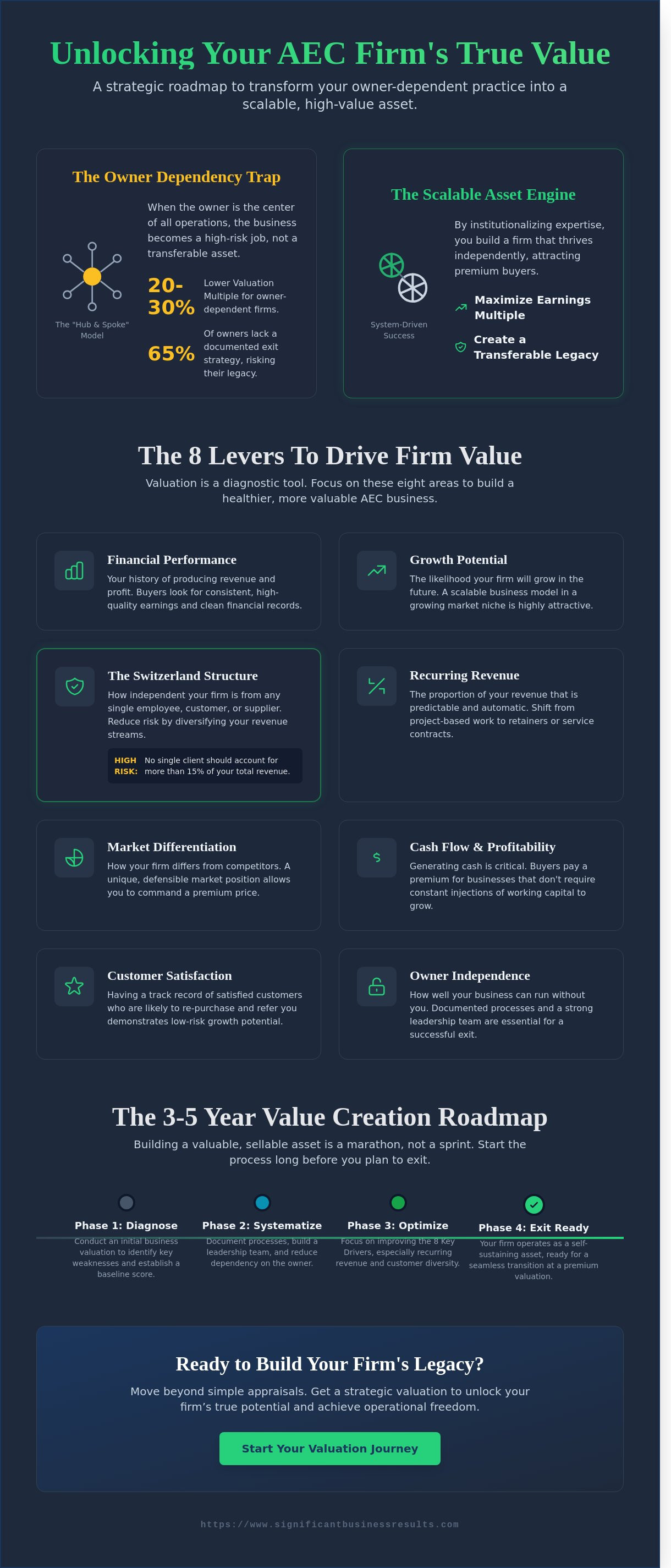
The Qualitative Shift: Increasing Firm Value by Reducing Owner Dependency
The single greatest killer of value in AEC firms is the "Hub-and-Spoke" model, where the owner sits at the center of every critical function. From business development to final project approval, everything depends on you. This structure makes your business incredibly difficult to sell and severely limits its growth potential. A business that runs without you is worth significantly more than one that requires your 60-hour work week.
Reducing owner dependency directly increases the multiple a buyer is willing to pay. It de-risks the acquisition and demonstrates that the firm has a sustainable future. This is achieved by delegating high-level responsibilities, empowering a leadership team, and building systems that ensure consistent results. Reducing your firm's reliance on you is the most direct path to increasing its value.
The 8 Key Drivers of AEC Company Value
The Value Builder System™ identifies eight core drivers that determine a company's sellable value. While financial performance and growth potential are important, other factors are critical for AEC firms. These include the "Switzerland Structure" (ensuring no single employee or client makes up too much of your business) and "Recurring Revenue" (creating predictable income streams). Understanding and improving your score across these eight drivers provides a comprehensive roadmap for building a more valuable firm.
Building Sustainable Systems in Construction and Design
To break the hub-and-spoke model, you must create systems that make your services repeatable and scalable without your direct oversight. This involves "productizing" your offerings—defining a clear, consistent process for every project, from initial client contact to final delivery. It also means exploring recurring revenue models, such as maintenance contracts or retainer-based consulting, to create predictable cash flow that isn't tied to the boom-and-bust cycle of project-based work.
Implementing the Framework: Transforming Valuation into Exit Readiness
Understanding your firm’s value and its key drivers is the first step. The next is implementation. Transforming your business from an owner-dependent practice into a self-sustaining asset requires significant organizational change, strategic alignment, and unwavering accountability. This is where many leaders stall, as the day-to-day demands of running the business get in the way of long-term strategic work.
Executive coaching and peer masterminds provide the structure and external perspective needed to navigate these changes effectively. The goal is to build a firm that is not just profitable but also exit-ready, giving you the freedom to choose your future, whether that involves an internal transition, an external sale, or simply stepping back from daily operations.
The Power of Peer Learning for AEC Leaders
Navigating the challenges of scaling an AEC firm can be an isolating experience. The Significant Business Results Mastermind connects you with a curated group of non-competing AEC owners who face similar challenges. This collective intelligence, guided by a no-nonsense advisor, helps you cut through organizational noise and implement proven strategies for growth and value creation.
Your Roadmap to a Successful Transition
Your journey to freedom begins with a clear assessment of where you are today. From there, you can build a strategic roadmap to align your team, systematize your operations, and prepare your firm for a successful and profitable transition. Seeing how other firms have successfully navigated this path can provide both inspiration and a practical blueprint for your own success.
Explore AEC case studies to see how other firm owners have increased their value and achieved their goals.
Frequently Asked Questions
How is an AEC firm valued differently than a standard service business?
AEC firms are valued with a heavy emphasis on project pipeline, client concentration risk, and the owner's role in securing new business. Unlike standard businesses, the personal reputation and relationships of the principals play a much larger, and often riskier, role in the valuation.
What is the most important factor that increases the value of an engineering or architecture firm?
The single most important factor is reducing owner dependency. A firm that can generate revenue, manage projects, and win new clients without the founder's daily involvement is fundamentally more valuable and less risky to a potential buyer.
Can I still sell my firm if I am the primary rainmaker for new business?
Yes, but the deal structure will likely include a multi-year employment or consulting agreement to ensure a smooth transition of client relationships. To maximize value, you must begin transferring those relationships and building a scalable sales and marketing system long before the sale.
How long does it take to significantly increase the value of my AEC business before an exit?
Meaningful change takes time. To implement new systems, develop a strong leadership team, and reduce owner dependency, you should plan for a 3-5 year timeline. Starting early is the key to maximizing your final sale price and ensuring a smooth transition.

Article by
Franne McNeal
Franne McNeal, President, Significant Business Results LLC has helped 885+ small business owners collectively create 15,000 jobs and nearly $11 billion in revenue. We help architecture, engineering, and construction industry business owners with $1M-$20M in annual revenue, improve revenue, performance and long-term value. We help owners build a business that runs without them & create financial & personal freedom. Our clients focus their energy for action to achieve significant business results.