.png)
How to Reduce Owner Dependency: A Guide for AEC Firm Owners to Reclaim Their Freedom

As the owner of a successful Architecture, Engineering, or Construction (AEC) firm, you’ve likely built your company on the back of your own expertise and hard work. But if you’re involved in every client meeting, every design decision, and every project crisis, you don’t own a business—you own a high-stress job. The constant demand on your time isn't just a path to burnout; it's a direct threat to your firm's value.
The good news is you can transition your firm from being owner-led to systems-driven. This strategic shift is the key to unlocking significant growth, increasing your company's market value, and finally reclaiming your personal freedom.
Understanding the Owner Trap in AEC Firms
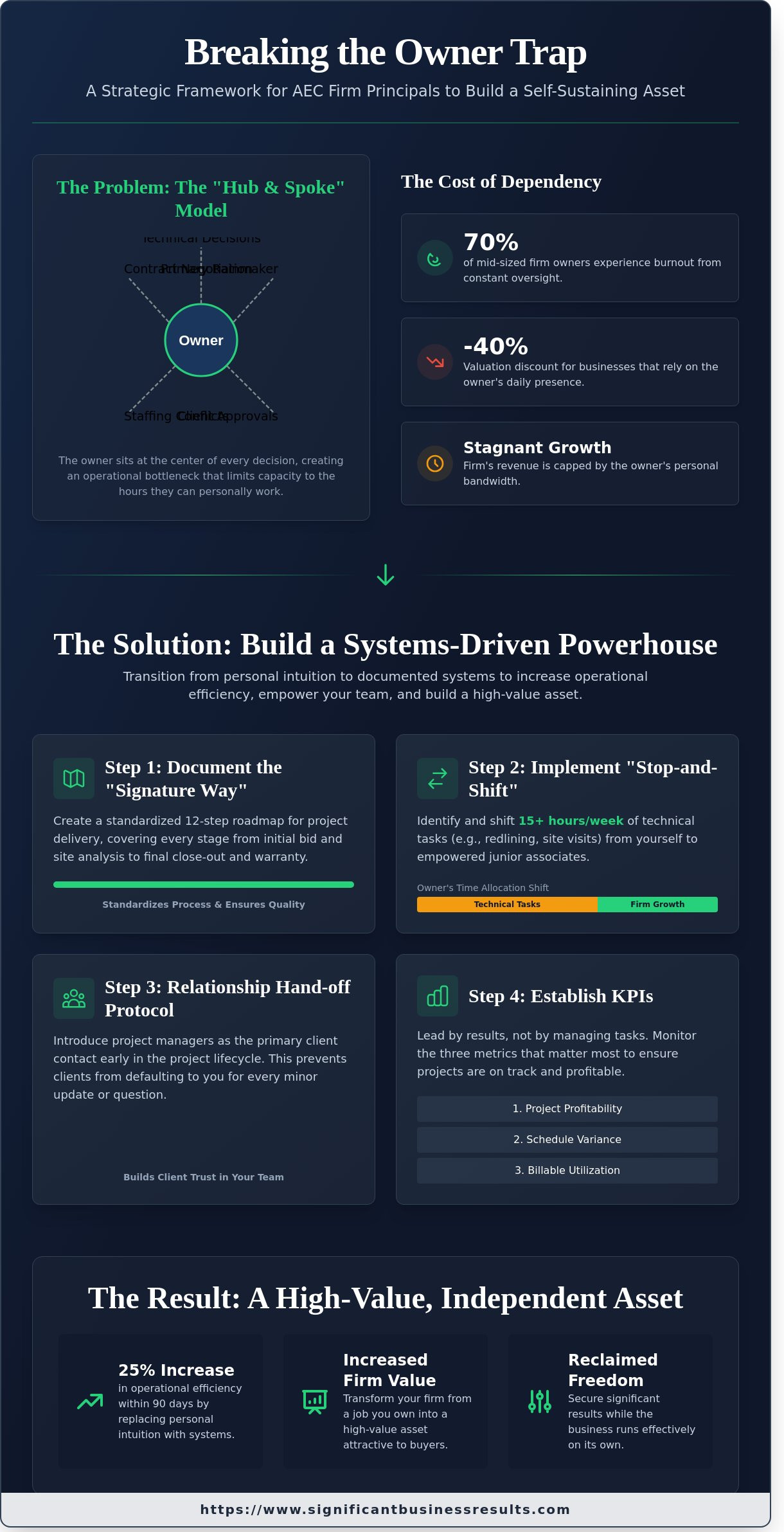
Owner dependency is the degree to which a business relies on its founder for daily operations, sales, and technical delivery. In the AEC world, this is especially common. Principals are often the best architect or engineer in the room, which naturally creates a "Hub and Spoke" model where every decision and client relationship flows through them.
While this feels like quality control, it puts a hard ceiling on your growth. Your firm can only grow as large as your personal capacity allows. For a potential buyer, this is a massive red flag. If the firm's most critical relationships and knowledge walk out the door with you, what are they actually buying?
A business that depends entirely on you is a job you can't sell. A business built on durable systems and a capable team is a valuable asset.
A 3-Step Framework to Reduce Owner Dependency
Breaking free from the owner trap requires a deliberate shift from doing the work to designing the systems that do the work. Here is a practical framework to get you started.
Step 1: Document Your Core Processes
You can't delegate what you haven't defined. Start by documenting the "signature way" your firm delivers results. Don't try to document everything at once. Begin with one critical process, such as your client onboarding procedure or your project bidding workflow.
Create simple checklists, templates, or flowcharts that anyone on your team can follow. This standardization is the first step toward creating consistent results without your direct involvement. It builds a foundation for a business that can scale beyond you.
Step 2: Empower Your Team to Own a Result
With clear processes in place, you can begin to delegate outcomes, not just tasks. This requires a significant mindset shift, which is often the hardest part of the journey. Instead of providing all the answers, your role is to equip your team with the tools and authority to find them.
A crucial part of this is the client relationship hand-off. Your clients may be used to dealing with you directly, but you can systematically transfer that trust to your team.
The Three-Meeting Rule
For a key client, introduce your project manager or team lead. Attend the first meeting as the leader, the second as a supportive peer, and by the third, let your team lead run the meeting while you are barely present or not there at all. This gradually shifts the client’s reliance from you to your team and processes. Expert AEC business coaching can help you navigate this transition with confidence.
Step 3: Manage the System, Not the People
Once your team is empowered, you need a way to monitor progress without micromanaging. This is where performance metrics become your best friend. Establish a handful of Key Performance Indicators (KPIs) that give you a high-level view of the firm’s health.
Track metrics like project profitability, client satisfaction scores, or proposal win rates. By reviewing a simple dashboard, you can spot potential issues and guide your team strategically, all without getting pulled back into the daily grind. This allows you to lead from a 30,000-foot view instead of being stuck in the weeds.
Turning Your Firm into a Sellable Asset
Reducing owner dependency isn't just about getting your time back; it's a direct strategy for increasing your company’s valuation. Systems like The Value Builder System™ identify eight key drivers that determine a company's worth, and the "Hub and Spoke" driver is one of the most important.
The less your company relies on you, the more a buyer is willing to pay. A systems-driven firm is a lower-risk investment, which translates to a higher multiple on your earnings. By implementing the steps above, you are systematically making your firm more independent, predictable, and ultimately, more valuable.
Your goal is to build a firm that provides both financial wealth and personal freedom. This is the definition of a significant business result.
Ready to find out how dependent your business is on you?
Take the Value Builder Scorecard to get your score in 13 minutes.
Frequently Asked Questions
How do I know if my AEC firm is too dependent on me?
A simple test: Could you take a four-week, completely unplugged vacation without your phone ringing constantly and projects grinding to a halt? If the answer is no, your firm is too dependent on you. Other signs include being the final decision-maker on all proposals and the primary contact for your top clients.
Will my clients leave if I stop being the primary point of contact?
This is a common fear, but it's rarely the reality if handled correctly. By using a structured hand-off process, you are transferring trust from yourself to your firm's reliable system. Clients want consistent, high-quality results; when your team delivers that, their loyalty will be to your brand, not just to you personally.
Can a $5 million engineering firm really run without the founder?
Absolutely. Many firms at this level and beyond operate successfully under a leadership team. The key is shifting the founder's role from the primary technical expert to the strategic visionary who guides the company's growth and culture.
What is the first system I should document to reduce my workload?
Start with the process that causes you the most repetitive stress or takes up the most of your time. For many AEC owners, this is either the sales/bidding process or the client onboarding and project kickoff workflow. Documenting one of these will provide immediate relief and build momentum for systemizing the rest of your business.

Article by
Franne McNeal
Franne McNeal, President, Significant Business Results LLC has helped 885+ small business owners collectively create 15,000 jobs and nearly $11 billion in revenue. We help architecture, engineering, and construction industry business owners with $1M-$20M in annual revenue, improve revenue, performance and long-term value. We help owners build a business that runs without them & creates financial & personal freedom. Our clients focus their energy for action to achieve significant business results.