.png)
AEC Business Valuation Services: Building a Firm That Thrives Without You

For many owners of architecture, engineering, and construction (AEC) firms, the business is both a source of pride and a significant burden. Your firm might generate between $1M and $20M in revenue, but it demands your constant attention. Every major decision, client relationship, and operational challenge lands on your desk. This reality raises a critical question: Have you built a valuable asset, or just a demanding job for yourself?
The answer lies in understanding your firm's true value, independent of your personal involvement. Specialized AEC business valuation services provide more than just a number; they offer a strategic blueprint for transforming your company into a self-sustaining entity that can thrive without you.
Beyond the Multiples: Why AEC Business Valuation is a Strategic Growth Tool
A business valuation is often viewed as a financial autopsy performed only when you’re ready to sell. This is a missed opportunity. For an AEC firm, a valuation should be a dynamic health check on your operational maturity. While traditional methods rely on a multiple of earnings (EBITDA), this simple calculation can be dangerously misleading if your firm’s success is entirely tied to you, the principal.
The strategic shift required is to move from working in the business to working on it. By starting this process 3-5 years before a potential exit, you create the time needed to implement changes that produce significant results and maximize your company’s sellable value.
According to Business valuation approaches, this is a well-documented area of ongoing research and practical application.
The Difference Between Price and Value
Price is what a buyer pays; value is what a buyer perceives based on future potential and risk. AEC firms often leave immense value on the table by failing to document systems, delegate key relationships, and build a strong leadership team. A buyer isn't just purchasing your past performance; they are investing in a predictable stream of future profits.
When Should You Get a Valuation?
Instead of waiting until you’re ready to sell, consider an annual valuation assessment as a performance benchmark. It helps you measure progress, identify weaknesses, and stay focused on building a more resilient and valuable company. A great starting point is understanding your current operational health.
To get an initial measure of your firm's health and sellability, take the 13-minute Value Builder Score assessment.
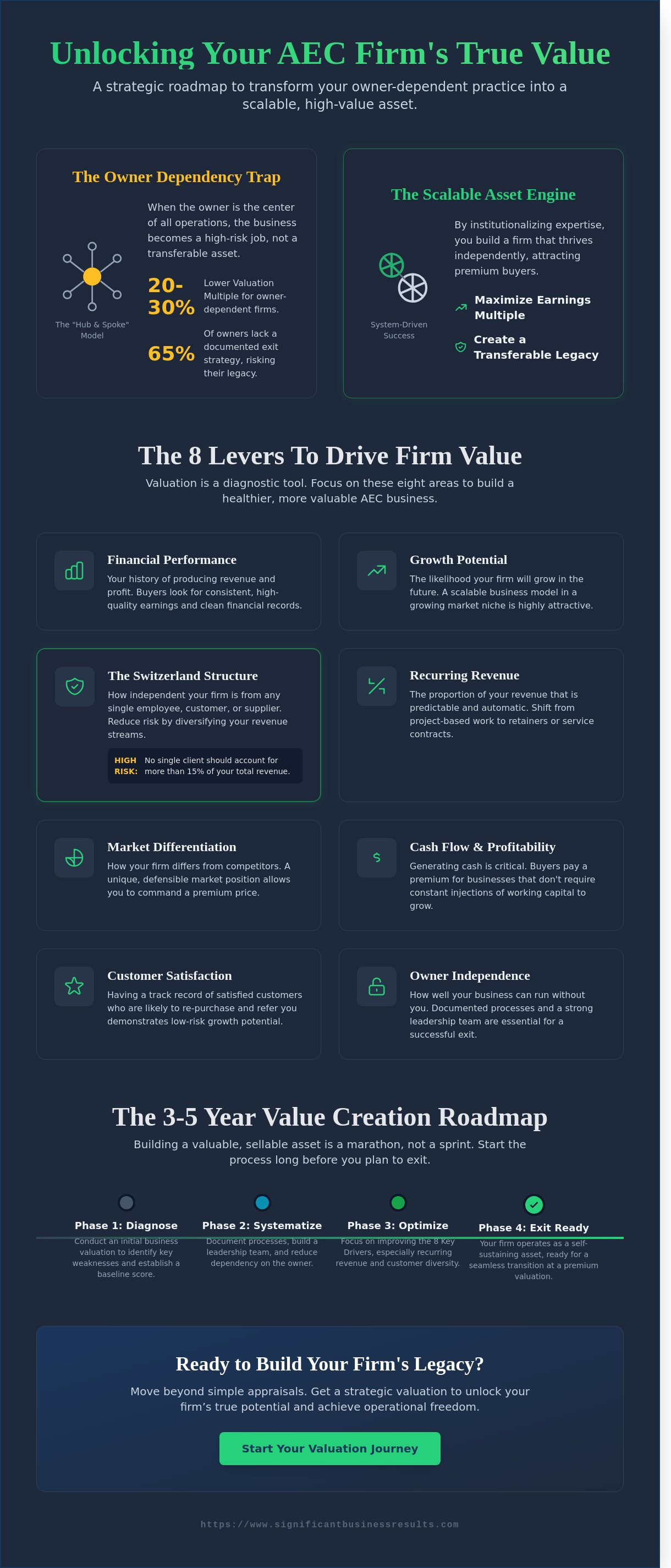
The Qualitative Shift: Increasing Firm Value by Reducing Owner Dependency
The single greatest factor suppressing the value of most AEC firms is the "Hub-and-Spoke" model, where the owner sits at the center of every critical function. When you are the primary rainmaker, project manager, and strategic thinker, the business has little to no value without you. A potential buyer sees this as a massive risk, which directly lowers the multiple they are willing to pay.
Breaking this dependency is the key to unlocking your firm’s true potential. The goal is to build a business that runs on systems, not on your 60-hour work week. This involves empowering a leadership team, delegating high-level responsibilities, and proving that revenue and operations are not tied to a single individual. A business that runs without you is inherently more valuable.
The 8 Key Drivers of AEC Company Value
Building a self-sustaining firm requires a focus on specific operational drivers. These include your financial performance, growth potential, and what The Value Builder System™ calls the "Switzerland Structure"—ensuring the business is not overly dependent on any one employee, customer, or supplier. Understanding these drivers provides a clear roadmap for improvement.
Download the free 8 Key Drivers of Company Value Ebook to learn more.
Building Sustainable Systems in Construction and Design
To reduce dependency, you must create systems that make your services repeatable and scalable. This could involve standardizing project delivery processes or "productizing" certain service offerings. Even in a project-based industry, exploring recurring revenue models for services like maintenance contracts or advisory retainers can significantly increase your firm's stability and value.
Learn more about this critical process in our guide on how to reduce owner dependency.
Implementing the Framework: Transforming Valuation into Exit Readiness
Understanding your firm’s value and its dependencies is the first step. The next is taking action. Using insights from a business valuation, you can begin to restructure your leadership team, delegate authority, and implement the systems needed for sustainable growth. This transformation is complex and often requires an outside perspective to navigate organizational hurdles and maintain accountability.
The Power of Peer Learning for AEC Leaders
Making these fundamental changes can be isolating. This is where the collective intelligence of a peer group becomes invaluable. A mastermind provides a confidential forum for AEC owners to solve complex scaling challenges with the support of like-minded leaders. A seasoned, no-nonsense advisor can help cut through the noise and keep you focused on achieving your strategic objectives.
Your Roadmap to a Successful Transition
Your journey from owner-operator to owner-investor follows a clear path: assess your current value, create a strategic plan to address key weaknesses, and execute that plan with discipline. The ultimate goal is to build a valuable asset that provides you with both financial and personal freedom, whether you choose to sell to an external buyer or transition leadership to an internal team.
Explore our AEC case studies to see how other firm owners have successfully increased their value and prepared for their next chapter.
Frequently Asked Questions (FAQs)
How is an AEC firm valued differently than a standard service business?
AEC firms are valued based on factors like backlog, client concentration, project diversity, team strength, and the owner's role in securing new work. Unlike other service businesses, the value is heavily tied to the firm's ability to consistently win and execute large, complex projects, making owner dependency a critical valuation factor.
What is the most important factor that increases the value of an engineering or architecture firm?
The single most important factor is reducing owner dependency. A firm that can generate new business, manage projects, and maintain client relationships without the founder's daily involvement is significantly more valuable because it represents a lower-risk investment for a buyer.
Can I still sell my firm if I am the primary rainmaker for new business?
Yes, but the value and terms will be heavily impacted. The sale would likely include a multi-year employment or consulting agreement to ensure a smooth transition of client relationships. To maximize value, it's crucial to begin transferring rainmaking responsibilities to a leadership team well before you plan to sell.
How long does it take to significantly increase the value of my AEC business before an exit?
Most owners need 3 to 5 years to implement the strategic changes required to significantly increase firm value. This timeframe allows you to build a strong leadership team, create scalable systems, and demonstrate a consistent track record of performance that is independent of your involvement.

Article by
Franne McNeal
Franne McNeal, President, Significant Business Results LLC has helped 885+ small business owners collectively create 15,000 jobs and nearly $11 billion in revenue. We help architecture, engineering, and construction industry business owners with $1M-$20M in annual revenue, improve revenue, performance and long-term value. We help owners build a business that runs without them & create financial & personal freedom. Our clients focus their energy for action to achieve significant business results.