.png)
Beyond the Balance Sheet: Why Your AEC Firm Needs a Business Value Assessment

For many owners of architecture, engineering, and construction (AEC) firms, the balance sheet tells a story of revenue and expenses. But it fails to answer the most critical question: Is your firm a valuable, sellable asset, or is it just a high-stress job? If your business relies entirely on your personal involvement to operate and grow, you haven't built an asset—you've built a trap.
A strategic business value assessment is the diagnostic tool that reveals the difference. It moves beyond simple financials to measure your firm's operational health, market attractiveness, and ability to thrive without you. This assessment identifies the hidden drivers that make your firm truly valuable and owner-independent, providing a clear roadmap to achieving financial and personal freedom.
What is a Business Value Assessment for AEC Firms?
Unlike a standard financial valuation that calculates a number based on past performance, a business value assessment is a forward-looking analysis of your firm's operational strengths and weaknesses. It evaluates how well your company functions as a system, independent of any single person. For AEC firms, where value is often tied to the principal's reputation and relationships, this distinction is critical.
Financial statements show what you’ve earned; an assessment reveals what your business is truly worth to a potential buyer. It's not an appraisal for a bank loan or a simple ROI calculation. It is a strategic deep-dive into the core functions of your business to identify what makes it resilient, scalable, and ultimately, sellable.
According to What is Business Valuation?, this is a well-documented area of ongoing research and practical application.
Identifying the 'Value Gap' in Your Operations
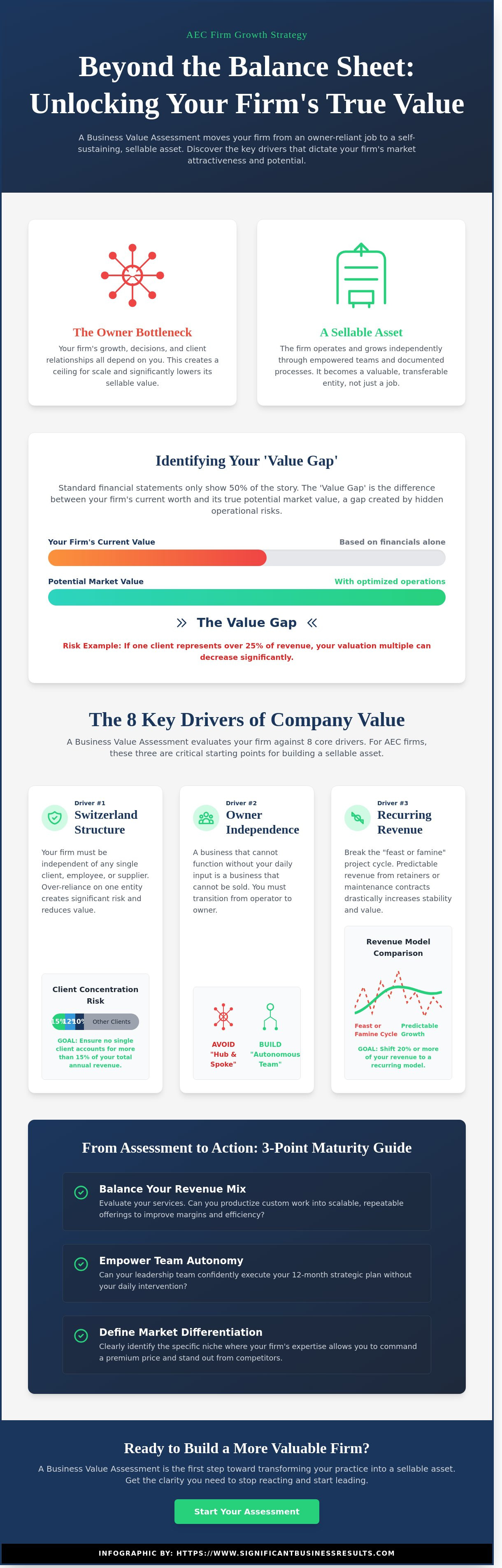
Most AEC firms have a "Value Gap"—the difference between what the business is worth today and what it could be worth with strategic improvements. A business value assessment pinpoints the operational leaks, dependencies, and inefficiencies that widen this gap. In short, the Value Gap is the distance between your current reality and your ideal exit price. Closing it is the key to building a significant asset.
The 8 Key Drivers: How to Evaluate Your Firm's Health
To systematically measure your firm's health, we use The Value Builder System™, a framework that analyzes eight key drivers of company value. While all eight are important, a few are particularly critical for AEC firms struggling with owner dependency and inconsistent project pipelines.
Two of the most impactful drivers are your firm’s dependency on you, the owner, and its dependency on a small number of clients.
Research published by key valuation drivers shows that this is a well-documented area of ongoing research and practical application.
Measuring Owner Dependency and Operational Efficiency
Many AEC principals operate on a "Hub and Spoke" model, where all major decisions, client relationships, and technical oversight flow through them. While this demonstrates expertise, it severely devalues the business. If the firm cannot function without you, a buyer isn't acquiring a company; they are acquiring your job. A business value assessment measures this dependency, revealing whether you have a leadership team and documented systems in place that allow for sustainable scaling. Breaking free from the Hub and Spoke model is the first step toward true owner independence.
The 'Switzerland Structure' and Recurring Revenue
Another critical driver is what we call "The Switzerland Structure"—ensuring your firm is neutral and not overly dependent on any one client, employee, or supplier. If a single client accounts for a large portion of your revenue, your firm carries significant risk. As an actionable step, review your client list. If any single client represents more than 15% of your annual revenue, you have a concentration problem that will concern a potential acquirer.
This dependency is often linked to the "feast or famine" project cycle common in the AEC industry. Building recurring revenue models, such as maintenance contracts or retainer-based consulting, creates predictable cash flow and a more stable, valuable business. For a deeper look at all eight drivers, you can download the free ebook.
From Assessment to Action: Building a Sellable Asset
A business value assessment is the starting line, not the finish line. Its purpose is to provide a clear, data-driven diagnosis of your firm's health so you can focus your energy on actions that build long-term value. For AEC leaders, this means moving from day-to-day project management to strategic work on the business itself.
This transition often requires a shift in mindset and strategy, which is why high-level coaching and peer learning are so effective in the AEC sector. Aligning your daily activities with your long-term goals is how you transform your firm into a self-sustaining asset.
Leveraging Your Value Builder Score
The assessment generates a quantifiable Value Builder Score, giving you a baseline to measure progress against. This score allows you to stop guessing and start making informed decisions. By analyzing your results, you can prioritize initiatives during strategic planning sessions, focusing on the areas that will have the greatest impact on your firm's value and your personal freedom. The first step is to get your confidential score and understand where you stand today.
Achieving Personal and Financial Freedom
The ultimate goal of building a valuable business is to achieve freedom—freedom of time, energy, and capital. By using the insights from a business value assessment, you can systematically transition your firm from founder-led to system-led operations. This creates a company that not only provides for you today but also becomes a significant asset you can sell or transition on your own terms in the future.
Frequently Asked Questions (FAQs)
How is a business value assessment different from a business valuation?
A valuation provides a snapshot of your firm's financial worth today, typically for a transaction like a sale or loan. A business value assessment is a strategic diagnostic tool that evaluates your company's operational health and sellability, providing a roadmap for increasing its future value.
My AEC firm is growing rapidly; why should I care about an assessment now?
Rapid growth often masks underlying operational weaknesses, such as owner dependency or poor cash flow management. An assessment helps ensure your growth is sustainable and profitable, allowing you to build a strong foundation before inefficiencies become embedded in your company culture.
What are the most common value-killers for engineering and architecture firms?
The most common value-killers are owner dependency (the "Hub and Spoke" model), customer concentration (relying on a few large clients), and inconsistent cash flow due to a lack of recurring revenue streams.
How long does a professional business value assessment typically take?
The initial online assessment can be completed in about 15 minutes. The subsequent analysis and strategic debriefing session with a certified advisor are designed to provide a comprehensive and actionable plan within a few weeks.

Article by
Franne McNeal
Franne McNeal, President, Significant Business Results LLC has helped 885+ small business owners collectively create 15,000 jobs and nearly $11 billion in revenue. We help architecture, engineering, and construction industry business owners with $1M-$20M in annual revenue, improve revenue, performance and long-term value. We help owners build a business that runs without them & create financial & personal freedom. Our clients focus their energy for action to achieve significant business results.