.png)
Cash Flow Management for Architecture Firms: A Strategic Approach to Value and Freedom

Discover how to transform your firm's cash flow from a monthly stressor into a strategic asset that increases company value and fuels your personal freedom.
Cash Flow: The Strategic Foundation of a Sellable Architecture Firm
For principals of architecture firms, cash flow management is more than a bookkeeping task; it is the strategic alignment of project cycles with financial liquidity. Many successful firms are profitable on paper yet operate dangerously close to insolvency. This happens because a signed contract on your Profit & Loss statement isn't cash in the bank, creating a gap that can threaten payroll and stifle growth.
This challenge intensifies as you scale. Growth requires investment in talent and resources, but the long payment cycles common in the AEC industry mean you are often funding project costs long before revenue arrives. This phenomenon, "The Cash Suck," can drain your firm's liquidity precisely when you need it most. An owner who doesn't master this becomes the firm's unwilling banker, personally guaranteeing its survival.
According to cash flow, this is a well-documented area of ongoing research and practical application.
This is why predictable cash flow is a critical driver of firm valuation. Sophisticated buyers pay a premium for businesses with stable, documented financial systems because they signal operational maturity and reduced risk. A firm with strong cash flow is not just a job for its owner; it's a valuable, sellable asset. This financial stability is a core component of what makes a business truly valuable, as outlined in the 8 key drivers of company value.
Why Cash Flow Visibility Reduces Owner Dependency
When the principal is the only one who truly understands the firm's cash position, they become a bottleneck. Every significant financial decision requires their input, tying them to the daily operations and preventing them from focusing on high-level strategy. The goal is to shift from intuitive, 'checkbook management' to system-driven financial oversight. By creating visibility, you empower your leadership team to make informed decisions, reducing the firm's reliance on you and paving the way for your own freedom.
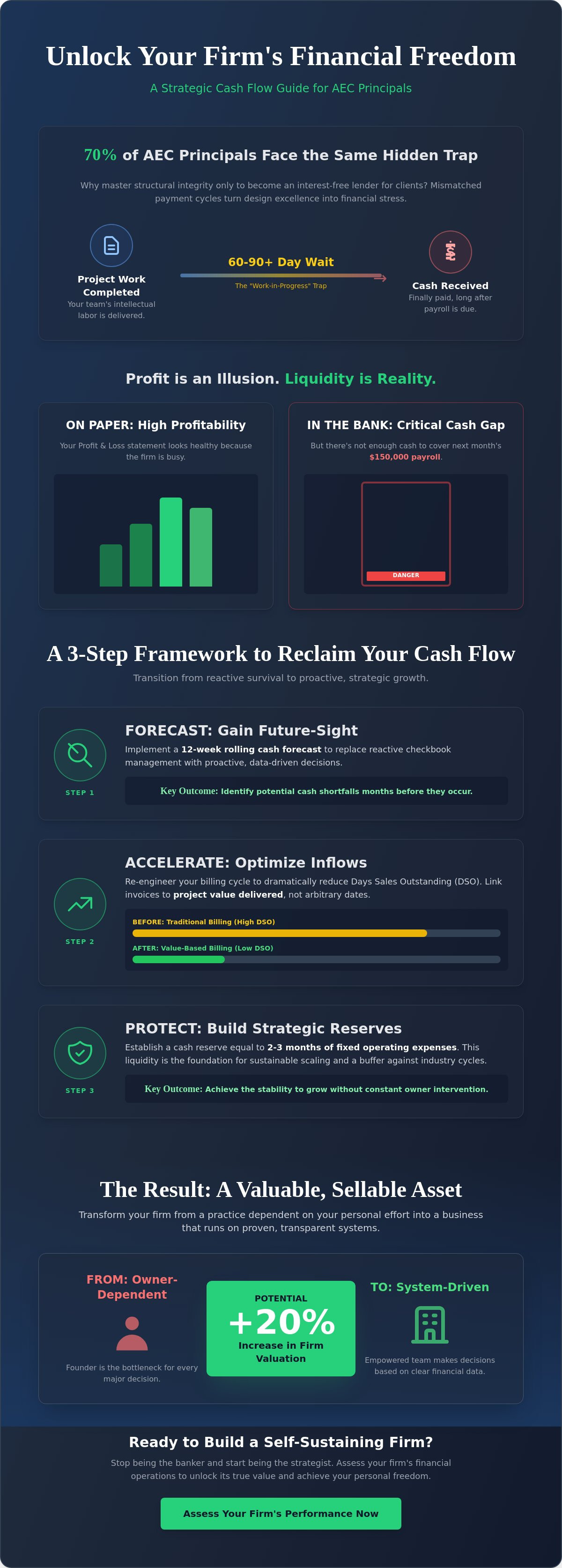
A 3-Step Framework to Accelerate Inflows and Protect Liquidity
Moving from a reactive to a proactive financial stance requires a disciplined framework. By focusing on forecasting, strategic billing, and maintaining reserves, you can gain control over your firm’s financial destiny.
Establish a 12-Week Rolling Forecast
Stop managing from the rearview mirror. A rolling forecast gives you a 90-day view of your cash position, allowing you to anticipate shortfalls and make strategic decisions about hiring, spending, and collections before they become crises. This tool is the foundation of proactive cash flow management for architecture firms.
Re-engineer Your Billing Cycle
The traditional 'end-of-month' billing model puts you at a disadvantage. It extends your Days Sales Outstanding (DSO)—the average number of days it takes to collect payment after an invoice is sent. A high DSO means your clients are using your firm's capital to fund their projects. Shift to a 'milestone-plus-retainer' model, invoicing immediately upon the completion of a valuable phase and securing upfront payments to fund project kickoff.
Implement a Strategic Reserve Policy
The AEC industry has inherent lulls between design and construction phases. A cash reserve, ideally equal to at least two months of operating expenses, protects your firm during these cycles. It provides the stability to retain top talent and pursue new opportunities with confidence, rather than desperation.
Optimising Inflows through Strategic Billing
When clients push back on tighter payment terms, respond with quiet confidence. Explain that your process is designed to ensure the project is properly resourced from day one. By aligning payments with the delivery of tangible value, you reframe the conversation from "paying your bills" to "investing in project momentum." This professional approach shortens your DSO and strengthens your firm’s financial leverage.
Leveraging Financial Systems to Achieve Personal Freedom
The ultimate result of mastering cash flow is not just a healthier balance sheet; it's a business that can thrive without you. When cash flow is predictable and managed by systems, the principal can finally step back from the daily financial grind. This transition from operator to owner is the key to achieving personal freedom and building a truly sustainable enterprise.
Financial transparency builds accountability. When your leadership team has access to clear financial dashboards, they understand the impact of their decisions on the firm's health. This empowers them to manage budgets, oversee project profitability, and contribute to the firm's strategic goals without your constant oversight. You begin to build a leadership team that can run the business, a critical step to reduce owner dependency and unlock significant value.
Preparing for a Successful Transition
Whether you plan to sell in two years or ten, building a sellable asset starts now. When a potential buyer conducts due diligence, the first thing they scrutinize is the financial records. Clean, predictable cash flow statements are the most compelling evidence of a well-run, low-risk business. By implementing these systems today, you are not just solving a short-term liquidity problem; you are actively crafting your eventual, and profitable, exit strategy.
Your firm's ability to generate cash independent of your daily involvement is a direct measure of its worth. To see how your current cash flow systems impact your firm's sellability, start by understanding your score.
Take the Value Builder Assessment to see how your cash flow impacts your firm's sellability.
Frequently Asked Questions
How can architecture firms improve cash flow without upsetting long-term clients?
Frame changes to your billing process as a professional evolution designed to better serve their projects. Propose new terms for new projects rather than altering existing agreements mid-stream. Emphasize that timely payments ensure their project receives dedicated resources without interruption.
What is the ideal cash reserve for an AEC firm with $5M-$10M in annual revenue?
A common benchmark is to maintain a cash reserve equivalent to 2-3 months of average operating expenses. For a firm in this revenue range, this provides a strong buffer against unforeseen project delays or economic downturns without tying up excessive capital that could be used for growth.
How does high Days Sales Outstanding (DSO) impact my firm's valuation?
A high DSO signals to a potential buyer that your revenue is unreliable and that the business has weak control over its finances. It increases perceived risk and can significantly lower the multiple they are willing to pay for your firm. A low, stable DSO demonstrates operational excellence and increases buyer confidence.
Should I use a 12-week or 13-week cash flow forecast for my architecture practice?
Both are effective. A 13-week forecast aligns perfectly with a standard business quarter, which is helpful for reporting. A 12-week forecast provides a solid 3-month rolling view. The key is not the precise number of weeks but the discipline of maintaining a forward-looking forecast consistently.

Article by
Franne McNeal
Franne McNeal, President, Significant Business Results LLC has helped 885+ small business owners collectively create 15,000 jobs and nearly $11 billion in revenue. We help architecture, engineering, and construction industry business owners with $1M-$20M in annual revenue, improve revenue, performance and long-term value. We help owners build a business that runs without them & create financial & personal freedom. Our clients focus their energy for action to achieve significant business results.