.png)
Exit Planning for Architecture Firms: Building a Business That Outlasts Your Tenure

For many founding architects, the firm is more than a business—it is a direct extension of their creative vision and personal reputation. While this drives initial success, it creates a significant challenge when the time comes to consider an exit. A firm built around a single person’s talent is a practice; a firm built on durable systems and a strong leadership team is a valuable, sellable asset.
A successful exit is not a transaction you execute at the end of your career; it is the result of a business you intentionally build years in advance. This strategic approach transforms your firm from a demanding job into a high-value entity that can thrive long after you step away.
Why Your Architecture Firm Exit Strategy Starts with Reducing Owner Dependency
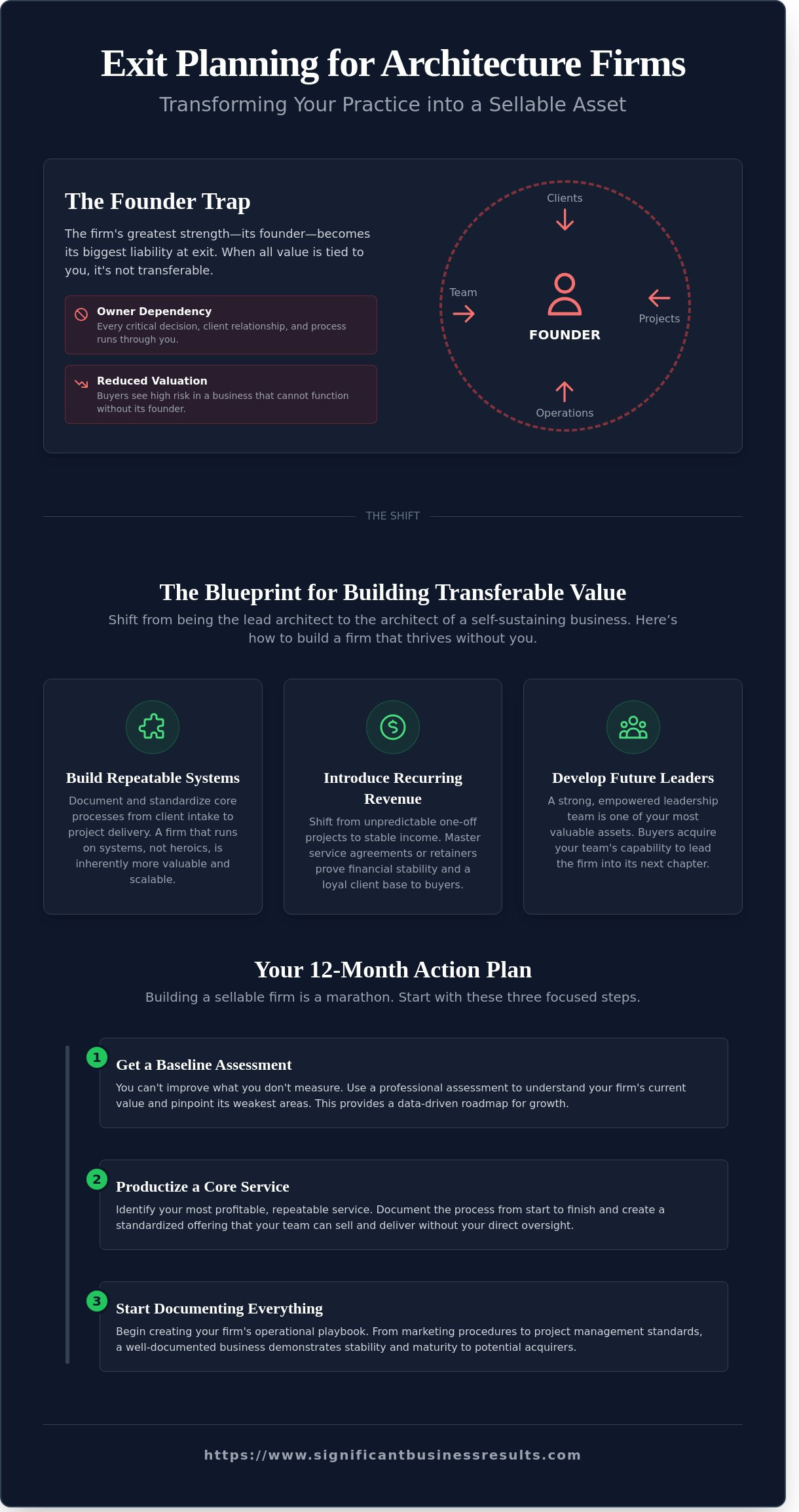
Exit planning is the strategic process of preparing a business for a future transition, whether through an internal succession or an external sale. For architecture firms, the primary obstacle to a successful exit is often "The Founder Trap"—a scenario where the firm's operations, client relationships, and creative direction are inextricably linked to the owner. When clients hire you instead of your firm, the business's value is limited to your personal capacity.
Potential buyers view this dependency as a major risk. They are not acquiring a self-sustaining business; they are acquiring a key-person dependency that could collapse once you leave. The core objective of exit planning for architecture firms is to build transferable value: a measure of your firm's worth that is independent of any single individual.
According to Succession planning, this is a well-documented area of ongoing research and practical application.
From Lead Designer to Business Architect
The first step is a fundamental mindset shift. You must evolve from being the primary designer and project lead to becoming the architect of the business itself. This means moving from managing projects to managing the systems that deliver those projects consistently and profitably. It requires a deliberate transition from day-to-day design involvement to high-level strategic oversight.
Audit your time
Analyze your weekly tasks. How many are centered on design execution versus business development, financial oversight, or team mentorship?
Delegate client relationships
Intentionally bring in senior associates and project architects to client meetings. Empower them to build their own rapport, transferring the relationship from you to the firm.
Codify your design philosophy
Document the principles, processes, and standards that define your firm’s unique approach. This transforms your "secret sauce" into a replicable system that others can learn and execute.
Building Systems for Predictable Creative Output
Systems are the scaffolding that allows your firm to scale and operate without your constant intervention. In an architecture practice, this isn't about stifling creativity; it's about creating a reliable framework so your team can produce high-quality work consistently. This involves standardizing the entire client engagement and design delivery process, from initial consultation and schematic design to construction administration. The goal is to create a "hub-and-spoke" model where processes and team leaders—not you—are the central hub.
Leveraging the 8 Key Drivers to Increase Your Firm’s Transferable Value
To systematically increase your firm's value, we use The Value Builder System™ as a proven framework. This methodology focuses on eight key drivers that significantly impact a company's worth. By strengthening these areas, you create a business that is not only more profitable today but also far more attractive to a future buyer.
While strong financial performance is essential, acquirers look deeper. They assess your firm's Growth Potential, evaluating how easily the business can scale. A well-documented design process, a niche market specialization, and a robust business development pipeline all signal a firm poised for future growth, with or without its founder.
Research published by Succession Planning for Architecture Firms shows that this is a well-documented area of ongoing research and practical application.
The Power of Recurring Revenue in Design Services
The traditional project-to-project model of most architecture firms creates unpredictable revenue streams, which lowers valuation multiples. Introducing recurring revenue is one of the most powerful strategies for building transferable value. This shifts your firm from a transactional service provider to a long-term strategic partner.
Consider implementing offerings such as:
- Phased master planning services with ongoing retainer contracts.
- Maintenance or facility management consulting agreements.
- Design advisory services for developers or large institutions.
Predictable, contracted revenue dramatically increases the multiple a buyer is willing to pay for your business because it reduces risk and ensures future cash flow.
Assessing Your Current Firm Value
Before you can improve your firm’s value, you must establish a clear baseline. A professional assessment provides an objective look at your business's strengths and, more importantly, its hidden weaknesses across all eight value drivers. This data-driven insight is the foundation of an effective strategic growth plan.
To understand where your firm stands today, discover your Value Builder Score. For a deeper dive into the strategic framework, download the free 8 Key Drivers of Company Value eBook.
Navigating the Transition: From Founder-Led to Independent Operation
A successful transition, whether to an internal leadership team or an external buyer, requires a runway of at least three to five years. This period is crucial for implementing systems, developing leaders, and methodically transferring client relationships. The "human element" is particularly critical in architecture, where firm culture and creative legacy are paramount. Preparing your team to carry that torch is as important as strengthening your balance sheet.
Ultimately, a well-executed exit is the capstone of your entrepreneurial career, securing your financial future and personal freedom while ensuring the firm you built continues to thrive.
Developing Your Next Generation of Leaders
A buyer isn't just acquiring your portfolio; they are acquiring your team. A strong, empowered leadership bench is one of the most valuable assets you can cultivate. This goes beyond technical skill. You must mentor senior associates to think and act like owners, capable of leading design teams, managing client expectations, and driving business development.
Investing in executive leadership development and AEC business coaching provides your future leaders with the strategic skills needed to guide the firm forward. This demonstrates to a buyer that the firm's success is sustainable and not dependent on you.
Actionable Steps for the Next 12 Months
Building a sellable asset is a marathon, not a sprint. Here are three focused actions you can take this year to begin the process:
Get a Baseline Assessment
Complete a Value Builder Score assessment to gain an objective understanding of your firm’s current strengths and weaknesses.
Systematize Your Signature Service
Identify your most profitable and repeatable project type. Document every step of the process, from client intake to final deliverables, creating a playbook that others can follow.
Delegate One Key Client Relationship
Choose a trusted, long-term client and begin transitioning the primary relationship to a senior team member. Supervise the process to ensure a seamless handover.
By taking these deliberate steps, you can begin the critical work needed to systematize and scale your firm, transforming it into an asset ready for a successful future transition.
Frequently Asked Questions (FAQs)
How long does it take to prepare an architecture firm for sale?
For a meaningful impact on valuation and a smooth transition, we recommend a 3-to-5-year timeline. This allows sufficient time to reduce owner dependency, strengthen systems, and develop a successor leadership team.
Can I sell my architecture firm if I am the lead designer?
Yes, but you must first transition your role from the sole creative genius to the leader of a creative system. This involves documenting your design philosophy, empowering other designers, and proving that the firm's creative quality is not solely dependent on you.
What is the average valuation multiple for an architecture firm?
Valuation multiples vary widely based on factors like recurring revenue, owner dependency, and market specialization. Firms that are highly dependent on the owner may sell for 2-3 times their pre-tax profit, while those with strong systems and a diverse client base can command multiples of 5 or higher.
What is the difference between succession planning and exit planning?
Succession planning is a component of exit planning that focuses specifically on identifying and preparing internal talent to take over leadership roles. Exit planning is a broader, more comprehensive strategy focused on maximizing the firm's total transferable value for any type of transition, whether internal or external.

Article by
Franne McNeal
Franne McNeal, President, Significant Business Results LLC has helped 885+ small business owners collectively create 15,000 jobs and nearly $11 billion in revenue. We help architecture, engineering, and construction industry business owners with $1M-$20M in annual revenue, improve revenue, performance and long-term value. We help owners build a business that runs without them & creates financial & personal freedom. Our clients focus their energy for action to achieve significant business results.