.png)
Exit Strategy Mistakes: Why Most Architecture Firm Owners Struggle to Sell

For decades, you’ve poured your expertise and energy into building a respected architecture, engineering, or construction (AEC) firm. You’ve managed complex projects, navigated economic cycles, and built a reputation on quality and trust. Now, as you begin to consider your future, a critical question emerges: can the business you built thrive without you? For most AEC owners, the answer is unsettling.
The greatest exit strategy mistake isn’t accepting a low offer—it’s building a firm that is fundamentally unsellable because its value is tied directly to your personal involvement. The good news is that this is a correctable error. By understanding the common pitfalls, you can shift your focus from simply running a practice to building a valuable, transferable asset.
The Strategic Trap: Why Most AEC Exit Plans Fail Early
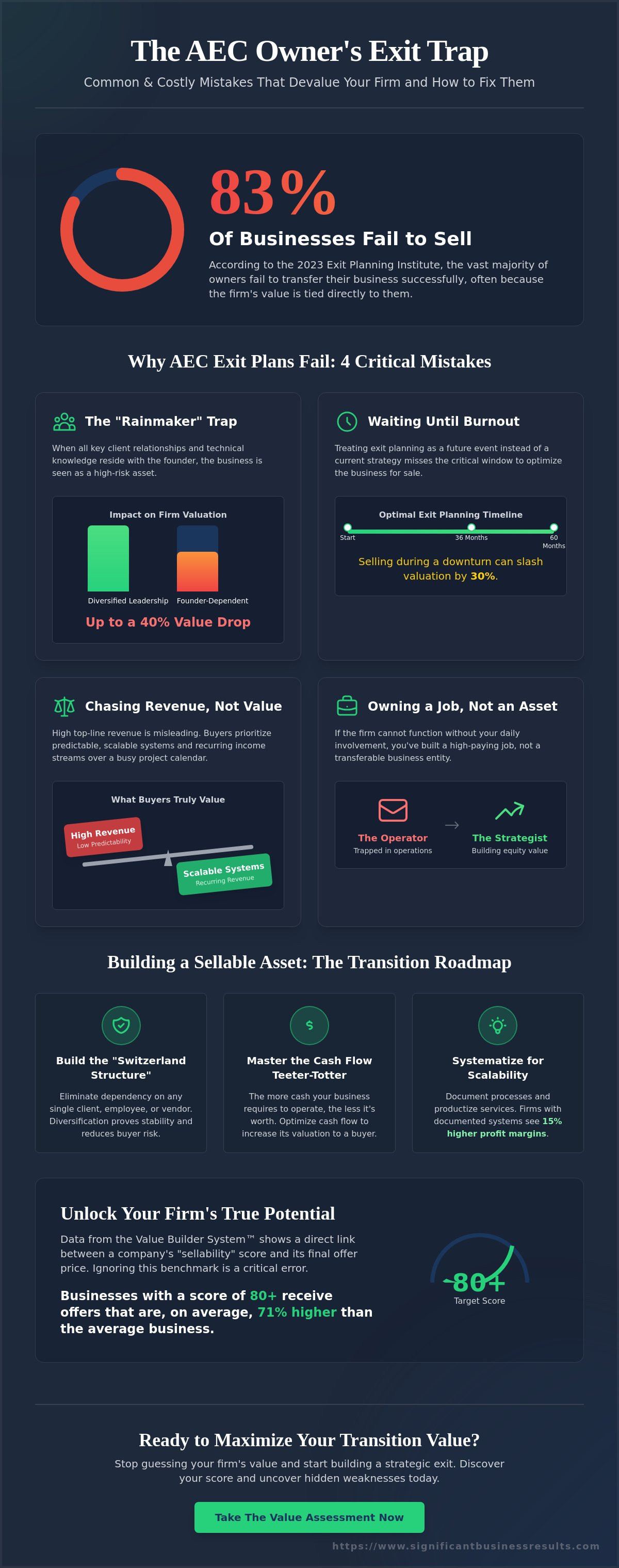
Many firm owners treat an exit strategy as a future event—a set of documents to be prepared when retirement is a year or two away. This is the first and most costly mistake. An effective exit strategy is not a transaction; it's an operational philosophy that should begin shaping your decisions three to five years before you plan to transition.
In the AEC industry, where project pipelines and client relationships are long-term, waiting until the last minute leaves no time to make the structural changes necessary to maximize value. A buyer isn't just acquiring your current projects; they are investing in your firm's future earning potential. If that potential depends entirely on you, the perceived risk skyrockets, and the value plummets.
According to exit strategy, this is a well-documented area of ongoing research and practical application.
The Danger of the 'Rainmaker' Principal
In most small to mid-sized AEC firms, the founder is the primary "rainmaker"—the one who nurtures key client relationships, secures the biggest contracts, and serves as the face of the company. While this is essential for initial growth, it becomes a major liability during an exit.
When a potential buyer analyzes your firm, they ask one crucial question: "If the owner leaves, will the clients and revenue leave, too?" If all critical relationships and specialized knowledge are siloed with you, the business is seen as a collection of projects, not a self-sustaining entity. To build a truly sellable asset, you must systematically transfer those relationships and responsibilities to your team. The goal is to evolve from being the firm’s most valuable player to becoming its most valuable coach. This process is central to reducing owner dependency and creating a business that can attract premium buyers.
Operational Oversights: Mistakes in Valuing and Scaling Your Firm
Another common exit strategy mistake is focusing on the wrong metrics. Owners often take pride in top-line revenue and a full project pipeline, but sophisticated buyers and investors look deeper. They are evaluating the quality and predictability of your earnings, not just the gross amount.
Three operational oversights consistently devalue AEC firms:
A Lack of Recurring Revenue
The project-to-project nature of the industry makes many firms appear risky. Buyers pay a premium for predictable revenue streams. Exploring service contracts, maintenance agreements, or phased consulting retainers can dramatically improve your firm’s financial stability and appeal.
The Failure to Systematize
If your firm’s success depends on individual heroics rather than documented processes, it cannot be easily scaled or transferred. Productizing your services—creating repeatable, teachable systems for everything from project management to client onboarding—turns your expertise into a company asset.
Ignoring Key Value Drivers
Revenue is just one piece of the puzzle. Buyers assess a business based on a range of factors that indicate its health and future potential.
Treating Your Firm Like a Job Instead of an Asset
For many AEC professionals, their firm provides a significant income but functions more like a high-paying job than a transferable business. The distinction is critical. A job requires your constant presence to generate income; an asset generates income with or without your daily involvement.
To build an asset, you must focus on the 8 Key Drivers of Company Value. These are the operational characteristics that buyers look for as proof of a healthy, sustainable business. They include factors like the stability of your earnings, the diversity of your customer base, and the strength of your management team. Understanding how your firm performs against these benchmarks reveals the hidden weaknesses that could derail an exit. It shifts your perspective from short-term profitability to long-term, sellable value.
The first step toward building a true asset is to get a clear, objective measure of your current standing. Taking a confidential value assessment can provide the data-driven insights you need to start making strategic improvements today.
The Transition Roadmap: Actionable Steps to Avoid Costly Exits
Avoiding these common exit strategy mistakes requires a deliberate, multi-year plan. It’s about making small, consistent changes that gradually transform your role and the structure of your business. This isn't something you can accomplish in a few months; it requires a strategic roadmap.
Establish a 3-5 Year Window
Give yourself adequate time to implement systems, develop your leadership team, and transfer key relationships. This timeline also allows for strategic tax planning to maximize your net proceeds from the sale.
Shift Your Role from Operator to Owner
Your primary job must evolve from being the "Chief Problem Solver" to the "Strategic Visionary." This means extricating yourself from daily operations and empowering your team to manage projects and client interactions independently.
Align Your Advisory Team Early
Your business coach, accountant, and attorney should be working together long before you go to market. A cohesive advisory team ensures that your operational, financial, and legal strategies are all aligned toward the same goal: a successful, high-value exit.
Implement Systems for Autonomy
Document every core process in your business, from how you generate leads to how you execute projects. Strong systems are the foundation of a business that can run without you.
Building a Business That Runs Without You
The ultimate goal of your exit strategy is to make yourself redundant. While that may sound counterintuitive, it is the single most important factor in achieving a successful sale and securing your personal and financial freedom.
Start with a simple, actionable step this week: identify one critical task that only you perform and create a plan to fully delegate it to a team member within the next 30 days. This could be initial client consultations, proposal reviews, or a key financial check. Each task you successfully hand off is a step toward building a more resilient and valuable company.
Navigating this transition can be challenging, but you don’t have to do it alone. Engaging with a peer Mastermind group or receiving one-on-one guidance can provide the accountability and strategic clarity needed to stay on track. If you're ready to begin your transition journey, exploring strategic coaching can provide the framework to transform your firm into a sellable asset.
Frequently Asked Questions (FAQs)
What is the #1 mistake AEC owners make when selling their firm?
The most common and costly mistake is building a business that is completely dependent on the owner. When all client relationships, technical knowledge, and decision-making authority reside with the founder, the firm's value is severely diminished because a buyer sees no clear path to continued success after the transition.
How long does it realistically take to prepare an engineering or architecture firm for exit?
For the best results, you should plan for a three-to-five-year transition period. This provides enough time to implement new systems, develop a strong leadership team, transfer client relationships, and optimize your financial performance to command the highest possible valuation.
Can I sell my business if it still relies on my professional license?
Yes, it is possible, but it adds a layer of complexity. The sale often requires a structured transition where you remain involved for a specific period post-sale. The ideal strategy is to build a firm where other licensed professionals are on staff and capable of overseeing projects, reducing the dependency on your individual license.
How do I know if my AEC firm is actually sellable or just a high-paying job?
Here’s a simple test: could you take a four-week, completely unplugged vacation without your phone or email? If you can, and the firm continues to operate smoothly and even grow in your absence, you have built a sellable asset. If the thought of being disconnected for that long causes panic, your firm is likely still operating as a job that depends on you.

Article by
Franne McNeal
Franne McNeal, President, Significant Business Results LLC has helped 885+ small business owners collectively create 15,000 jobs and nearly $11 billion in revenue. We help architecture, engineering, and construction industry business owners with $1M-$20M in annual revenue, improve revenue, performance and long-term value. We help owners build a business that runs without them & create financial & personal freedom. Our clients focus their energy for action to achieve significant business results.