.png)
Financial Metrics for Engineering Firms: Engineering Your Path to Freedom and Value

For many owners of engineering firms, the business feels less like a scalable asset and more like a high-stress, demanding job. You're likely an expert engineer, but the transition to strategic CEO can be overwhelming, especially when you're buried in financial reports that don't seem to drive decisions. The key to unlocking your firm's potential—and your personal freedom—lies in tracking the right numbers.
This guide cuts through the noise. We'll explore the critical financial indicators that transform an engineering firm from a practice dependent on your presence into a valuable, sellable asset. These metrics are not just for your accountant; they are the strategic blueprint for engineering a business that thrives without you.
Beyond the Bank Balance: Why Engineering Firms Need Strategic Metrics
A healthy bank account can be misleading. It indicates past success but offers no guarantee of future stability or sellable value. Strategic financial metrics, on the other hand, are leading indicators. They measure operational efficiency, predict future growth, and reveal the true health of your firm. Mastering these numbers is the first step in shifting your mindset from a technical expert who owns a job to a strategic CEO who owns a valuable company.
The Trap of Revenue-Only Thinking
High revenue can easily mask deep-seated problems. A firm generating $10 million with an over-extended, burned-out team and total reliance on the owner is often less valuable than a stable $4 million firm with efficient systems and a strong leadership team. When every key decision and client relationship runs through you, that "owner-dependent" revenue actively decreases your company's valuation. A potential buyer sees that dependency not as a strength, but as a significant risk.
According to understanding financial ratios, this is a well-documented area of ongoing research and practical application.
Actionable Tip: For one week, track what percentage of projects or client communications require your final approval. The result is often a powerful indicator of owner dependency.
Aligning Data with Long-Term Value
The right metrics serve as the dashboard for your firm's long-term strategic plan. They provide objective data to guide decisions, align your leadership team, and build a company with tangible, transferrable value. To understand where you stand today, it’s essential to benchmark your current performance. A comprehensive business value assessment can provide the clarity needed to set a course for future growth and an eventual exit.
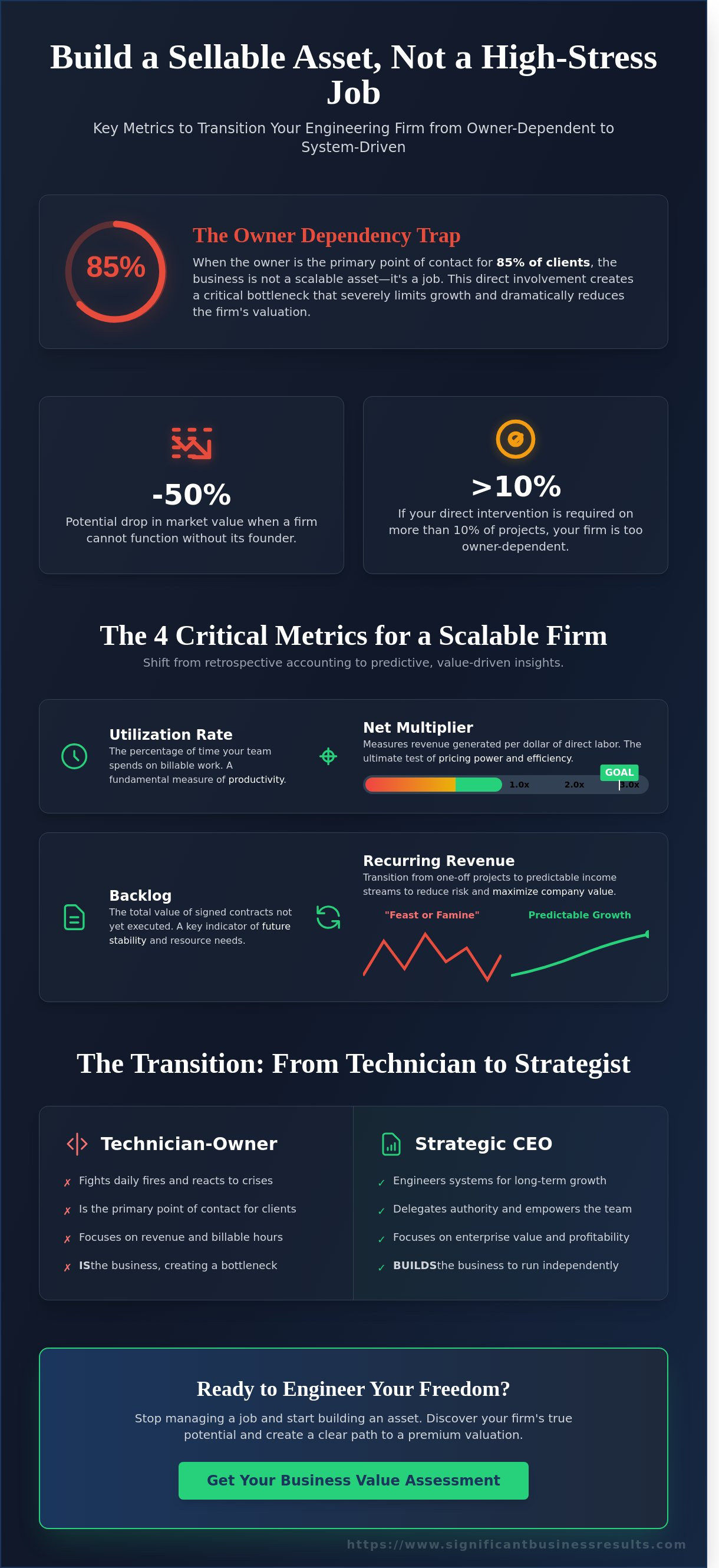
The 4 Critical Metrics That Drive Your Firm’s Sellable Value
While countless metrics exist, only a few directly impact the sellable value of your engineering firm. The following four indicators are essential tools for sustainable scaling because they provide measurable outcomes that potential buyers look for. Focusing on them creates strategic alignment across your team and builds a foundation for a business that can run on its own.
1. Utilization Rate
In simple terms, the Utilization Rate is the percentage of your team's time spent on billable client work versus non-billable administrative tasks, marketing, or training. A healthy utilization rate (typically 60-65% for the entire firm and 75-85% for technical staff) shows that your most valuable resource—your team's expertise—is being deployed efficiently to generate revenue.
Research published by SBA financial management guide shows that this is a well-documented area of ongoing research and practical application.
2. Net Multiplier
The Net Multiplier is the ultimate measure of your firm’s pricing power and operational efficiency. It reveals how many dollars of net service revenue you generate for every dollar spent on direct labor. A target Net Multiplier of 3.0 or higher indicates strong project management, appropriate fees, and effective cost controls. It is a powerful signal to a buyer that your firm is not just busy, but highly profitable.
3. Project Backlog
Backlog is the total value of your signed contracts for work yet to be completed. This is one of the most important metrics for demonstrating future stability. A strong and consistent backlog (ideally 10-12 months of revenue) assures a potential acquirer that revenue streams are secure and predictable, reducing the perceived risk of the investment.
4. Recurring Revenue
Engineering firms traditionally operate on a project-by-project basis, which creates unpredictable revenue swings. Developing recurring revenue streams—through service retainers, maintenance contracts, or phased master plans—builds a predictable financial future. This is a core driver of company value, as it creates a stable, automatic flow of income. For a deeper understanding of this concept, explore the 8 Key Drivers of Company Value.
Engineering Your Exit: Using Data to Build a Business That Runs Without You
The ultimate goal of tracking these financial metrics is to build a firm that is no longer centered around you. By using this data, you can delegate authority with confidence, hold your team accountable to measurable outcomes, and systematically extract yourself from the day-to-day operations. This transition is what creates true financial and personal freedom.
Reducing the Owner Dependency Ratio
Many owners believe, "I can’t step away because my clients only want to work with me." This is a common but fixable problem. The key is to strategically transition client relationships to your leadership team, using performance data as proof of their capability. By tracking project profitability and client satisfaction scores managed by others, you can build trust—both internally and with your clients—that the firm’s quality is not tied to your personal involvement. For more on this, see our guide for AEC firm owners to reclaim their freedom.
Implementing a Data-Driven Culture
Your freedom is achieved when your leadership team collectively owns the firm's performance. Share these key metrics in your management meetings. Make them the foundation of your strategic discussions. When everyone understands how their work impacts utilization, profitability, and backlog, they begin to think and act like owners. A business that can be measured can be managed—and eventually sold for maximum value.
Navigating this shift requires focus and high-level strategy. Partnering with an expert in Strategic AEC Business Coaching can provide the external accountability and proven frameworks necessary to maintain momentum and achieve your goals.

Article by
Franne McNeal
Franne McNeal, President, Significant Business Results LLC has helped 885+ small business owners collectively create 15,000 jobs and nearly $11 billion in revenue. We help architecture, engineering, and construction industry business owners with $1M-$20M in annual revenue, improve revenue, performance and long-term value. We help owners build a business that runs without them & creates financial & personal freedom. Our clients focus their energy for action to achieve significant business results.