.png)
How to Scale an Engineering Firm: Moving Beyond Owner-Led Growth

Your technical brilliance built your engineering firm. Now, it’s holding it back.
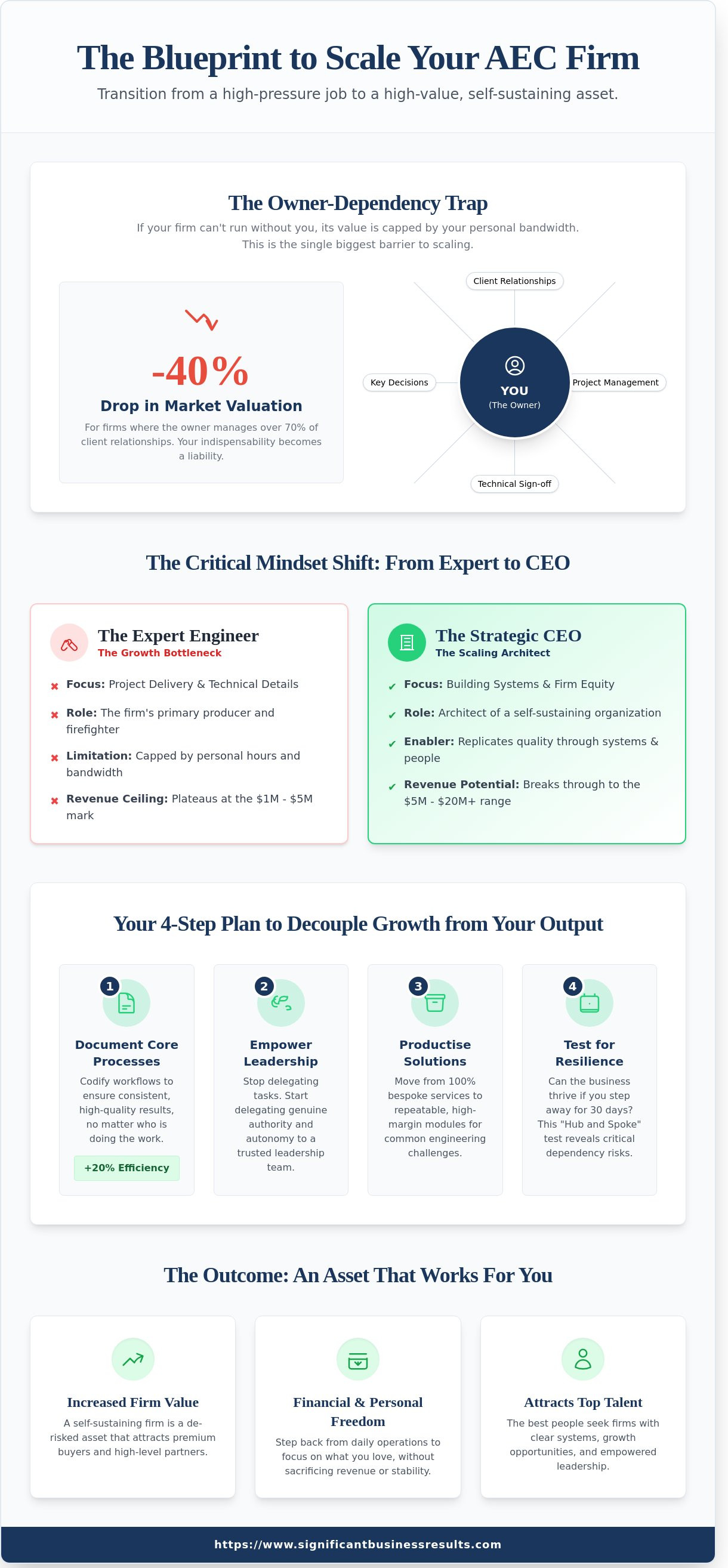
For many principals in the architecture, engineering, and construction (AEC) industry, this is the expert trap. You are the best engineer in the room, the primary client contact, and the ultimate quality control. As a result, the firm’s growth is directly tied to the number of hours you can personally work. This is not a scalable model; it is a path to burnout.
True scaling isn't about hiring more engineers to handle more projects; it's about increasing your firm's capacity and value without a linear increase in your personal workload. To achieve this, you must make a critical strategic shift: from being the firm’s lead engineer to becoming its Chief Executive Officer.
The Strategic Shift: From Expert Engineer to Firm CEO
The first ceiling on your firm’s growth is your own involvement. When every decision, client call, and project review has to pass through you, you become the bottleneck. This owner dependency is common in firms reaching the $1M-$5M and $5M-$20M revenue plateaus. At these stages, the systems that got you here are no longer sufficient to get you to the next level.
Sustainable scaling is the ability to replicate quality and results through systems, not just through your personal effort. This requires moving from tactical firefighting to strategic oversight. Instead of solving today’s engineering problem, your job becomes building the organizational framework that can solve the next 100 problems without you.
According to understanding business scalability, this is a well-documented area of ongoing research and practical application.
This transition is a deliberate process of letting go, trusting a team, and adopting a professional operating framework to guide your firm’s growth. It means shifting your focus from doing the work to designing the business that does the work.
Implementing Systems to Decouple Growth from Owner Output
Growth that depends on you is not scalable. To build a valuable asset, you must decouple the firm’s performance from your personal output. This is not an engineering problem; it is a systems problem. By implementing a clear operational structure, you create a business that can run itself.
Here are four essential steps to build that structure:
Research published by proven growth strategies shows that this is a well-documented area of ongoing research and practical application.
Document Core Processes.
Your firm’s unique approach to project delivery, client management, and quality control must be documented. Standard Operating Procedures (SOPs) ensure project delivery remains consistent and high-quality, regardless of who is in the office.
Empower a Leadership Team.
Delegate authority, not just tasks. Equip your key leaders with clear Key Performance Indicators (KPIs) and a framework for decision-making. This fosters a culture of accountability, moving your team from tactical firefighting to strategic ownership. For many leaders, high-level executive coaching helps bridge the gap between technical management and strategic leadership.
Systematize Your Operations.
Your goal is to pass the "Hub and Spoke" test: can the business thrive if you take a four-week vacation? If the answer is no, it’s because you are the hub. Documented systems for sales, project management, and finance create a resilient structure that doesn’t rely on a single person. To help professionalize your digital sales systems, you can check out REVI for expert web development and video production. This is the key to reducing owner dependency and reclaiming your freedom.
Shift to Productized Solutions.
Where possible, move from purely bespoke services to standardized or "productized" engineering solutions. This creates predictable workflows, simplifies training, and can establish recurring revenue streams, making your growth far more predictable.
Implementing these systems is the foundation of a valuable, sellable business. They directly address the most critical of the 8 Drivers of Company Value: ensuring the business can thrive without you.
Optimizing Operations for Profitability and Future Exit
A scalable firm is an inherently more profitable and valuable firm. As you implement systems, your focus should be on optimizing for long-term value, not just short-term revenue. This means making strategic choices that increase your firm’s health and attractiveness to a future buyer or successor.
Focus your operational improvements on high-margin profit streams and establishing recurring revenue models, such as maintenance or consulting contracts. This financial stability and predictability are highly attractive to acquirers. Even if you don’t plan to sell for a decade, building a business with exit readiness in mind forces you to make decisions that increase its value and resilience today.
Research published by five stages of small business growth shows that this is a well-documented area of ongoing research and practical application.
To guide this process, you must measure what matters. Instead of focusing solely on billable hours, track metrics that reflect your firm’s operational health and scalability. A comprehensive Value Builder Assessment can benchmark your firm’s performance across key value drivers and provide a clear roadmap for improvement.
Scaling your engineering firm is about intentionally designing a business that can deliver significant results without your constant intervention. By implementing robust systems and empowering your leadership, you not only drive sustainable growth but also build a lasting asset. As our AEC Case Studies show, this transition transforms both the firm's future and the owner's freedom.
Frequently Asked Questions
How do I know if my engineering firm is ready to scale?
Look for signs of owner burnout, stagnant revenue despite a full pipeline, and a leadership team that lacks decision-making authority. If every project requires your personal sign-off, you have reached a growth ceiling that requires a systems-based approach to break through.
What is the most common mistake AEC owners make when trying to grow?
The most common error is hiring more technical staff without building the management systems to lead them. This often results in the owner working harder to manage more people, rather than the business working harder for the owner.
Can an engineering firm really run without the founder’s daily input?
Yes, by transitioning from a Hub and Spoke model where you are the center of all decisions to a decentralized structure. This requires documented processes and a leadership team empowered with the authority to deliver results independently.
How does reducing owner dependency increase the actual sale price of the firm?
Buyers look for return on investment and low risk. If a firm is entirely dependent on the owner, the risk of the business failing after the sale is high, which lowers the valuation. A business that runs itself is a valuable, sellable asset.
Schedule a Strategic Planning Session to start scaling your firm today.
Article by
Franne McNeal
Franne McNeal, President, Significant Business Results LLC has helped 885+ small business owners collectively create 15,000 jobs and nearly $11 billion in revenue. We help architecture, engineering, and construction industry business owners with $1M-$20M in annual revenue, improve revenue, performance and long-term value. We help owners build a business that runs without them & create financial & personal freedom. Our clients focus their energy for action to achieve significant business results.