.png)
How to Value an Engineering Firm: A Strategic Guide for AEC Owners

As an owner of a successful engineering firm, you’ve likely asked yourself two critical questions: “What is my business actually worth?” and “How can I make it more attractive to a potential buyer?” The answer isn't found in a simple formula. An engineering firm’s value is not a static calculation; it is a dynamic score based on how well the business operates without you.
This guide moves beyond simple accounting to give you a strategic framework for understanding, measuring, and significantly increasing your firm’s market value. It’s about shifting your mindset from day-to-day operator to the strategic architect of a truly sellable asset.
The Mechanics of Valuation: Moving Beyond Simple Multiples
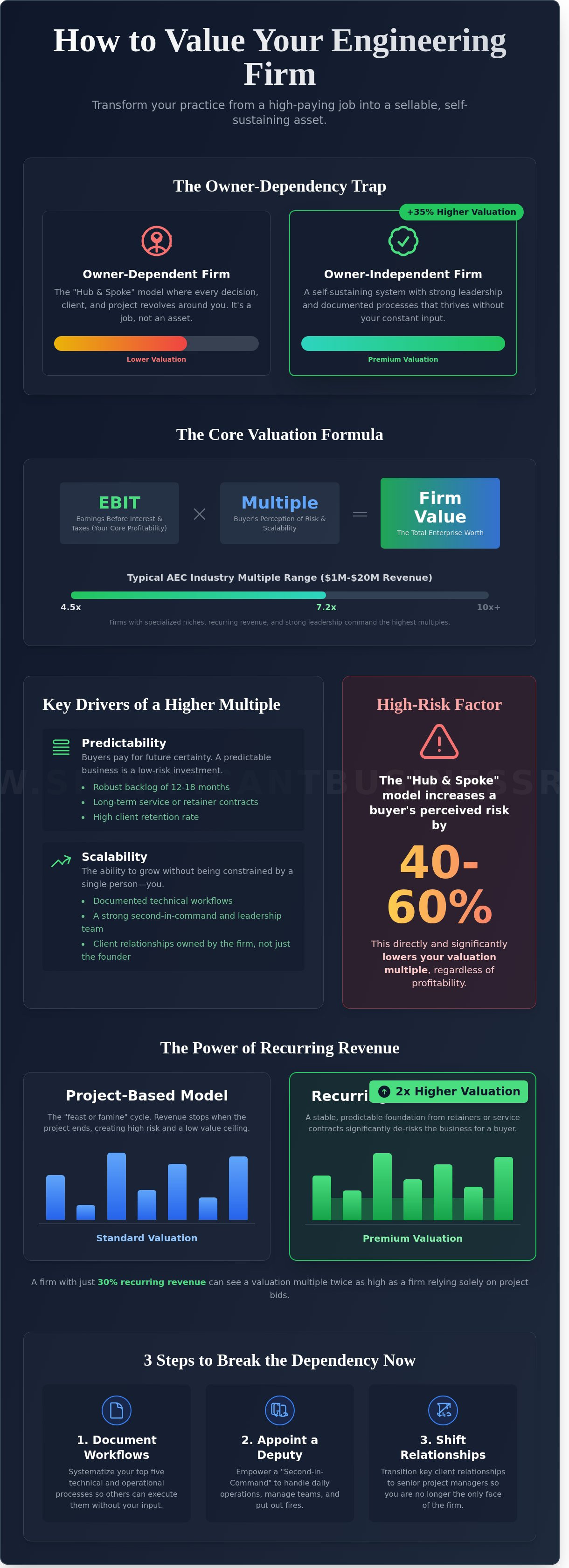
Valuing an engineering firm is part science and part art. The "science" is the basic formula: a measure of your profit multiplied by a market-specific number. For most firms in the Architecture, Engineering, and Construction (AEC) industry, the starting point is a metric like EBITDA (Earnings Before Interest, Taxes, Depreciation, and Amortization), which is essentially a measure of your firm's cash flow and profitability.
This profit figure is then multiplied by a "Market Multiple" to determine your firm's estimated value. For example, if your firm generates $500,000 in adjusted profit and the typical market multiple is 5x, your baseline valuation would be $2.5 million.
However, your balance sheet only tells half the story. The "art" of valuation lies in the factors that influence that multiple. Why might one firm command a 6x multiple while another, with similar revenue, only gets a 4x? The difference lies in intangible assets that don't appear on a spreadsheet:
Goodwill
The strength of your brand, reputation, and established client relationships.
Backlog
A strong pipeline of signed contracts provides a buyer with predictable future revenue, reducing their risk.
Intellectual Capital
The collective expertise of your team and your firm’s proprietary processes.
These elements determine whether a buyer sees your firm as a stable, high-potential investment or a risky acquisition tied to a handful of key people.
The 8 Key Drivers: What Actually Dictates Your Multiple
Buyers are not just purchasing your past performance; they are investing in your future potential. They look for two things above all else: predictability and scalability. The most effective way to demonstrate both is by focusing on the eight core drivers of company value. Strengthening these areas is the most direct path to increasing your multiple because it systematically reduces risk for an acquirer.
Two of the most critical drivers for engineering firm owners are owner dependency and recurring revenue.
Breaking the "Hub and Spoke" Dependency
In many firms, the owner is the central hub for every major decision, client relationship, and technical review. While this model can work for a time, it severely limits your company’s value. If the business cannot function without your constant input, a buyer isn't acquiring a company; they're acquiring your job.
A business that "runs on you" is worth significantly less. The key is breaking the “hub and spoke” model by empowering your team. Start by delegating high-level technical decisions to senior staff, entrusting key client relationships to your project managers, and documenting your processes so they can be replicated and improved by others.
The Power of Recurring Revenue in Engineering
The AEC industry is often project-based, leading to unpredictable revenue cycles. Buyers pay a premium for revenue that is automatic rather than "hunted" every quarter. While massive, one-off projects look great on paper, a portfolio of recurring service contracts or retainer-based engineering support is far more valuable.
This predictable revenue stream demonstrates market stability and makes future cash flow easier to forecast. Look for opportunities to convert project-based clients into long-term service agreements. Even a small percentage of recurring revenue can have an outsized impact on your valuation multiple. To learn more about this and the other drivers, you can explore the 8 Key Drivers in detail.
Preparing for a Significant Result: Maximizing Value Before the Exit
The best time to think about your exit is two to three years before you plan to leave. This gives you the runway to make strategic adjustments that will maximize your firm’s value. This process involves transforming your role from the "Chief Engineer" to the "Chief Visionary."
Your goal is to build a leadership team that operates independently, ensuring continuity and growth long after you're gone. A robust middle-management layer that can handle operations, business development, and client management is one of the most valuable assets you can build. It proves to a buyer that the firm's success is embedded in its systems and its people, not just its founder.
By focusing on operational efficiency, fostering a strong leadership team, and creating a business that is no longer dependent on you, you are not just preparing for a sale. You are building a durable, valuable asset that can provide you with financial and personal freedom for your next chapter.
Ready to see how your firm stacks up against the key drivers of value? The first step is getting an objective measure of your company's performance.
Take the Value Builder Assessment today to get your score and identify the strategic levers you can pull to achieve a more significant result.
Frequently Asked Questions
What is the average valuation multiple for a mid-sized engineering firm?
While multiples fluctuate with market conditions, mid-sized engineering firms (e.g., $1M-$20M in revenue) often see multiples in the range of 4x to 6x of their adjusted profit (EBITDA). Firms with strong recurring revenue, low owner dependency, and a diverse client base can command higher multiples.
How does owner dependency specifically lower the value of my engineering business?
Owner dependency creates significant risk for a buyer. If you are the primary client contact, lead technical expert, and main business generator, your departure could cripple the company. This risk forces a buyer to lower their offer, often by a substantial amount, to compensate for the instability your exit would create.
Can I value my engineering firm myself or do I need a professional?
You can calculate a baseline estimate yourself using the profit x multiple formula. However, a professional valuation expert or a strategic coach specializing in the AEC industry can provide a much more accurate and defensible valuation. They understand industry benchmarks and can properly assess the intangible assets (like goodwill and owner dependency) that heavily influence the final number.
What is the difference between an internal transition to employees and selling to an outside firm?
An internal transition (like a management buyout) often prioritizes legacy and continuity. The valuation may be more flexible, and payment terms can be structured over a longer period. Selling to an outside firm (like a larger competitor or private equity) is typically a more formal process focused on maximizing the financial return. The valuation is often higher, but the deal structure may be more rigid.

Article by
Franne McNeal
Franne McNeal, President, Significant Business Results LLC has helped 885+ small business owners collectively create 15,000 jobs and nearly $11 billion in revenue. We help architecture, engineering, and construction industry business owners with $1M-$20M in annual revenue, improve revenue, performance and long-term value. We help owners build a business that runs without them & creates financial & personal freedom. Our clients focus their energy for action to achieve significant business results.