.png)
Leadership Team Alignment: Building a Self-Sustaining AEC Firm

As an owner in the architecture, engineering, or construction (AEC) industry, you built your firm on technical expertise and project excellence. Yet, as you scale, you may find yourself managing departmental conflicts more than driving growth. Your design lead has one set of priorities, your head of construction has another, and you are the only one connecting the dots. This isn't a personnel problem; it's a structural one rooted in misalignment.
Many AEC owners believe their leadership team is on the same page because projects get completed on time and on budget. But true leadership team alignment is not about project harmony; it is the operational prerequisite for building a sellable business asset. Without it, your firm remains a collection of high-performing silos completely dependent on you to function.
What is Leadership Team Alignment in an AEC Context?
In the AEC world, leadership team alignment is a unified, top-down commitment to the firm’s long-term business goals, not just the successful completion of individual projects. It’s the difference between running a series of jobs and building a sustainable company.
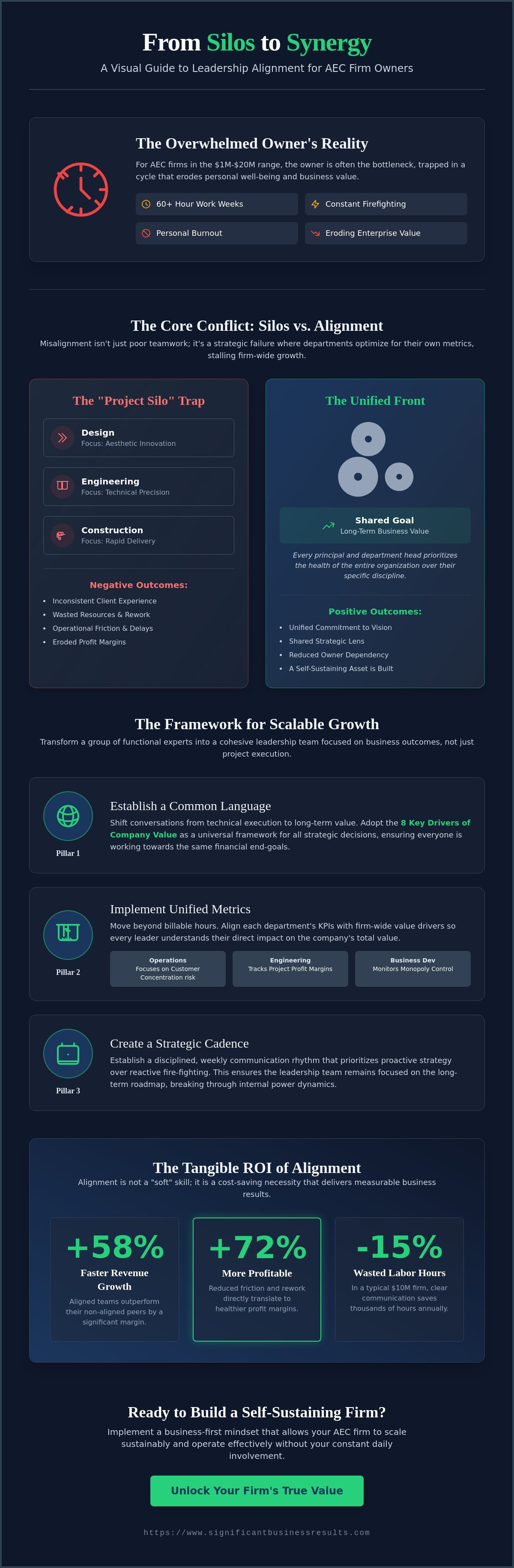
Most firms fall into the "Project Silo" trap. The design, engineering, and construction departments each focus on their own metrics—design awards, engineering efficiency, or project margins. While important, these isolated goals often conflict, creating friction that undermines firm-wide growth. This is the gap between tactical alignment (getting daily tasks done) and strategic alignment (creating long-term, transferable value).
According to What is Strategic Alignment?, this is a well-documented area of ongoing research and practical application.
When your leaders aren't strategically aligned, every major decision defaults to you. This constant fire-fighting directly increases owner dependency and, as a result, reduces your firm’s market value.
The Symptoms of a Misaligned AEC Team
Misalignment isn't always obvious. It often shows up as persistent, low-grade operational issues that drain resources and stall growth. Key symptoms include:
• Inconsistent client experiences depending on which project manager is in charge.
• Conflicting priorities and resource battles between the office and the job site.
• Key employees leaving due to frustration over a lack of clear direction.
This creates what we call "operational friction"—the hidden financial cost of leadership silos working against each other instead of toward a common goal.
Three Pillars of Strategic Alignment for Scalable Growth
To build a self-sustaining firm, you must shift your team’s focus from a project-first mindset to a business-first mindset. This transition rests on three pillars that create a common language and a shared definition of success. While many owners feel they are "too busy" for strategic work, the ROI of alignment is found in dramatically reduced rework, fewer emergencies, and accelerated growth.
1. Establishing a Common Language for Value
Your leadership team cannot work toward a common goal if they define that goal differently. The first step is to establish a shared vocabulary for what drives the firm's value beyond revenue. Using a framework like The 8 Key Drivers of Company Value provides a neutral, data-driven language for every leader to understand how their department contributes to the overall health and sellability of the business.
2. Creating Unified Performance Metrics
AEC firms are experts at tracking project-level metrics like billing hours and completion rates. However, strategic alignment demands metrics that track firm-wide performance. This means moving beyond project accounting to measure things like client acquisition cost, employee retention rates, and the percentage of revenue from recurring sources. When every leader understands and is accountable for these higher-level numbers, their decisions naturally begin to align with the company's long-term strategic objectives.
3. Reducing Owner Dependency Through Delegated Authority
True alignment is achieved when the business can run without you. This requires defining clear decision-making boundaries for each member of the leadership team. When leaders know what they own and have the authority to act, they stop escalating issues to you. This is the foundation of a business that can scale and eventually thrive under new ownership. True alignment allows an owner to step away without the business stalling. If you're unsure where your biggest dependency gaps are, taking a confidential Value Builder Assessment can provide immediate clarity. For more on this, see our guide on how to reduce owner dependency.
Moving From Friction to Freedom: Steps to Align Your Team
Achieving leadership team alignment is a deliberate process, not a one-time event. It requires pulling your team out of the day-to-day project grind to focus on the business itself. A neutral, third-party facilitator is often essential to break through established power dynamics and ensure conversations remain focused on strategic outcomes, not internal politics.
This structured alignment process is what makes a future exit or internal transition smooth and profitable. A buyer or successor isn't just acquiring your projects; they are acquiring your leadership team's ability to execute a strategic plan.
The Strategic Planning Retreat
An off-site strategic planning session is non-negotiable. It is the only way to pull leaders out of their project-delivery mode and force them to think like business owners. The goal is not just to have a conversation but to capture that conversation in a formal, actionable growth plan that assigns clear ownership and deadlines to every strategic initiative.
Creating a Culture of Accountability
Alignment can be uncomfortable, especially for long-term leaders accustomed to the "old way" of working. Resistance is best handled by tying strategic goals directly to team and individual performance metrics. When leaders see how alignment benefits them and the company, accountability becomes part of the culture. A fully aligned team also becomes a magnet for high-level talent, as ambitious professionals are drawn to organizations with a clear vision and a defined path for growth.
Maintaining this focus requires consistent effort. Ongoing Executive Leadership Coaching provides the structure and external accountability needed to ensure your team stays aligned long after the initial planning session.
Frequently Asked Questions (FAQs)
How do I know if my leadership team is truly misaligned?
If you are the final decision-maker on nearly every issue, if departments blame each other when problems arise, or if you hear different versions of the company’s priorities from different leaders, you have a misalignment problem.
Can leadership alignment help if I plan to sell my AEC firm in the next 3 years?
Yes, it's critical. A potential buyer will pay a premium for a business with a strong, aligned leadership team that can run the company without you. It is one of the most direct ways to increase your company's valuation.
What is the most common mistake owners make when trying to align their teams?
The most common mistake is treating alignment as a single meeting. Owners hold one "rah-rah" session and expect things to change. True alignment requires a structured process, consistent follow-up, and metrics to track progress.
How often should a leadership team meet for strategic alignment sessions?
A comprehensive strategic planning session should happen annually. This should be supported by quarterly full-day reviews to check progress against the plan and monthly leadership meetings to address tactical issues within the strategic framework.

Article by
Franne McNeal
Franne McNeal, President, Significant Business Results LLC has helped 885+ small business owners collectively create 15,000 jobs and nearly $11 billion in revenue. We help architecture, engineering, and construction industry business owners with $1M-$20M in annual revenue, improve revenue, performance and long-term value. We help owners build a business that runs without them & create financial & personal freedom. Our clients focus their energy for action to achieve significant business results.