.png)
Leadership Team Alignment: Building a Self-Sustaining AEC Firm

As an owner in the Architecture, Engineering, or Construction (AEC) industry, you’ve built a firm on technical excellence. Your teams deliver complex projects on time and on budget. Yet, you find yourself pulled into daily decisions, mediating disputes, and feeling like the business would stall without your constant presence. This is a classic symptom of a leadership team that is tactically proficient but strategically misaligned.
True leadership team alignment isn’t about your managers liking each other or agreeing on every point. It’s about a shared, unwavering commitment to the firm’s long-term business goals—the goals that build a valuable, self-sustaining asset, not just a portfolio of completed projects.
What is Leadership Team Alignment in an AEC Context?
In many AEC firms, leaders fall into the “Project Silo” trap. The head of Design focuses on design awards and billable hours, Engineering prioritizes technical accuracy, and Construction manages job site logistics. While each department may hit its individual targets, they often do so at the expense of firm-wide growth. This creates operational friction, the hidden cost of leadership silos that erodes profitability and increases your workload.
Strategic alignment breaks down these walls. It elevates the conversation from daily project tasks to long-term value creation. When your team is strategically aligned, they make decisions based on what’s best for the entire business, not just their department. This shift is critical because misalignment directly increases owner dependency, which in turn reduces your firm’s market value and your personal freedom.
According to Strategic Alignment, this is a well-documented area of ongoing research and practical application.
The Symptoms of a Misaligned AEC Team
Misalignment isn’t always obvious. It often shows up as persistent, low-grade problems that drain energy and resources. Look for these signs:
Inconsistent Client Experiences
Clients receive different levels of service depending on which project manager they work with.
Office vs. Field Conflict
There are constant conflicting priorities and communication breakdowns between your office-based teams and job site crews.
Key Decisions Always Land on Your Desk
Your leaders are hesitant to make final calls without your approval, pulling you back into the weeds.
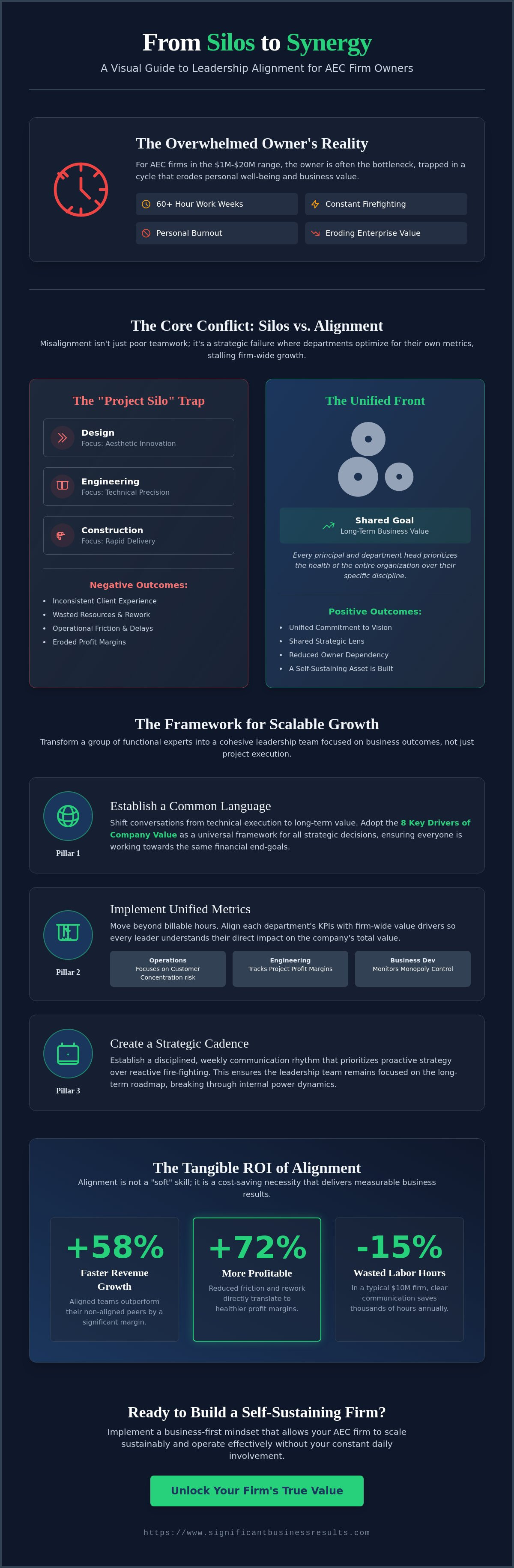
Three Pillars of Strategic Alignment for Scalable Growth
To build a firm that can thrive without you, you need a framework that moves your team from a project-first mindset to a business-first mindset. This structure is built on three essential pillars that create a common language for growth and decision-making.
1. Establishing Unified Performance Metrics
Your team rallies around what you measure. If you only track billable hours and project margins, you encourage siloed thinking. True alignment requires metrics that reflect the overall health and value of the business. Introduce your team to the 8 Key Drivers of Company Value as a shared vocabulary. When every leader understands how their department’s efficiency impacts the firm’s recurring revenue or customer satisfaction scores, they start operating as a cohesive business unit.
Research published by Conflict Management and Prevention shows that this is a well-documented area of ongoing research and practical application.
2. Reducing Owner Dependency Through Delegated Authority
Alignment is impossible when you are the final decision-maker on everything. The second pillar is defining clear decision-making boundaries for each member of your leadership team. Document who is responsible for what and empower them to act. True alignment allows an owner to step away without the business stalling. If you’re unsure where your biggest dependency gaps are, taking a confidential Value Builder Assessment can provide immediate clarity.
3. Creating a Culture of Accountability
A plan is only as good as its execution. The third pillar is a culture where leaders hold themselves and each other accountable for strategic goals. This isn't about blame; it's about a shared commitment to achieving significant results. When your team is aligned, accountability feels like a natural part of the process, not a top-down mandate. A culture of accountability also makes it easier to attract and retain high-level talent who want to be part of a winning team. For more on this, see our guide on how to improve team accountability in your AEC firm.
Moving From Friction to Freedom: Steps to Align Your Team
Achieving leadership team alignment is a deliberate process, not a one-time event. It begins with creating the space for strategic thinking and is maintained through consistent effort.
The Strategic Planning Retreat
You cannot think strategically while immersed in daily operations. An off-site strategic planning session is essential to pull your leaders out of project-delivery mode. In this focused environment, you can have the open, honest conversations required to build a unified vision. The goal is to capture this conversation in a formal, actionable growth plan that becomes the team’s North Star for the next year.
Because of established power dynamics in many AEC firms, bringing in a neutral, third-party facilitator is often the key to a breakthrough. A facilitator ensures every voice is heard and keeps the team focused on strategic priorities rather than old habits or internal politics.
Maintaining Momentum with Executive Coaching
The initial alignment from a retreat can fade as project pressures mount. This is where ongoing support becomes invaluable. Executive Leadership Coaching provides the structure and accountability to keep your team focused on the strategic plan. It helps leaders navigate challenges, manage resistance from those who prefer the "old way" of working, and maintain the discipline required for long-term success.
Ultimately, a fully aligned leadership team transforms your business from a demanding job into a valuable, sellable asset. It’s the foundation for a smoother exit, a more profitable operation, and the personal freedom you deserve. [Schedule a Strategic Planning Session to Align Your Team](https://www.significantbusinessresults.com/coaching#aec)

Article by
Franne McNeal
Franne McNeal, President, Significant Business Results LLC has helped 885+ small business owners collectively create 15,000 jobs and nearly $11 billion in revenue. We help architecture, engineering, and construction industry business owners with $1M-$20M in annual revenue, improve revenue, performance and long-term value. We help owners build a business that runs without them & create financial & personal freedom. Our clients focus their energy for action to achieve significant business results.