.png)
Navigating AEC Leadership Challenges: From Technical Expert to Strategic CEO

For many leaders of architecture, engineering, and construction (AEC) firms, growth feels directly tied to their personal effort. Your technical expertise built the company, but now it may be the very thing holding it back. If your firm’s progress halts the moment you step away, you’re facing one of the most common AEC leadership challenges: owner dependency.
The path to sustainable growth and a valuable, sellable business isn’t about working harder or overseeing more projects. It’s about a strategic shift in your role—from the firm’s most skilled technician to its most valuable leader. This guide will help you navigate that transition, overcome key leadership bottlenecks, and build a firm that thrives on its own.
The Owner Dependency Trap: Moving from Technician to Strategist
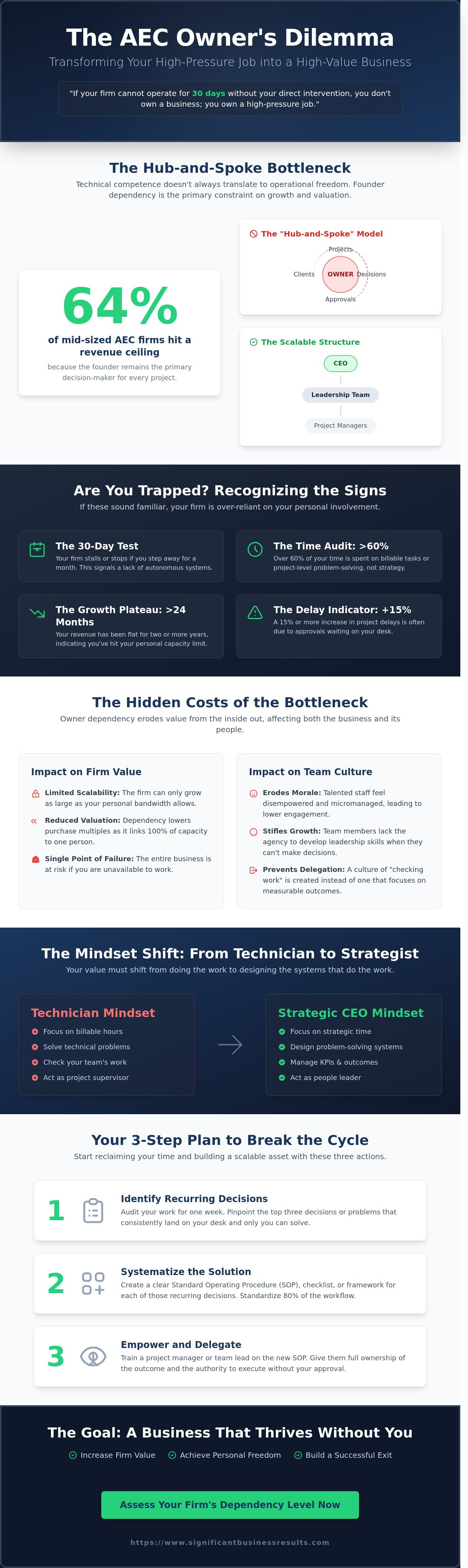
Many successful AEC firms operate on a "Hub-and-Spoke" model, where the owner is the central hub for every major decision, client issue, and quality check. While this ensures high standards initially, it creates a ceiling on growth. This is the Technical Expert Trap: your excellence in design, engineering, or construction becomes a barrier to scaling because the business cannot produce results beyond your personal capacity.
Signs that you’ve become the bottleneck include:
According to Architectural engineering principles, this is a well-documented area of ongoing research and practical application.
Constant Interruptions
Your team cannot move forward on projects without your direct input or approval.
Decision Fatigue
You spend your days putting out fires and making tactical choices instead of focusing on long-term strategy.
Stagnant Growth
Revenue plateaus because the firm’s output is limited by the number of hours you can work.
The first step is a mindset shift. You must transition from solving technical problems to designing systems that empower your team to solve them. This means valuing strategic thinking time as your highest-revenue activity. The critical question to ask is not "How can I fix this project?" but "How can I create a process so this problem doesn't happen again?" Learning how to reduce owner dependency is the first step toward reclaiming your freedom and unlocking your firm’s true potential.
Operational Excellence: Scaling Beyond Your Personal Capacity
Breaking free from the dependency trap requires building a robust operational structure that can function without your constant oversight. This isn’t about micromanaging; it’s about creating a culture of accountability and strategic alignment where your leadership team shares a unified vision for success.
Your role must evolve from "checking the work" to "managing performance." This is achieved by establishing clear Key Performance Indicators (KPIs) that allow you to gauge project health, team productivity, and financial stability at a glance. When your team knows what success looks like—and how it’s measured—they can manage their own activities to achieve the desired outcomes.
Research published by navigating the AEC talent cliff shows that this is a well-documented area of ongoing research and practical application.
A key part of this process is strengthening your middle management. Empower project managers to own the entire client relationship, including profitability and satisfaction. When they have true autonomy and are held accountable for results, you are freed up to focus on high-level strategy. This is the foundation of building a firm that thrives without you, transforming it from a reflection of your skills into a self-sustaining asset.
Future-Proofing the Firm: Building Value for a Successful Exit
Every step you take to solve your immediate AEC leadership challenges directly increases your firm's long-term value. Potential buyers and investors are not interested in a business that relies on a single person. They are acquiring a system—a predictable, profitable engine that will continue to run long after you’ve left. Reducing owner dependency is one of the most powerful ways to boost your company’s sellability.
The Value Builder System™ identifies eight key drivers of company value, and overcoming the "Hub and Spoke" model is central to this framework. By documenting processes, empowering your team, and ensuring client relationships are spread across your organization (known as The Switzerland Structure), you create a turnkey operation that commands a higher purchase multiple.
Your exit strategy isn’t a distant event; it begins today with your leadership style. By shifting from indispensable expert to strategic owner, you are not just preparing for a future sale—you are building a more resilient, profitable, and enjoyable business right now. This is the path to achieving true personal and financial freedom. To understand how your business currently stacks up, start by learning about the 8 key drivers that determine your company's value.
Ready to see if your firm is a scalable asset or a demanding job? Take the first step toward building a business that can run without you.
Take the Value Builder Assessment to discover your firm's hidden value and potential.
Frequently Asked Questions (FAQs)
How do I know if my AEC firm is too dependent on me?
Ask yourself this: could your firm operate successfully for 30 days without any contact from you? If the answer is no, you have an owner dependency problem. Other signs include being the final decision-maker on all proposals, handling all key client relationships personally, and having a team that waits for your direction.
What are the most common leadership mistakes in the construction industry?
A primary mistake is remaining in the "master technician" role for too long. Leaders who rose through the ranks often struggle to delegate meaningful authority, preferring to solve problems themselves rather than coaching their team. This caps growth and leads to burnout.
Can I really scale an architecture firm without being involved in every project?
Absolutely. Scaling requires you to shift your focus from project design to business design. Your role is to create repeatable systems for marketing, sales, project management, and quality control that allow your team to deliver excellent results consistently without your direct involvement in every detail.
How does my leadership style affect the eventual sale price of my engineering firm?
Your leadership style has a direct and significant impact on your firm's valuation. A business that is highly dependent on you is seen as a major risk by potential buyers, which drastically lowers the sale price. A firm with a strong, autonomous leadership team and documented systems is a far more valuable and attractive asset.

Article by
Franne McNeal
Franne McNeal, President, Significant Business Results LLC has helped 885+ small business owners collectively create 15,000 jobs and nearly $11 billion in revenue. We help architecture, engineering, and construction industry business owners with $1M-$20M in annual revenue, improve revenue, performance and long-term value. We help owners build a business that runs without them & creates financial & personal freedom. Our clients focus their energy for action to achieve significant business results.