.png)
The AEC Guide to a Successful Internal Business Transition in 2026

For founders in the architecture, engineering, and construction (AEC) industry, the question of legacy is paramount. After decades of building a firm from the ground up, you face the critical challenge: How do you hand over your life’s work to key employees without losing the value you’ve painstakingly created? Many owners fear their business will collapse without their personal involvement, a concern that stalls progress and devalues the firm.
The solution lies in reframing the challenge. A successful internal business transition is an operational stress test, not just a financial transfer. It requires building a firm that functions independently of its founder. This guide provides a strategic framework to help you transition your AEC firm to the next generation, maximizing its value and ensuring operational continuity for years to come.
Understanding the Strategy of an Internal Business Transition
An internal business transition is the transfer of ownership to trusted insiders, such as family members or key employees. Unlike an external sale to a larger competitor, this path prioritizes legacy, culture, and continuity. It's about ensuring the firm you built retains its unique identity and continues to serve its clients with the same principles you established.
The primary challenge for AEC leaders is evolving the company from a "practice" led by a single principal to a "business" led by a capable team. This multi-year process requires a strategic shift that should begin long before you plan to exit, making the next few years critical for laying the groundwork.
According to Succession planning, this is a well-documented area of ongoing research and practical application.
The Benefits of Keeping it in the House
Choosing an internal transition offers distinct advantages for AEC firms, where relationships and specialized knowledge are the bedrock of success.
Preserving Firm Culture
You maintain the unique work environment and client relationships that define your brand.
Retaining Top Talent
It provides a clear and motivating career path for your most ambitious architects, engineers, and project managers.
Ensuring Project Stability
Continuity in leadership prevents disruption to existing project pipelines and long-term contracts.
The #1 Obstacle: High Owner Dependency
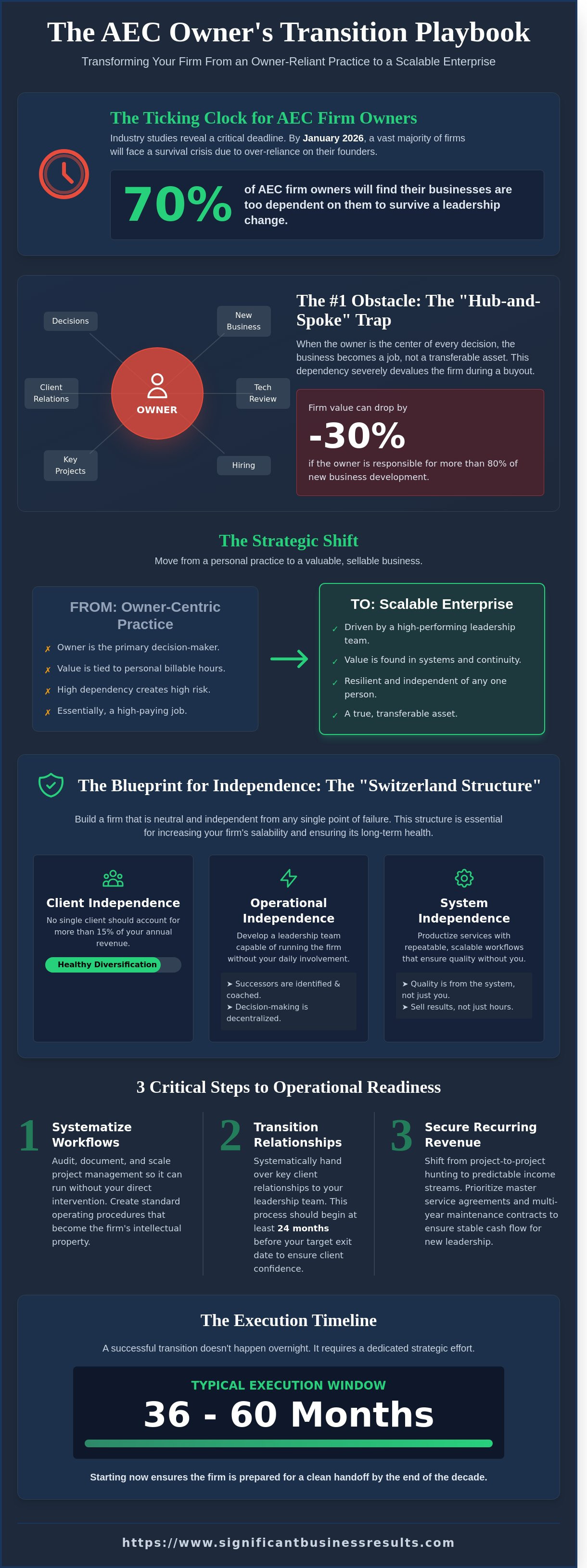
The single greatest threat to a successful internal transition is owner dependency. Many AEC firms operate in a "Hub-and-Spoke" model, where the founder is the center of every critical decision, client relationship, and new business opportunity. This structure may have fueled initial growth, but it severely devalues the firm during a buyout because the business cannot function without you.
When successors see that all value is tied to one person, they rightfully question what they are buying. Overcoming this dependency is the first and most crucial step in preparing your firm for a sustainable future. If you're the primary rainmaker, it's time to build a new system. For a deeper look at this challenge, explore our complete guide on how to reduce owner dependency.
Building a Firm That Runs Without You: The Operational Foundation
To make your firm truly sellable to an internal team, you must build it to run without you. This requires a systematic approach to operations, client management, and service delivery. We use frameworks like The Value Builder System™ to help owners focus on the 8 Key Drivers of Company Value, which provide a clear roadmap for increasing operational independence.
A core principle is creating what we call "The Switzerland Structure"—a business that is neutral and not reliant on any one client, employee, or supplier. For AEC firms, this also means diversifying revenue streams beyond project-based fees by incorporating recurring revenue models like maintenance contracts or master service agreements.
Research published by Internal Business Transition Steps shows that this is a well-documented area of ongoing research and practical application.
Step-by-Step Operational Readiness
Building a self-sustaining firm is a deliberate process. Start by focusing on these three areas:
Systematize Workflows
Audit your current project management and design processes. Document them meticulously so they are repeatable, scalable, and not dependent on your institutional knowledge.
Transition Key Relationships
Begin intentionally transferring primary client contact from yourself to your emerging leadership team. Allow them to lead meetings and become the face of the firm on key accounts.
Identify Hidden Risks
A business that runs on autopilot is a valuable one. Use a formal assessment to uncover operational gaps and dependencies you may not see. A Value Builder Score assessment provides an objective analysis of your firm’s readiness for a transition.
Productizing Your AEC Services
Shifting from "selling hours" to "selling results" is a powerful way to improve margins and make your services easier for a new leadership team to sell and deliver. By creating standard operating procedures (SOPs) for distinct phases of design and construction, you create a teachable, predictable system. This operational clarity is essential for a smooth handover. Remember this key insight: "A business that depends on the owner's presence is not an asset; it is a job."
Executing the Handover: Leadership Alignment and Significant Results
With a strong operational foundation in place, the final phase of an internal business transition focuses on leadership and strategy. This requires you to shift your own mindset from "Owner-Operator" to "Chairman." Your new role is to guide, mentor, and empower your successors, not to manage day-to-day operations.
Executive coaching and strategic planning are vital during this stage. They ensure your incoming team is prepared for the pressures of principal-level leadership and that both sides are fully aligned on the vision for the firm’s future. This alignment is critical for preventing friction and ensuring the transition stays on track.
The Human Element: Coaching and Masterminds
Technical expertise in architecture or engineering does not automatically translate to successful business ownership. Your successors need to develop the "soft skills" of leadership: effective delegation, holding teams accountable, and casting a compelling vision for the future. Peer-to-peer learning in a structured environment like an AEC Mastermind can accelerate this development, providing a confidential forum for new leaders to solve high-stakes challenges with guidance from experienced peers.
Finalizing the Strategic Roadmap
A successful handover doesn't happen overnight. It should be mapped out with a clear, strategic roadmap that spans three to five years.
Set Measurable Milestones
Define clear targets for the gradual transfer of operational control and ownership equity.
Ensure Financial Viability
Structure the buyout to ensure the firm has sufficient cash flow to fund the transition without compromising its ability to invest in growth.
Commit to the Plan
The final transition is the ultimate achievement of a significant business career, marking your success in building a lasting enterprise.
An internal business transition is your opportunity to secure your financial future while preserving the legacy you've built. By focusing on operational excellence and leadership development, you can confidently pass the torch to a new generation.

Article by
Franne McNeal
Franne McNeal, President, Significant Business Results LLC has helped 885+ small business owners collectively create 15,000 jobs and nearly $11 billion in revenue. We help architecture, engineering, and construction industry business owners with $1M-$20M in annual revenue, improve revenue, performance and long-term value. We help owners build a business that runs without them & creates financial & personal freedom. Our clients focus their energy for action to achieve significant business results.