.png)
The AEC Leader’s Guide: Business Decision Making Framework that Builds Value

As the owner of a growing Architecture, Engineering, or Construction (AEC) firm, you are the engine of its success. But if you are also the firm’s sole decision-maker, you have become its biggest bottleneck. Every choice, from project-level staffing to firm-wide strategy, lands on your desk, leading to decision fatigue and stalled growth. You’re trapped in a cycle where the business cannot function, let alone scale, without your constant input.
The solution isn’t to simply make decisions faster; it’s to build a system that empowers others to make them correctly. In the AEC world, your firm's value isn't ultimately built by the decisions you make, but by the business decision making framework you create that allows your team to make them. This guide provides a clear framework to help you move from Chief Problem Solver to strategic leader, building a valuable and autonomous firm.
The Owner’s Trap: When Your Expertise Limits Your Firm's Value
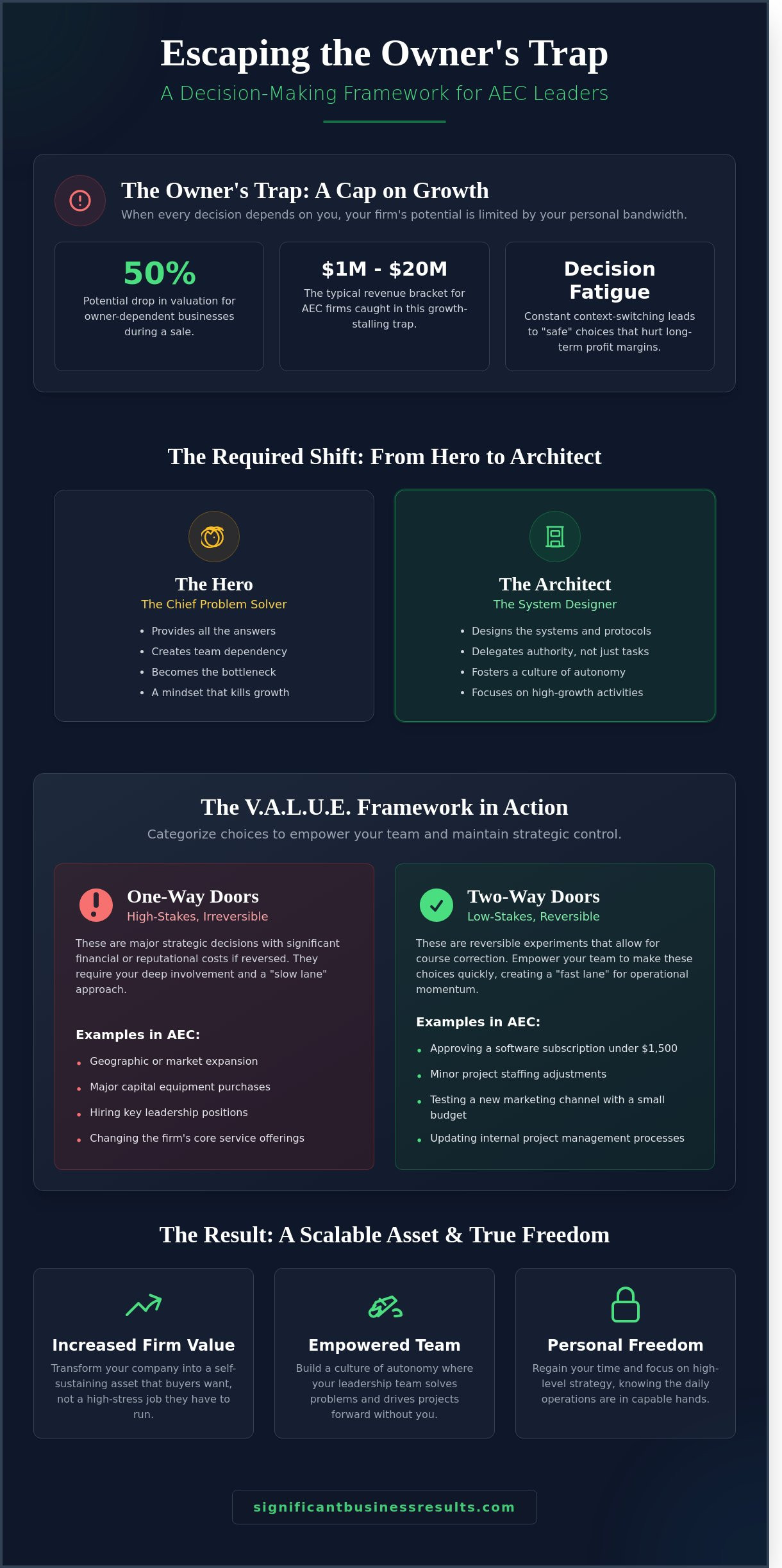
The "Owner's Trap" is a common reality in the AEC industry. It occurs when a firm's operations, client relationships, and critical choices are so dependent on the principal that the business is essentially a job, not a sellable asset. When you are the only person who can approve a major proposal, solve a complex engineering challenge, or authorize a significant expense, your firm's revenue is capped by your personal bandwidth.
This dependency has a direct and damaging impact on your firm’s valuation. A potential buyer isn't purchasing a business; they're purchasing a job that requires your specific expertise. To break this cycle, you must shift your mindset from being the hero who solves every problem to the architect of a system that runs without you. This begins when you create the systems that reduce owner dependency and cultivate a leadership team that can think for itself.
One-Way vs. Two-Way Doors: A Simple Filter for AEC Decisions
Not all decisions carry the same weight, yet many leaders treat them as if they do. This creates organizational paralysis. A simple and effective way to categorize choices is to think of them as "one-way" or "two-way" doors.
•
One-Way Doors: These are high-stakes, nearly irreversible decisions. In an AEC context, this includes choices like a merger, a major geographic expansion, or changing your firm’s core service offering. These decisions require deep involvement from the principal, extensive analysis, and strategic alignment. They should be made slowly and deliberately.
•
Two-Way Doors: These are reversible decisions. If the outcome is poor, you can "walk back through the door" without causing significant damage. Examples include selecting a vendor for a specific project, adopting a new software tool, or assigning project staff. These choices should be delegated to project managers and department heads, allowing your team to move quickly and develop their own judgment.
By explicitly labeling decisions this way, you signal to your team where they have autonomy, freeing you to focus only on the choices that truly shape the firm's future.
The V.A.L.U.E. Framework for Strategic Choices
To ensure decisions made at every level contribute to your firm’s growth, you need a shared logic. The V.A.L.U.E. framework is a business decision making framework tailored for scaling AEC firms. It acts as a filter to evaluate opportunities and challenges consistently.
•
V - Vision Alignment: Does this decision move us closer to our 3-year strategic goal? Every choice, from the projects you bid on to the people you hire, should reflect your firm’s core mission and vision. Strong strategic alignment prevents chasing short-term revenue at the expense of long-term identity.
•
A - Autonomy Impact: Does this decision make the firm more or less dependent on the owner? A choice that requires your unique skills creates a bottleneck. One that systematizes a process or empowers a team member builds a more resilient, independent company.
•
L - Leverage: Does this choice allow us to do more with our existing resources? Leverage can mean adopting technology that automates a process, developing a "productized" service from a custom one, or training a project manager to handle tasks you once owned.
•
U - Upside vs. Risk: Is the potential margin gain worth the professional liability? In the AEC world, this calculation is critical. A high-margin project with undefined scope and significant liability risk may be a poor strategic choice compared to a moderately profitable one with a clear, repeatable process.
•
E - Exit Readiness: Would a future buyer see this decision as a value-add or a liability? Decisions that create documented processes, diversified client rosters, and a strong management team all increase your firm’s multiple when it comes time to sell.
Building a Culture of Delegated Authority
A framework is only effective if your team is empowered to use it. This requires shifting from delegating tasks to delegating true decision-making authority. The key is to provide clear guardrails so your team can act with confidence.
Start by establishing a "Level of Authority" matrix. This document clearly defines who can make what decisions without seeking approval. For example, a Project Manager might have the authority to approve expenses up to $5,000, hire a subcontractor from an approved list, or adjust project timelines by one week. Anything beyond those limits requires escalation.
These "safe to fail" zones give your team the room to experiment and learn within boundaries that protect the firm from catastrophic risk. As you build this culture, coach your team to bring you solutions, not just problems. When a challenge arises, expect them to arrive with a recommended course of action, already vetted through the lens of the V.A.L.U.E. framework.
From Daily Choices to Long-Term Value
Implementing a structured business decision making framework transforms a chaotic, owner-dependent firm into a valuable, scalable asset. Every decision your team makes using this logic strengthens the systems that allow the business to run without you. This operational efficiency is directly tied to the multiple a buyer will one day pay for your firm.
The ultimate goal is to build a business that provides you with both financial and personal freedom. By moving from the primary decision-maker to the architect of the decision-making system, you create significant, lasting results. This journey is a core component of Scaling Your AEC Firm and achieving true independence.
Ready to build a firm that runs without you? Explore our Strategic Coaching services and learn how we help AEC owners build businesses that create freedom and value.

Article by
Franne McNeal
Franne McNeal, President, Significant Business Results LLC has helped 885+ small business owners collectively create 15,000 jobs and nearly $11 billion in revenue. We help architecture, engineering, and construction industry business owners with $1M-$20M in annual revenue, improve revenue, performance and long-term value. We help owners build a business that runs without them & creates financial & personal freedom. Our clients focus their energy for action to achieve significant business results.