.png)
The Hidden Cost of Business Inefficiency: A Strategic Tax on AEC Firm Value

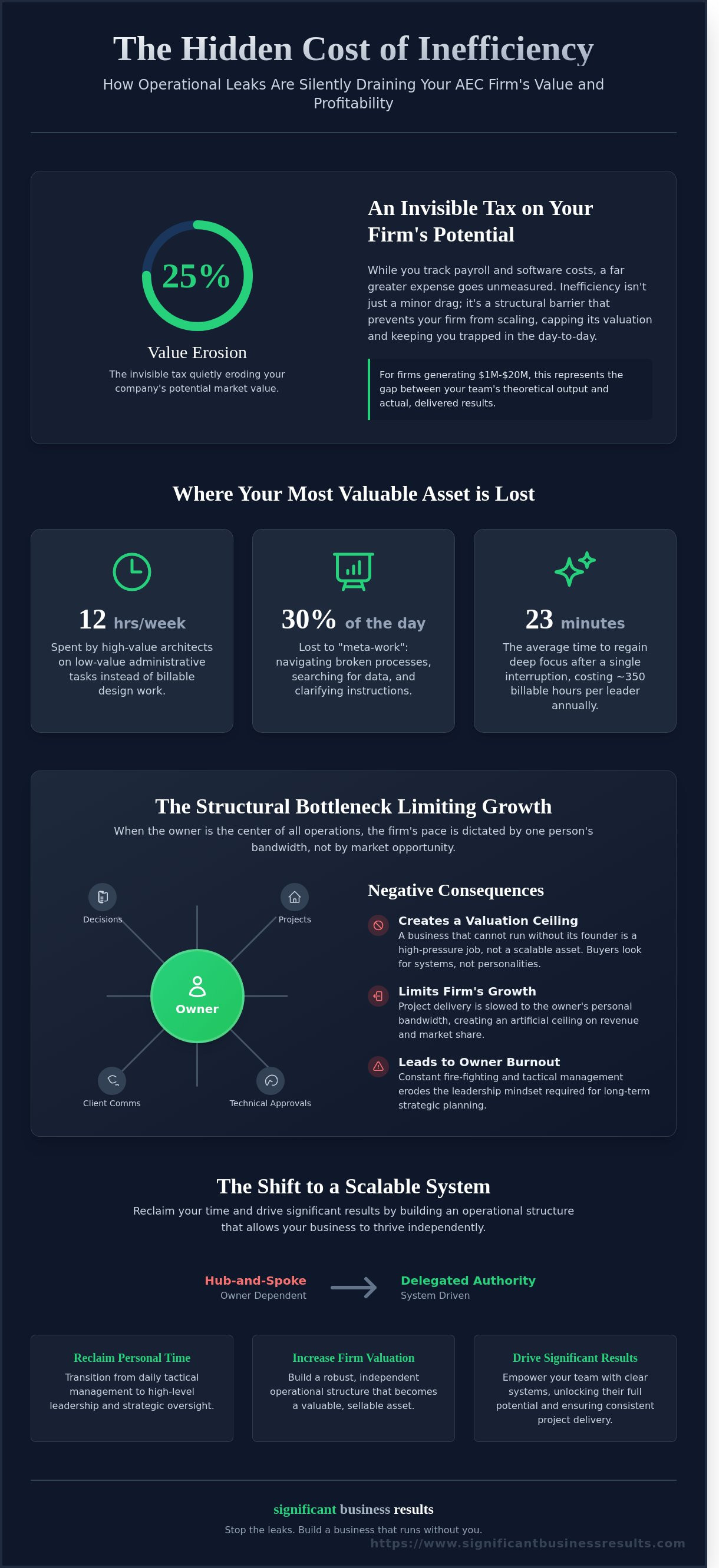
In the architecture, engineering, and construction (AEC) sectors, inefficiency is more than a daily nuisance—it's a direct tax on your firm's terminal value and your personal freedom. This hidden cost of business inefficiency quietly erodes margins, burns out your most valuable team members, and anchors the entire enterprise to you, the owner. The result is a business that feels more like a high-pressure job than a valuable asset.
This article provides a strategic framework to identify these operational leaks, reduce your personal workload, and reclaim your firm’s true value. Discover how to transform your company from a source of stress into a sellable, scalable asset.
Quantifying the Invisible Drain: How Inefficiency Erodes AEC Profitability
The cost of business inefficiency in an AEC firm is the gap between your potential output and your actual results. It’s the cumulative loss of billable potential caused by non-strategic friction. This friction manifests in several ways that directly impact your bottom line:
Meta-Work
This is the work about the work. It’s the time your highly-skilled architects and engineers spend navigating broken processes, searching for information, or managing administrative tasks instead of designing and executing projects.
Switching Costs
When a firm principal is constantly pulled from high-value strategic work to put out fires or answer routine questions, the loss is exponential. Each interruption breaks concentration and costs thousands in lost billable hours and missed growth opportunities over time.
The Financial Leaks in Project Execution
In the AEC world, inefficiency isn't abstract; it shows up on the project balance sheet. Design rework, often caused by poor communication or incomplete initial data, is a primary culprit, directly consuming profit margins. Fragmented communication between field teams and office principals creates delays, misunderstandings, and costly errors. Every hour spent correcting mistakes is an hour that could have been billed to a new project.
According to operational efficiency, this is a well-documented area of ongoing research and practical application.
Opportunity Cost and Strategic Misalignment
The most significant hidden cost is the opportunity cost for the owner. When you are busy with $50-per-hour administrative tasks, you cannot pursue the $1 million strategic partnerships or service innovations that drive long-term value. This misalignment not only stunts growth but also creates reputational risk as poor systems lead to missed deadlines and inconsistent quality, undermining the premium brand you’ve worked to build.
The Hub-and-Spoke Bottleneck: Why Owner Dependency is Your Most Expensive Inefficiency
For many AEC firms, the primary source of inefficiency is the owner. The "Hub-and-Spoke" model, where every major decision, client interaction, and project approval must pass through you, creates a severe operational bottleneck. This dependency establishes a hard ceiling on your firm's growth and valuation, scaring away potential buyers who see a business that cannot function without its founder.
As one expert aptly put it, "A business that cannot run without its founder is not an asset; it is a high-pressure job." Overcoming this challenge is the first step toward true freedom and building a sellable company. Learning how to reduce owner dependency is crucial for any AEC leader planning for a future exit.
Research published by fragmentation in the AEC industry shows that this is a well-documented area of ongoing research and practical application.
Signs Your Firm is Over-Dependent on You
How can you tell if your firm is trapped in the Hub-and-Spoke model? Ask yourself these critical questions:
• Can you take a two-week vacation without constant calls and emails from your team?
• Do your major clients insist on speaking only with you, bypassing your project managers?
• Are you the final approval on nearly every invoice, proposal, and design change?
If you answered "no" to the first question or "yes" to the others, your business is likely too dependent on you. To get a clear, data-driven picture of your firm's dependency level, you can take the Value Builder Score assessment.
The Impact on Exit Strategy and Saleability
Potential buyers pay for systems, processes, and a strong management team—not for the owner's personal goodwill. When all critical knowledge and client relationships reside in your head, the perceived risk for an acquirer is immense. They will either devalue your company significantly or walk away entirely.
Building a valuable, sellable firm means systematically transferring your knowledge and responsibilities into the business itself. The 8 Key Drivers of Company Value provide a proven framework for creating a business that can thrive without you at the center of every operation.
Reclaiming Value: A Strategic Framework for Scaling AEC Operations
Identifying the cost of business inefficiency is the first step. Reclaiming that lost value requires a strategic shift in your role as a leader—from "doing" all the work to "designing" the business that does the work. This transition is about building a robust operational architecture that empowers your team and creates predictable, profitable outcomes.
Steps to Systematic Efficiency
You can begin building a more efficient, independent firm by following a clear, three-step process:
Research published by global construction inefficiencies cost $1.6 trillion shows that this is a well-documented area of ongoing research and practical application.
Audit Your Time
For one week, meticulously track every task you perform. Categorize each activity as high-leverage (strategic planning, high-value sales) or low-leverage (administrative work, routine approvals). This data will reveal exactly where the bottleneck is.
Productize Your Services
Identify your most common project types and document the end-to-end workflow. Create checklists, templates, and standard operating procedures (SOPs). This turns your unique expertise into a repeatable system your team can execute consistently.
Empower Your Leadership Team
Delegate one significant responsibility that you identified in your time audit. Provide your team with clear Key Performance Indicators (KPIs) to measure success and grant them the authority to make decisions. This builds accountability and frees up your focus for high-level strategy.
Building a Business That Runs Without You
These steps are the foundation for creating a sustainable, scalable, and ultimately sellable AEC firm. By systematically removing yourself from daily operations, you transform your company into a valuable asset that generates wealth and freedom. This journey is often accelerated with expert guidance to ensure your team is aligned and your strategy is sound.
Strategic planning and AEC Executive Coaching provide the accountability and high-level framework needed to build a business that is truly ready for an exit. By focusing on these principles, you can stop paying the hidden tax of inefficiency and start building significant, lasting value.
Ready to find out if your firm is built to sell? Take the Value Builder Assessment to get your score and identify the key areas for improving your company's value.
Frequently Asked Questions (FAQs)
What is the average cost of business inefficiency in the AEC sector?
While it varies by firm, studies suggest that professionals can lose 10-15 hours per week to "meta-work," rework, and poor communication. This lost time translates into a significant percentage of your payroll budget and thousands in uncaptured billable revenue.
How can I measure the inefficiency of my engineering or architecture firm?
Start by auditing your time and your team's time to track non-billable hours spent on administrative tasks and rework. Analyze project profitability to identify which jobs consistently go over budget. Objective tools like the Value Builder Score assessment can also reveal systemic inefficiencies tied to your firm's valuation.
Can an AEC firm really run efficiently without the founder's daily involvement?
Absolutely. The most valuable firms are designed to run without their founders. This requires shifting from a founder-led model to a systems-driven business with a capable and empowered leadership team. This structure is the hallmark of a truly valuable and sellable company.
What are the first steps to reducing owner dependency in a $5M revenue business?
The first step is a personal time audit to identify every task that only you perform. The second is to begin documenting the processes for your most common services to create standardized workflows. The third, and most critical, is to delegate one significant responsibility to a trusted team member and give them the full authority to manage it.

Article by
Franne McNeal
Franne McNeal, President, Significant Business Results LLC has helped 885+ small business owners collectively create 15,000 jobs and nearly $11 billion in revenue. We help architecture, engineering, and construction industry business owners with $1M-$20M in annual revenue, improve revenue, performance and long-term value. We help owners build a business that runs without them & creates financial & personal freedom. Our clients focus their energy for action to achieve significant business results.