.png)
The Hidden Cost of Business Inefficiency: A Strategic Tax on AEC Firm Value

For owners of architecture, engineering, and construction (AEC) firms, inefficiency feels like a constant, low-grade headache. It's the project that needs extra oversight, the principal engineer bogged down in administrative tasks, or the client call you feel only you can handle. But this operational friction is more than a daily nuisance. The true cost of business inefficiency is a hidden tax that silently erodes your profitability, handcuffs your freedom, and ultimately suppresses your firm's total value.
This isn't just about lost hours; it's about lost opportunity. It's the gap between your firm's actual performance and its true potential. When you understand how to identify and plug these leaks, you don’t just improve margins—you begin building a valuable, sellable asset.
Quantifying the Invisible Drain: How Inefficiency Erodes AEC Profitability
In the AEC sector, inefficiency is the cumulative loss of billable potential due to non-strategic friction. It’s the "meta-work"—the work about the work—that forces your highly-skilled team to navigate broken processes instead of designing, building, and managing projects. Every time a principal is pulled from a high-value design task to approve a minor expense, the switching cost can translate to thousands in lost billable time and delayed project timelines.
The Financial Leaks in Project Execution
The most visible costs of inefficiency appear directly on your project balance sheets. These leaks, while common, are not unavoidable:
According to Operational Efficiency, this is a well-documented area of ongoing research and practical application.
Design Rework
Miscommunications or flawed data early in a project can lead to costly revisions, directly impacting profit margins and client satisfaction.
Fragmented Communication
When information isn't flowing seamlessly between the field and the office, decisions are delayed, mistakes are made, and projects stall.
Talent Misallocation
Paying a senior architect's salary for them to spend hours on administrative work is a direct drain on your firm’s financial resources and a surefire path to burnout.
Opportunity Cost and Strategic Misalignment
The less obvious, yet more significant, cost is the opportunity cost. Every hour an owner spends on $50/hour tasks is an hour they are not spending on securing a $1M strategic partnership or developing a new, high-margin service line. Poor systems create constant fire-fighting, which not only damages your reputation through missed deadlines but also keeps you, the leader, trapped in the day-to-day operations, preventing you from steering the ship.
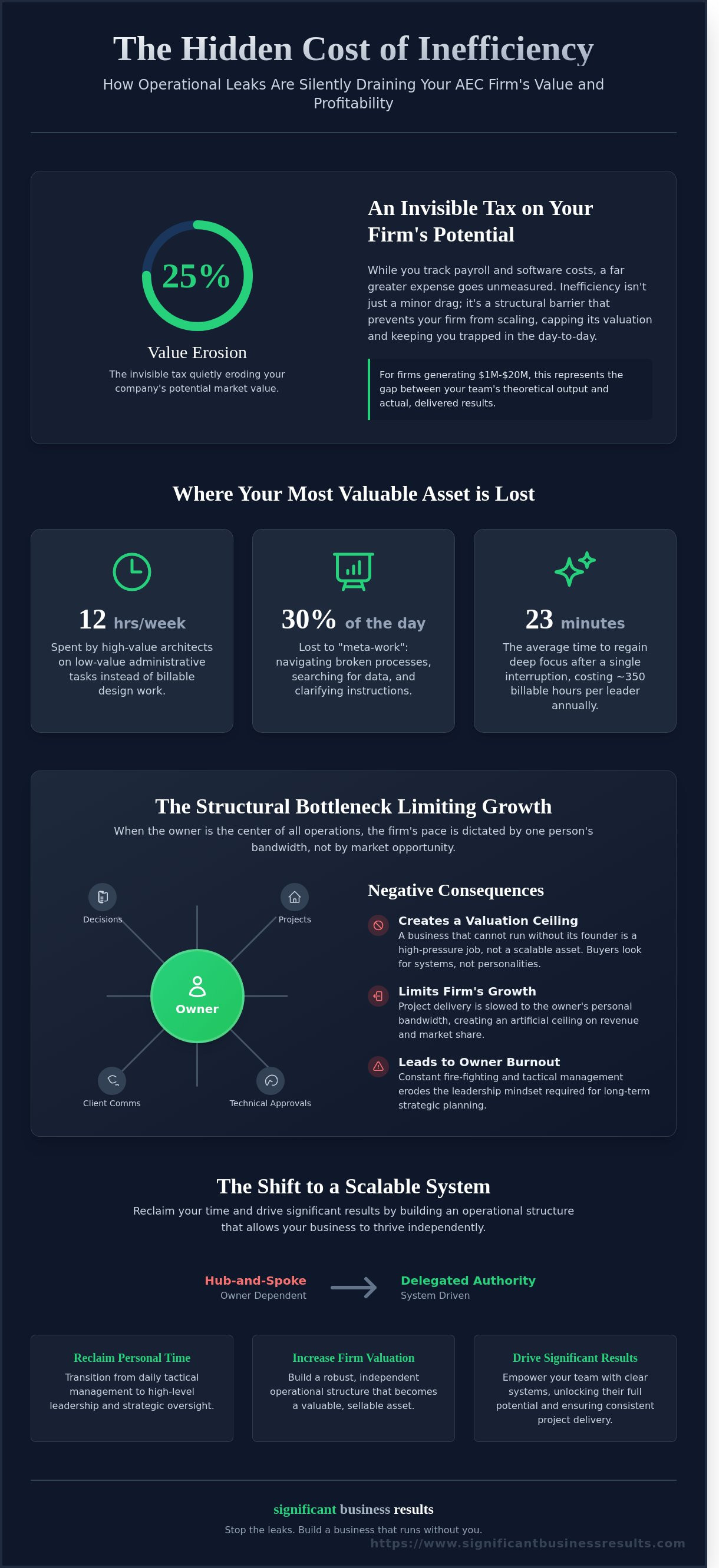
The Hub-and-Spoke Bottleneck: Why Owner Dependency is Your Most Expensive Inefficiency
For many AEC firms, the primary source of inefficiency is the founder themselves. In a "Hub-and-Spoke" model, every major decision, client interaction, and workflow must pass through the owner. While this feels like quality control, it actually creates a valuation ceiling that scares away potential buyers. A business that cannot run without its founder is not a sellable asset; it is a high-pressure job. This dependency leads to owner burnout and prevents a true leadership team from developing.
Signs Your Firm is Over-Dependent on You
How do you know if you are the bottleneck? Ask yourself these critical questions:
Research published by cost of bad data in construction shows that this is a well-documented area of ongoing research and practical application.
• Can you take an uninterrupted two-week vacation without the business stalling or key decisions being put on hold?
• Do your most important clients insist on speaking only with you, refusing to work with your senior team members?
• Are you still the primary reviewer for the majority of proposals and project deliverables?
If you answered "no" or "yes" in the ways that concern you, it's a strong indicator of high owner dependency. To see how your firm scores on this and other key metrics, you can take the Value Builder Score assessment.
The Impact on Exit Strategy and Saleability
Potential buyers are not looking to buy themselves a job. They are acquiring a system—a well-oiled machine that generates predictable profits. When all the processes, client relationships, and strategic knowledge reside solely in the owner's head, the perceived risk is too high. This reality is reflected in the 8 Key Drivers of Company Value, a framework where systems and independence are paramount. Reducing owner dependency is not just about getting your time back; it's about fundamentally increasing what your business is worth. For more on this, see our guide on how to reduce owner dependency.
Reclaiming Value: A Strategic Framework for Scaling AEC Operations
Addressing the cost of business inefficiency requires a strategic shift from "doing" all the work to "leading" the organization. This involves designing the systems and empowering the people that allow your firm to scale beyond you. It’s about building a sustainable structure that produces consistent results, whether you are in the office or not.
Steps to Systematic Efficiency
Breaking the cycle of dependency and inefficiency starts with a clear, deliberate plan. Here are three actionable steps you can take:
Audit Your Time
For one week, meticulously track your activities. Identify every task that could be delegated, automated, or eliminated. This data provides an undeniable look at where your highest value is—and is not—being spent.
Productize Your Services
Document the process for your most common project types from start to finish. Creating a standardized playbook for recurring services ensures quality, consistency, and profitability, and it makes it easier for your team to execute without your direct input.
Empower Your Leadership Team
Define clear roles, responsibilities, and key performance indicators (KPIs) for your senior staff. Give them the authority to make decisions and hold them accountable for the results. A strong leadership team is the foundation of a self-sustaining business.
Building a Business That Runs Without You
Ultimately, transforming your firm from a founder-dependent practice into a valuable, independent entity is a journey of strategic leadership. It requires a dedicated focus on building systems, aligning your team, and preparing the business for a future where it can thrive on its own. Through structured AEC executive coaching and strategic planning, you can create the operational excellence that delivers not only significant business results but also the personal freedom you've earned.

Article by
Franne McNeal
Franne McNeal, President, Significant Business Results LLC has helped 885+ small business owners collectively create 15,000 jobs and nearly $11 billion in revenue. We help architecture, engineering, and construction industry business owners with $1M-$20M in annual revenue, improve revenue, performance and long-term value. We help owners build a business that runs without them & create financial & personal freedom. Our clients focus their energy for action to achieve significant business results.