.png)
The Strategic Timeline for Selling an Engineering Firm: A Multi-Year Roadmap

Many engineering firm owners believe selling their business is a straightforward, six-month transaction handled by a broker. This common misconception often leads to disappointing offers or failed deals. The reality is that a high-value exit is not a transaction; it is the result of a multi-year strategic evolution. To command your firm’s maximum market price, you must shift your mindset from "selling" to "building a sellable asset." This roadmap outlines the realistic timeline for selling an engineering firm, focusing on the critical preparation that makes all the difference.
The Value-Building Phase: 12 to 36 Months Before the Sale
The most critical work happens long before your firm is ever listed for sale. This 1-to-3-year period is the difference between a fire sale and a premium exit. Instead of just running your business, your focus must shift to systematically increasing its value. This involves cleaning up your financial reports to present a clear picture of profitability (recast EBITDA) and, most importantly, implementing systems that allow the firm to operate efficiently without your daily intervention.
Reducing Owner Dependency to Command a Premium
In the AEC industry, many firms fall into the "Hub and Spoke" trap, where every major decision, client relationship, and project detail flows through the owner. This high dependency is a major risk for potential buyers and significantly lowers your company's value. To command a premium, you must prove the firm is a self-sustaining asset. The key steps include:
According to Mergers and Acquisitions Process, this is a well-documented area of ongoing research and practical application.
Identify Operational Gaps
A business is less valuable if it can't function without its owner. A formal assessment can pinpoint exactly where your business relies too heavily on you. The Value Builder Score is designed to identify these specific operational gaps, giving you a clear path for improvement.
Develop a Second Tier of Leadership
Actively train and empower a management team to handle key client relationships and oversee project delivery. A buyer is acquiring your team and systems, not just your personal book of business.
Systematize Your Processes
Document your firm’s core processes for everything from project management to business development. This demonstrates that your results are repeatable and not dependent on your individual expertise.
Strengthening Your Recurring Revenue and Backlog
Buyers pay a premium for predictability. A firm that relies on a constant churn of one-off projects is viewed as riskier than one with a stable, predictable future. To increase buyer confidence and your valuation, focus on:
Securing Master Service Agreements
Shift your business model from single projects to long-term service agreements or retainer-based consulting. This creates a foundation of recurring revenue that buyers love to see.
Building a Healthy Backlog
A strong and predictable project backlog provides clear evidence of future revenue, making your firm a much more attractive and less risky acquisition target.
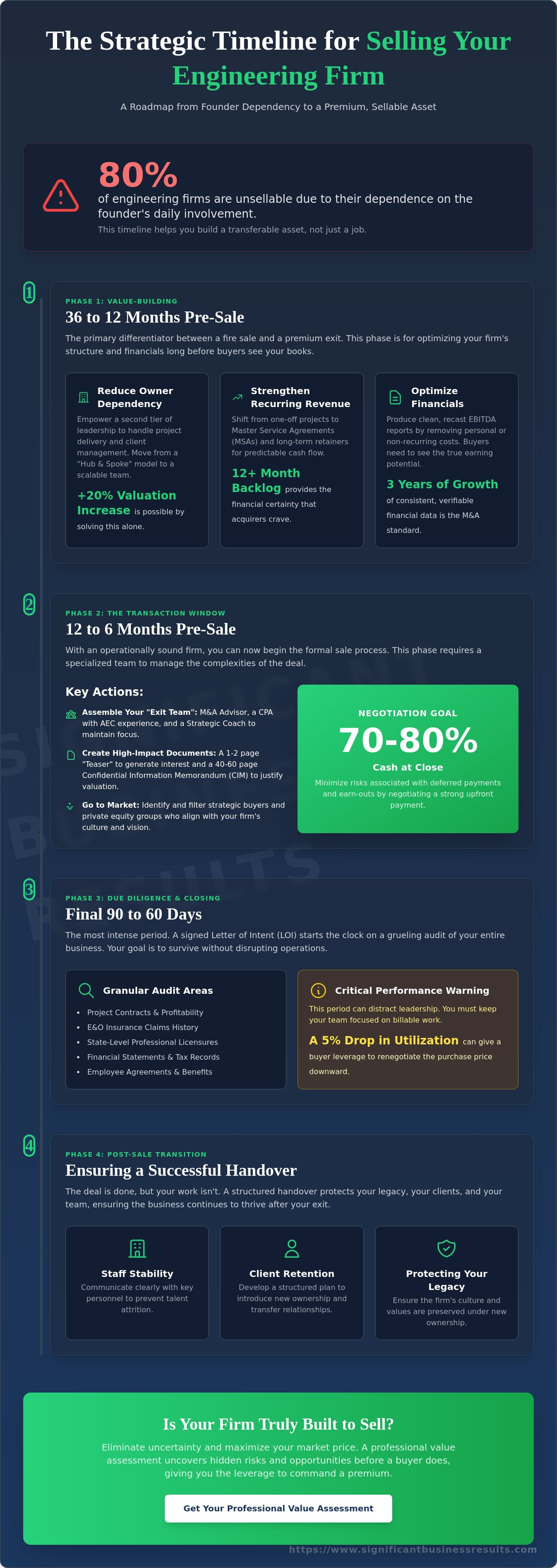
The Transaction Window: Navigating the 6 to 12 Month Sale Process
Once your firm is a well-oiled machine that no longer depends on you, you can enter the active selling phase. This 6-to-12-month window is when you assemble your "Exit Team"—an M&A advisor, a CPA, and a strategic coach—to guide you through the complexities of the deal. Your team will help create the marketing documents, such as a "Teaser" and a Confidential Information Memorandum (CIM), to present to potential buyers. After identifying and vetting buyers, you will eventually negotiate a Letter of Intent (LOI), which starts a 60-90 day clock for the intense due diligence period.
Survival Guide for Due Diligence in Engineering Firms
Due diligence is where deals often fall apart. For engineering firms, buyers will conduct a deep dive into your project contracts, professional liability (E&O) insurance, and state licensure compliance. Preparation is non-negotiable. You must have your documentation organized and ready for scrutiny. A critical challenge during this time is keeping your team focused on billable work and maintaining business momentum while you manage the sale behind the scenes. This is where a strong second-tier leadership team proves its immense value.
Research published by Preparing Your Business for Sale shows that this is a well-documented area of ongoing research and practical application.
The Post-Sale Transition: Ensuring a Successful Handover
Selling your firm doesn’t mean you can walk away the day the deal closes. Most AEC sales include a 1–3 year transition period where you, the former owner, stay on to ensure a smooth handover of client relationships and institutional knowledge. This period is often tied to an "earn-out," a portion of the purchase price you receive only if the firm hits specific performance targets post-sale. Your role will shift from owner to consultant, and successfully navigating this cultural change is key to securing your full purchase price and protecting your legacy.
Managing the Earn-Out and Integration Period
The success of your earn-out depends on the continued performance of the business. Common milestones for engineering firms are tied to revenue targets, profit margins, or the retention of key staff and clients. Your ability to collaborate with the new ownership and guide your team through the transition will directly impact your final financial outcome. The ultimate goal is to leave behind a firm that continues to thrive, solidifying your legacy and allowing you to confidently step into your next act.
Achieving a high-value exit requires a long-term, strategic approach. By focusing on building a valuable, independent business first, you set the stage for a successful transaction that rewards you for years of hard work. To understand your firm's current sellability and get a personalized roadmap for improvement, start with a comprehensive assessment.
Take the Value Builder Assessment to see how sellable your firm is today.
Frequently Asked Questions
How much is my engineering firm worth?
The value of an engineering firm is typically a multiple of its EBITDA (Earnings Before Interest, Taxes, Depreciation, and Amortization). This multiple is influenced by factors like owner dependency, recurring revenue, and the strength of your management team. For a detailed breakdown, see our guide on how to value an engineering firm.
Can I sell my engineering firm in less than six months?
While a transaction can technically close in six months, a rushed sale of an unprepared business almost always results in a significantly lower price. A strategic timeline allows you to address weaknesses and maximize value, leading to a much better financial outcome.
What is the most common reason engineering firm sales fail?
The most common reason is high owner dependency. If the business cannot operate, maintain client relationships, and generate revenue without the founder, buyers see it as too risky. Other common reasons include messy financial records discovered during due diligence and a lack of a strong leadership team.
What is an earn-out in an engineering firm sale?
An earn-out is a portion of the sale price that is paid to the seller after the closing, contingent upon the business achieving certain performance goals. It is used by buyers to mitigate risk and ensure the seller is motivated to help the company succeed during the transition period.

Article by
Franne McNeal
Franne McNeal, President, Significant Business Results LLC has helped 885+ small business owners collectively create 15,000 jobs and nearly $11 billion in revenue. We help architecture, engineering, and construction industry business owners with $1M-$20M in annual revenue, improve revenue, performance and long-term value. We help owners build a business that runs without them & create financial & personal freedom. Our clients focus their energy for action to achieve significant business results.