.png)
What Is My Architecture Firm Worth? A Strategic Guide for AEC Owners

As an architecture firm owner, you’ve poured years of dedication into building a portfolio and a reputation. But when you step back and ask, "What is my architecture firm worth?" the answer is often more complex than a simple look at your balance sheet. The real value isn't just in the projects you've completed; it's in the business you've built—specifically, how well it can thrive without you at the center of every decision.
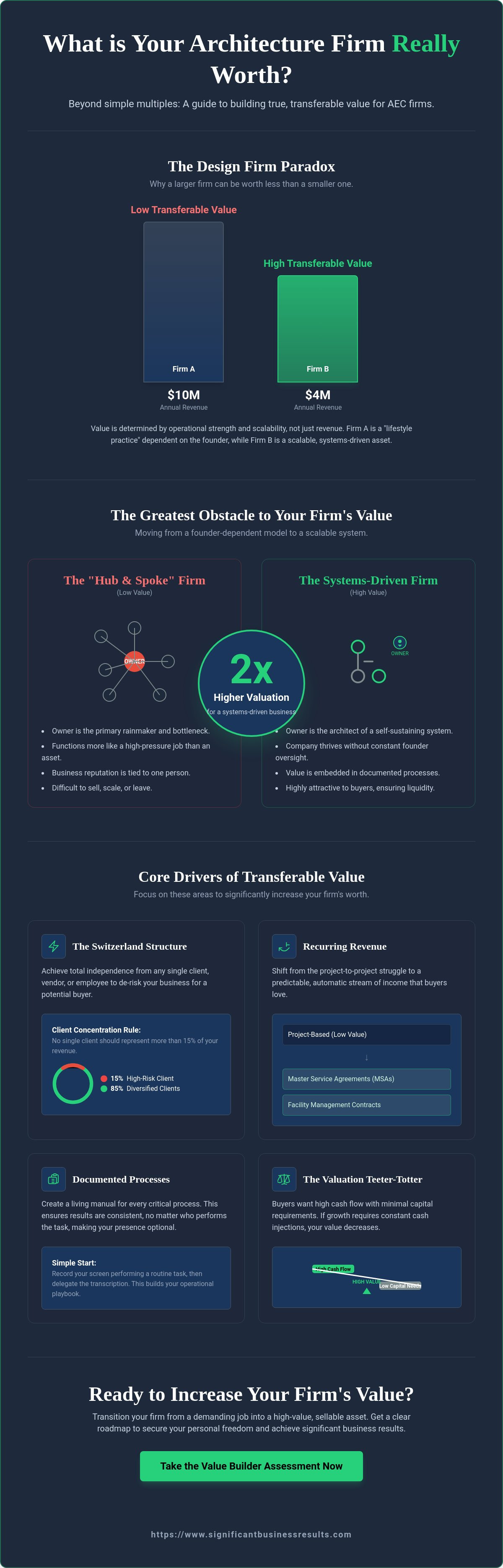
Many owners fall into the "Design Firm Paradox": they generate significant revenue but have a low market value because the firm’s success is tied directly to their personal involvement. To build true, transferable value, you must shift your perspective. Think of valuation not as a one-time event for a future sale, but as a continuous diagnostic tool that measures your firm's health and sustainability today.
Understanding Architecture Firm Valuation: More Than Just a Number
When most people think of business valuation, they turn to standard financial formulas. You’ve likely heard of multiples like 1.5x book value or 4-6x EBITDA (Earnings Before Interest, Taxes, Depreciation, and Amortization). While these numbers provide a baseline, they fail to capture the full picture for a service-based business like an architecture firm.
Why? Because an architecture firm's most significant assets aren't on the balance sheet. They are intangible—your team's expertise, your client relationships, and your pipeline of future work. A potential buyer, whether an external company or an internal leadership team, is purchasing future profits, not past performance. This is where the concept of transferable value becomes critical. It’s the value of your firm that can be successfully transferred to a new owner, independent of your personal brand and effort.
According to Business valuation, this is a well-documented area of ongoing research and practical application.
This distinction is crucial. A firm that relies entirely on its founder for business development might have strong cash flow, but it has very low transferable value. If you leave, the rainmaking stops, and the profits disappear. This is why understanding the underlying drivers of value is far more important than memorizing a specific multiple.
The 8 Drivers That Determine Your Firm’s Transferable Value
To move beyond simple accounting, we use The Value Builder System™ to analyze the eight core drivers that determine a company's true worth. For AEC owners, a few of these drivers are particularly critical because they directly combat the industry's tendency toward owner dependency.
Focusing on these areas will have the most significant impact on your firm’s valuation:
Research published by what your business is worth shows that this is a well-documented area of ongoing research and practical application.
The Hub & Spoke Model
This is the single biggest value killer for architecture firms. If you are the "hub" and all major clients, decisions, and projects run through you (the "spokes"), the business cannot function without you. A buyer sees this as a massive risk. To increase your firm’s value, you must systematically extract yourself from the daily operations. An actionable first step is to document your core processes—from client intake to project delivery—so they can be taught, delegated, and managed by your team. For a deeper dive, explore strategies on how to reduce owner dependency and reclaim your freedom.
The Switzerland Structure
How diversified are your revenue streams? If one client represents more than 15% of your total revenue, your firm is vulnerable. Losing that single client could be catastrophic, and a potential buyer will discount your valuation accordingly. Building a "Switzerland Structure" means ensuring you are not overly reliant on any one client, employee, or supplier. It creates a stable, resilient business that is far more attractive to an acquirer.
Recurring Revenue
Project-based work creates unpredictable cash flow. Firms with predictable, recurring revenue streams command higher valuations. For architecture firms, this doesn't have to mean a complete business model overhaul. It can be achieved through master service agreements, ongoing facility management contracts, or phased retainer-based consulting. These models provide financial stability and demonstrate long-term client loyalty.
A business that can run without its owner is not just a theory; it commands a valuation that can be twice as high as a similar-sized, founder-centric firm.
From Assessment to Action: How to Increase Your Firm’s Market Value
Knowing what your architecture firm is worth is only the first step. The real goal is to actively increase that value over time, turning your practice from a high-stress job into a sellable asset that provides financial and personal freedom.
This transformation requires a strategic shift from "doing" the work to "leading" the business. It involves empowering your leadership team, refining your operational systems, and preparing the firm for its next chapter, whether that involves an internal transition or an external sale.
Strategic Steps to Build a More Valuable Firm
Establish a Baseline
You cannot improve what you don’t measure. The first step is to get an objective assessment of your firm's current value based on the eight key drivers. This provides a clear roadmap, highlighting your strengths and identifying the areas that need immediate attention.
Align Your Leadership Team
Building a self-sustaining firm is a team sport. Your key employees need to be aligned with the long-term vision. Through executive coaching and strategic planning, principals learn to delegate effectively and lead their departments, reducing the firm's reliance on a single owner.
Develop a Succession Plan
An exit strategy is not the same as a succession plan. An exit strategy is an event; a succession plan is a process of developing the next generation of leaders to ensure the firm's legacy and continued success. This long-term thinking is essential for maximizing value during any transition.
Ultimately, the worth of your architecture firm is a direct reflection of the strength and independence of the business you've built. By focusing on reducing owner dependency and strengthening your operational systems, you create a valuable, transferable asset that secures your financial future and solidifies your legacy.
Ready to discover how your firm scores on the eight key drivers of value? Take the first step toward building a more valuable business today.
Get Your Value Builder Score Today

Article by
Franne McNeal
Franne McNeal, President, Significant Business Results LLC has helped 885+ small business owners collectively create 15,000 jobs and nearly $11 billion in revenue. We help architecture, engineering, and construction industry business owners with $1M-$20M in annual revenue, improve revenue, performance and long-term value. We help owners build a business that runs without them & create financial & personal freedom. Our clients focus their energy for action to achieve significant business results.