.png)
Why Construction Business Sales Fail: Common Pitfalls and How to Build Transferable Value

For many owners in the architecture, engineering, and construction (AEC) industry, selling their firm is the culmination of a lifetime’s work. Yet, a surprising number of these sales fail to cross the finish line, leaving owners with a devalued asset or no exit at all. The problem isn’t a lack of buyers or a weak market; it’s that many owners have spent decades building a high-paying job for themselves, not a transferable business asset.
A successful sale depends on one thing: transferable value. This is the value a business holds independent of its owner. It’s what a buyer is truly acquiring—a set of systems, a brand, and a team that can generate profit long after you’ve left. Here are the common reasons construction business sales fail and how you can start building a firm that’s truly built to sell.
The Invisible Obstacles That Derail a Sale
The most significant barriers to a successful sale are often the very things owners believe make their firm strong. These deep-rooted issues can make a business nearly impossible to transfer to a new owner.
The Founder-Dependency Trap
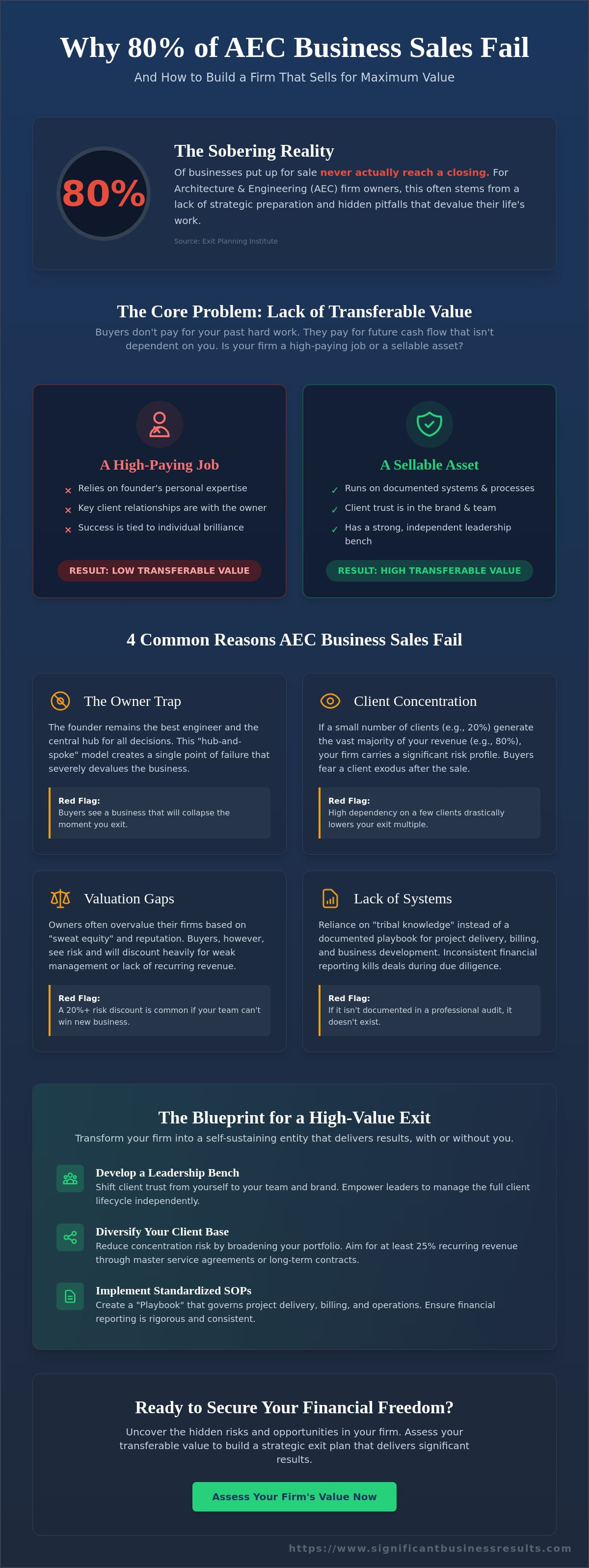
In the AEC world, expertise is everything. Many firm owners are the best architect, engineer, or project manager in the room. While this drives initial success, it creates a critical flaw known as the "Owner Trap." If you are the primary contact for key clients, the lead rainmaker for new business, and the final decision-maker on all major projects, the business cannot function without you.
According to common reasons for business failure, this is a well-documented area of ongoing research and practical application.
A potential buyer sees this not as a strength, but as a massive risk. They aren't buying your firm; they are buying your job. The moment you exit, the client relationships, operational knowledge, and strategic direction could exit with you. To build transferable value, you must systematically transition client trust from yourself to the firm and empower a leadership team to execute without your daily oversight. A business that runs on its own is a business a buyer can confidently acquire. For actionable steps, see our guide on how to reduce owner dependency.
Client Concentration and Revenue Risk
Another common pitfall is revenue concentration. Many successful AEC firms rely on a few large clients for the majority of their revenue—the classic 80/20 rule. While profitable, this model is fragile. A buyer will heavily discount your firm’s value if losing just one or two clients could cripple the business. They will question whether those key relationships are with you personally or with the firm. Diversifying your client base and service offerings demonstrates stability and makes your revenue streams more predictable and, therefore, more valuable.
Strategic Missteps During the Sale Process
Even a fundamentally sound business can fail to sell if the owner is unprepared for the realities of the transaction process. A significant gap often exists between an owner's perception of value and the market's assessment.
The Gap Between Perception and Market Reality
AEC owners often value their firm based on "sweat equity"—the years of hard work, personal sacrifice, and industry reputation they've built. A buyer, however, values it based on a cold, hard calculation of future cash flow and risk, typically a multiple of EBITDA (Earnings Before Interest, Taxes, Depreciation, and Amortization). Your firm’s true worth isn’t just about its balance sheet; it's about its ability to generate future profits without you. If you're unsure what your architecture firm is worth, it's critical to get an objective view long before you plan to sell.
Lack of Repeatable Systems
During due diligence, a buyer will scrutinize every aspect of your operations. If your processes for project delivery, billing, and business development exist only in your head or as "tribal knowledge" among senior staff, you have a problem. Buyers look for a documented "playbook"—a set of standard operating procedures (SOPs) that ensures consistent, high-quality results regardless of who is in charge. Without documented systems, a buyer sees inconsistency and operational risk, which directly lowers the price they are willing to pay.
Building a Sellable AEC Firm: Your Path to a Significant Exit
The key to avoiding these pitfalls is to stop thinking like a principal and start acting like a strategic CEO. Your goal is to build a business that is sale-ready at all times, which requires a deliberate, multi-year effort focused on creating transferable value.
The first step is a mindset shift. Instead of being the central hub for all activity, your role is to build the systems and the team that make the business successful. This means delegating authority, investing in your leadership bench, and creating a culture of accountability. A structured approach like strategic planning is essential to making this transition effective.
To systematically increase your firm’s value, focus on the 8 Key Drivers of Company Value. This framework helps you identify and strengthen the specific areas that buyers scrutinize, such as your financial performance, growth potential, and customer satisfaction. By methodically improving your scores in these areas, you transform your practice into a turnkey asset that commands a premium valuation.
Preparing for a sale isn't a last-minute sprint; it's a marathon that should begin 2-3 years before your target exit date. By starting early, you give yourself time to fix operational weaknesses, document your processes, and prove that your firm can thrive without you at the helm. This is how you build a legacy that lasts and secure the financial freedom you deserve.
Frequently Asked Questions
Why do AEC firms often have lower valuations than other professional service businesses?
AEC firms typically suffer from higher owner dependency, project-based (non-recurring) revenue models, and significant client concentration risks. These factors increase the perceived risk for a buyer, which lowers the valuation multiple.
How long does it take to prepare an AEC business for a successful sale?
Ideally, you should begin preparing 24-36 months in advance. This provides enough time to implement new systems, develop a strong leadership team, and demonstrate a consistent track record of owner-independent performance to a potential buyer.
What is the most common reason a buyer walks away from an AEC deal?
The most common deal-killer is discovering during due diligence that the business is completely dependent on the owner. If a buyer concludes that key client relationships and operational knowledge will leave with the founder, the deal is often terminated.
Can I sell my firm if I am still the lead rainmaker for new business?
Yes, but your valuation will be significantly lower, and the deal structure will likely include a lengthy and restrictive earn-out. The goal is to build a marketing and sales system that generates leads and closes deals, proving the firm can grow without you.

Article by
Franne McNeal
Franne McNeal, President, Significant Business Results LLC has helped 885+ small business owners collectively create 15,000 jobs and nearly $11 billion in revenue. We help architecture, engineering, and construction industry business owners with $1M-$20M in annual revenue, improve revenue, performance and long-term value. We help owners build a business that runs without them & create financial & personal freedom. Our clients focus their energy for action to achieve significant business results.