.png)
How to Get a Construction Business Ready to Sell: A Strategic Guide for AEC Owners

For many owners in the Architecture, Engineering, and Construction (AEC) industries, the business they’ve built is their life’s work. But when it’s time to consider an exit, they face a difficult reality: the company’s value is intrinsically tied to their personal involvement. A potential buyer doesn't want to purchase a job; they want to acquire a high-value asset that operates independently.
The key to a profitable sale is not finding the right buyer—it's building the right business. This guide outlines the strategic shifts required to transform your construction firm from an owner-dependent operation into a sellable, scalable asset that attracts premium offers.
Reducing Owner Dependency: The Foundation of a Sellable Construction Business
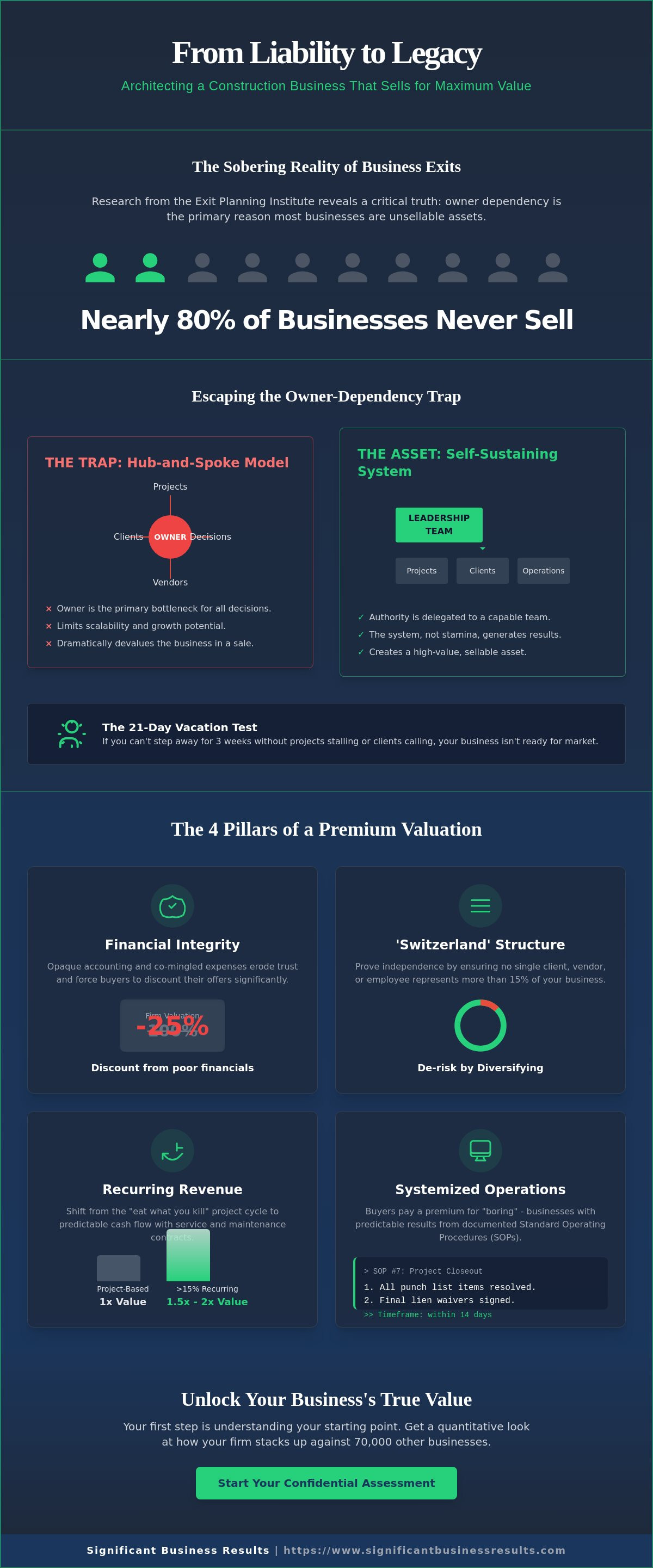
The single greatest obstacle to selling a construction business is owner dependency. If every major decision, client relationship, and project crisis requires your personal intervention, you've created a "Hub-and-Spoke" model. You are the hub, and without you, the wheels fall off. This structure dramatically devalues your firm in the eyes of a buyer.
To determine your level of dependency, consider the "Vacation Test": could you take a four-week, completely unplugged vacation without your business operations grinding to a halt? If the answer is no, it’s time to build systems that can run without you. This process begins with systematically removing yourself from the center of daily operations.
According to Business valuation, this is a well-documented area of ongoing research and practical application.
Delegate Key Decisions
Identify the top three decisions that always land on your desk. Create clear guidelines and empower your project managers or leadership team to make these calls independently. This builds their capabilities and demonstrates to a buyer that the business has a functioning command structure.
Transfer Relationships
Your long-standing relationships with clients and vendors are valuable, but they must belong to the company, not just to you. Strategically transition the ownership of these key accounts to your management team, ensuring that clients see the entire firm—not just the founder—as their partner.
Document Your Processes
What feels like intuition to you is a liability to a buyer. Document your core workflows, from bidding and project closeouts to client onboarding. Standardized, repeatable processes prove that your firm’s success is a result of a system, not just your personal craft. A business with predictable outcomes is a business that commands a premium. For more on this, read our guide on how to reduce owner dependency.
Maximizing Business Value Through the 8 Key Drivers
Once your business can function without you, the next step is to maximize its value. While clean financials are important, buyers are investing in future potential, not just past performance. The Value Builder System™ identifies 8 Key Drivers that holistically measure a company’s value and sellability. These drivers help you see your firm as an investor would.
For construction firms, two drivers are particularly critical for increasing valuation:
Research published by tax implications shows that this is a well-documented area of ongoing research and practical application.
The Switzerland Structure
This driver measures your company's independence from any single client, vendor, or employee. If more than 15% of your revenue comes from one client, you present a significant risk to a buyer. Diversifying your client base and cross-training employees on critical functions makes your business more resilient and, therefore, more valuable. The goal is to prove that the company’s stability isn't fragile.
Recurring Revenue
The traditional "bid-build" project cycle creates unpredictable cash flow. To increase your valuation multiple, focus on developing recurring revenue streams. This could involve offering ongoing maintenance contracts, service agreements, or phased inspection services. Predictable, contracted revenue provides a stable foundation for growth and is highly attractive to buyers who want to see a clear path to future profits.
Understanding how your business performs across all 8 Key Drivers is the first step in any serious exit strategy. It provides a clear roadmap of where to focus your efforts for the greatest return.
Executing Your Construction Business Exit Strategy: The Long View
Preparing a construction business for sale is not a last-minute task; it is a strategic initiative that should begin two to three years before you plan to go to market. This timeline gives you the runway to implement changes, measure their impact, and build a track record of strong, independent performance.
A central part of this long-term strategy is building a "management bench" that a buyer can trust to lead the company after you're gone. A strong, aligned leadership team is one of your most valuable assets. They are the proof that the business has a future beyond its founder.
Strategic Planning for a Successful Transition
Your role as the owner must shift from tactical fire-fighting to high-level strategic direction. This means empowering your team to handle daily operations while you focus on the initiatives that drive long-term value. A well-defined construction company succession plan is not just about choosing a successor; it’s about building an organization that is ready for new leadership.
Begin by identifying one or two key leaders who could potentially succeed you and start their formal development now. This preparation not only ensures a smooth transition but also gives a potential buyer confidence in the company's continuity and future growth.
Ultimately, a sellable construction business is the result of intentional design. By reducing your personal dependency, strengthening your value drivers, and preparing your team for the future, you create a valuable asset ready for a successful and profitable exit.
Ready to understand the true sellability of your business?
Get your Value Builder Score today to see how your construction firm measures up against the 8 Key Drivers of Company Value. It’s the first step toward building a business that can thrive without you.
Frequently Asked Questions (FAQs)
How do I value my construction company for sale?
Valuation is typically based on a multiple of your EBITDA (Earnings Before Interest, Taxes, Depreciation, and Amortization). However, this multiple is heavily influenced by factors like owner dependency, recurring revenue, and the strength of your management team. A formal business value assessment will provide the most accurate picture.
How long does it take to get a construction business ready to sell?
For optimal results, plan on a 2-3 year timeline. This allows you enough time to implement strategic changes, reduce owner dependency, strengthen your financials, and demonstrate a consistent track record of performance to potential buyers.
What is the most common mistake AEC owners make when selling?
The most common mistake is waiting too long to start planning. Many owners begin the process when they are already burnt out and want a quick exit, which forces them to sell an under-optimized business at a lower valuation.
Can I sell my construction business if it is still dependent on me?
Yes, but it will be more difficult and will sell for a significantly lower price. Buyers may require you to stay on for an extended "earn-out" period to transition relationships and knowledge, reducing your ability to make a clean break.

Article by
Franne McNeal
Franne McNeal, President, Significant Business Results LLC has helped 885+ small business owners collectively create 15,000 jobs and nearly $11 billion in revenue. We help architecture, engineering, and construction industry business owners with $1M-$20M in annual revenue, improve revenue, performance and long-term value. We help owners build a business that runs without them & create financial & personal freedom. Our clients focus their energy for action to achieve significant business results.