.png)
Strategic Planning for Engineering Companies: Building a Firm That Thrives Without You

For many engineering firm owners, "strategic planning" feels like a corporate exercise disconnected from the realities of project deadlines and client demands. You built your company on your technical expertise, and now you are the firm’s chief problem-solver. The challenge is that this position, while essential for day-to-day operations, is the primary obstacle to building long-term, sellable value.
The truth is, effective strategic planning for engineering companies is not about creating better project roadmaps. It is a deliberate process of transforming your business from a practice dependent on you into a valuable asset that can thrive without you. It is the bridge between your current operations and your future freedom.
Beyond Project Delivery: Redefining Strategic Planning for Engineering Leaders
Most engineering leaders are experts at planning projects. You excel at defining scopes, managing resources, and delivering high-quality technical work. However, this project-based mindset often fails to build a sellable business. Why? Because it keeps you trapped "working in the business" rather than "working on the business."
When you are the lead engineer, the final quality check, and the primary client relationship holder, you become a bottleneck. Your firm’s growth is limited by your personal capacity, and its value is directly tied to your presence. This is the Technical Expert Trap. Escaping it requires a fundamental shift: you must move from being the company’s most valuable employee to being its most valuable strategist.
According to Strategic planning, this is a well-documented area of ongoing research and practical application.
Strategic planning is the mechanism for this shift. It aligns your leadership, operations, and financial decisions toward a single goal: building a company that runs efficiently and profitably, independent of your daily involvement.
Reducing Owner Dependency to Scale Performance
A business that cannot function without its owner is a job, not an asset. To build real value, you must systematically delegate high-level responsibilities and create systems that empower your team. This begins with trusting your leadership team to make critical technical and operational decisions.
Consider implementing a "Switzerland Structure," where your firm is not overly reliant on any single employee, client, or supplier. Diversifying your revenue streams and client base makes your business more resilient and attractive to a potential buyer. The goal is to build a self-sustaining organization where processes, not people, drive results. For a deeper look at this process, explore our guide on how to reduce owner dependency.
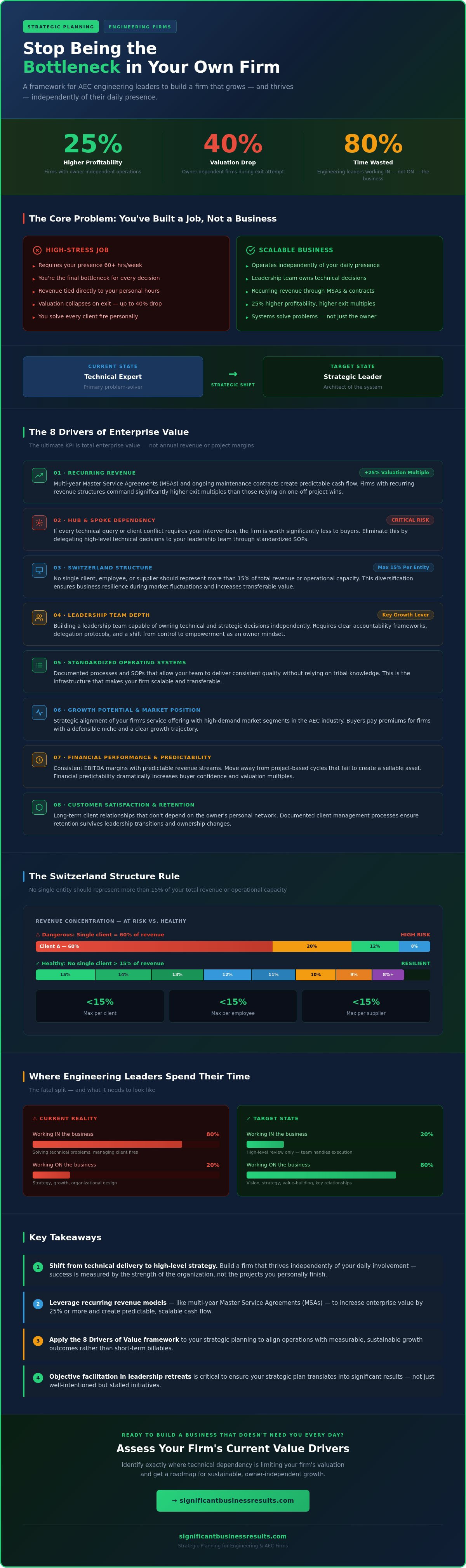
The 8 Drivers of Value: A Framework for Your Strategy
A successful strategic plan is measured by its impact on your company's value. The Value Builder System™ identifies eight key drivers that influence what your business is worth. For engineering firms, two are particularly critical: recurring revenue and your role as the "Hub and Spoke."
Your firm is worth significantly less if you are the "hub" and all decisions flow through you. A strategic plan must focus on building a management team and operational structure that can function independently.
Research published by ongoing organizational process shows that this is a well-documented area of ongoing research and practical application.
Simultaneously, developing recurring revenue models—such as maintenance contracts or master service agreements—creates predictable cash flow and increases your company's valuation. It moves you away from the uncertainty of a project-to-project existence. To see how your firm currently performs across all eight drivers, a business value assessment provides an essential benchmark.
Executing the Plan: From Retreats to Significant Results
A brilliant strategy is useless without disciplined execution. This is where most strategic plans fail. Engineering leaders often leave a planning retreat with renewed energy, only to be pulled back into the daily grind of project management. The plan gathers dust.
Successful implementation requires three key elements:
Research published by making of an integrated set of choices shows that this is a well-documented area of ongoing research and practical application.
Objective Facilitation
An external facilitator can challenge assumptions and ensure discussions stay focused on long-term value creation, not just short-term operational fixes.
Measurable Outcomes
Vague goals like "improve efficiency" are meaningless. A strong plan sets clear, quantifiable targets with defined timelines and assigns ownership to specific team members.
A Culture of Accountability
Your leadership team must own the outcomes of the strategic plan. This requires a culture where everyone is responsible for driving the firm toward its long-term goals.
By focusing on execution and fostering leadership team alignment, your strategic plan becomes a living document that actively increases your firm’s revenue and performance.
Frequently Asked Questions
What is the difference between a business plan and a strategic plan for an engineering firm?
A business plan is typically a static document used for startups or securing financing, outlining the company's structure, market, and financial projections. A strategic plan is a dynamic management tool for an existing business, focused on defining a long-term vision and outlining the specific actions needed to achieve goals related to growth, value, and owner independence.
How often should an engineering company update its strategic plan?
A comprehensive strategic plan should be developed every 3-5 years. However, it should be reviewed and adjusted annually, or even quarterly, to adapt to changing market conditions, competitive pressures, and internal performance.
Can an engineering firm really run without the owner being involved in daily projects?
Yes, absolutely. It requires a deliberate effort to build robust systems, develop a strong leadership team, and delegate authority. The owner's role shifts from technical execution to strategic oversight, ensuring the company is on track to meet its long-term value goals.
How does strategic planning impact the valuation of my engineering company?
Strategic planning directly increases valuation by creating a business that is less risky and more attractive to a buyer. It demonstrates predictable revenue, a capable management team, documented processes, and a diverse client base—all of which prove the company's ability to generate future profits without being dependent on the founder. Learn more about how to value an engineering firm here.

Article by
Franne McNeal
Franne McNeal, President, Significant Business Results LLC has helped 885+ small business owners collectively create 15,000 jobs and nearly $11 billion in revenue. We help architecture, engineering, and construction industry business owners with $1M-$20M in annual revenue, improve revenue, performance and long-term value. We help owners build a business that runs without them & create financial & personal freedom. Our clients focus their energy for action to achieve significant business results.