.png)
The Core Drivers of Company Value for Architecture firm owners: Building a sellable asset

For many owners of architecture, engineering, and construction (AEC) firms, the business feels less like an asset and more like a demanding, high-stakes job. You are the expert, the lead rainmaker, and the final decision-maker. While this deep involvement has driven your success, it also places a hard ceiling on your firm’s ultimate value. The key to unlocking a higher valuation multiple—and achieving true personal and financial freedom—lies in understanding the specific strategic levers that transform your firm into a sellable asset that can thrive without you.
Valuation is not just a multiple of your EBITDA. It’s a measure of a buyer’s confidence in future profits. The real drivers of company value are the qualitative factors that reduce risk and demonstrate that your success is systematic, not solely dependent on you. Let's explore the core drivers that matter most in the AEC industry.
Table of Contents
• The AEC Value Paradox: Why Revenue Growth Isn't Always a Driver of Company Value
• Strategic Independence: Eliminating the Three Critical Risks to Your Valuation
• Future-Proofing Your Firm: Recurring Revenue and Scalable Systems
The AEC Value Paradox: Why Revenue Growth Isn't Always a Driver of Company Value
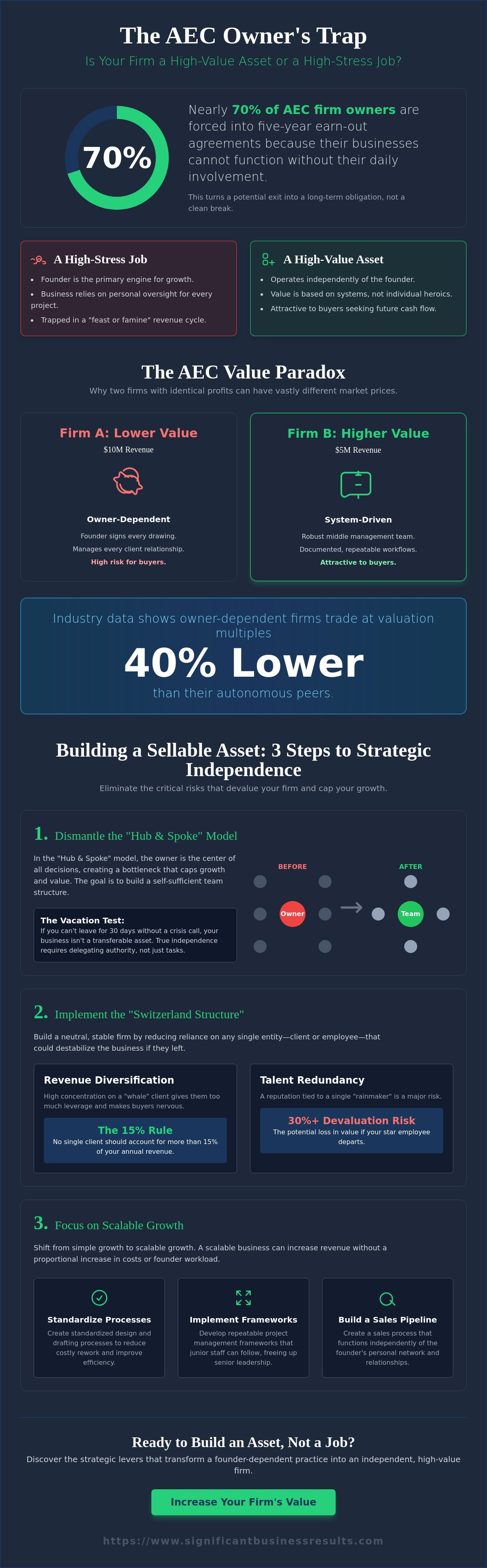
In the AEC world, it’s easy to fall into the trap of equating high revenue with high value. But a prospective buyer sees things differently. A $10 million firm that would collapse without its founder is often worth less than a stable, system-driven $5 million firm. This is the AEC Value Paradox. True value is found in the operational maturity and resilience of the business itself.
Financial Performance and Audit-Readiness
Your financial statements are the first thing a serious buyer will scrutinize. They are not just looking at the bottom line; they are looking for signs of professionalism and transparency. Clean, professionally prepared financials act as a powerful trust signal. Transitioning from cash-basis to accrual-basis accounting is a critical step. It provides a true picture of project profitability and demonstrates a level of financial sophistication that sophisticated buyers expect. This isn't just about bookkeeping; it's about presenting a clear, credible story of your firm's financial health.
According to business valuation methodologies, this is a well-documented area of ongoing research and practical application.
The Growth Potential Driver in AEC
Growth is a critical value driver, but only if it's sustainable. A buyer needs to see a clear path to future returns that doesn't rely on your personal intervention. Is your firm’s growth tied directly to the number of hours you can personally bill or the relationships only you can manage? Or is it fueled by a repeatable, scalable process that a new owner could step into and expand? In short, Growth Potential is a buyer's ability to see future returns without founder intervention. Building scalable systems is essential for demonstrating this potential. For more on this, see our guide on how to scale an architecture firm beyond owner-dependency.
Strategic Independence: Eliminating the Three Critical Risks to Your Valuation
From a buyer's perspective, value is inversely proportional to risk. The more your business relies on a single person, client, or employee, the riskier the investment. Building strategic independence means systematically de-risking your operations and proving the company is a standalone entity.
The 'Hub and Spoke' Risk
If every major decision, client relationship, and project oversight runs through you, you are the hub. This model is efficient for startups but severely caps market value because the business cannot function without its central figure.
The 'Switzerland Structure'
This driver measures your firm’s neutrality and resilience. True value comes from reducing reliance on any single 'whale' client, one key supplier, or a single 'rainmaker' employee who brings in all the new business.
Customer Satisfaction
Moving beyond anecdotal claims of "we do great work" is crucial. Implementing measurable, third-party verifiable data like a Net Promoter Score (NPS) provides concrete proof of client loyalty and satisfaction, which is a strong indicator of future revenue stability.
Unsure where your biggest risks lie? Taking a confidential assessment can provide immediate clarity. Discover your specific risk factors by taking the Value Builder Score assessment.
Research published by understanding value drivers shows that this is a well-documented area of ongoing research and practical application.
Breaking the Hub and Spoke Model
The first step toward independence is delegation—not just of tasks, but of authority. Empower your project leads to manage high-level client communication and decision-making. A simple but effective way to measure your progress is the 'vacation test.' Could you take a two-week, completely unplugged vacation without your phone ringing constantly? If the answer is no, it’s a clear sign that owner dependency is still suppressing your firm's value. Reducing this dependency is key to reclaiming your freedom and building a sellable asset.
The Switzerland Structure for Design and Build
For AEC firms, client and project concentration is a common vulnerability. As a rule of thumb, you can mitigate this risk by ensuring no single client or project accounts for more than 15% of your annual revenue. Diversification also applies to your talent. If your firm's reputation is inextricably linked to one star architect or lead engineer, the departure of that individual could be catastrophic. Building a strong, collaborative team brand over individual 'stars' creates a more stable and valuable enterprise.
Future-Proofing Your Firm: Recurring Revenue and Scalable Systems
The most valuable companies are not just profitable today; they have a clear and predictable path to future profits. For project-based AEC firms, this means moving beyond the 'feast or famine' cycle and building systems that ensure long-term stability and growth.
Recurring Revenue Models for AEC Firms
Buyers pay a significant premium for predictable revenue. While the AEC industry is traditionally project-based, there are powerful ways to build recurring income streams. This can include shifting from one-off projects to master service agreements (MSAs), retainers for ongoing advisory work, or developing facility management and maintenance contracts. Even a small percentage of recurring revenue can drastically increase your valuation multiple because it smooths out cash flow and reduces the uncertainty inherent in project-based work. To learn more, explore our guide to recurring revenue models for AEC service businesses.
Establishing a Monopoly of Control
This driver is about identifying your unique 'X-factor'—the one thing your firm does demonstrably better than any competitor. It's not about being the biggest, but about being the best in a well-defined niche. Deep specialization allows you to command premium pricing, attract top talent, and create a protective moat around your business. A firm that is the go-to expert for designing sustainable data centers, for example, is far more valuable than a generalist architecture firm. This niche dominance makes you difficult to replace and highly attractive to a strategic buyer.
By focusing on these core drivers, you shift your role from the primary doer to the strategic architect of your business. This journey not only creates significant results in your firm's final sale price but also delivers invaluable personal and financial freedom along the way.
Ready to implement these structural changes in your firm? Our specialized AEC coaching programs are designed to help you build a more valuable, independent business.
Frequently Asked Questions
What is the most important driver of company value for an engineering firm?
While all drivers are important, for engineering firms, reducing 'Hub and Spoke' owner dependency and establishing a 'Monopoly of Control' through technical specialization are often the most critical. A buyer needs to see that the firm's technical expertise and client relationships exist within the team and systems, not just with the founder.
How can an architecture firm create recurring revenue?
Architecture firms can create recurring revenue through long-term master service agreements (MSAs) with institutional clients, offering ongoing design review or advisory services on retainer, providing building maintenance or management contracts post-construction, or licensing proprietary design templates or processes.
Why does owner dependency lower the value of my construction business?
Owner dependency creates significant risk for a buyer. If you manage all key client relationships, bids, and project oversight, a buyer will question whether the business can survive your departure. This forces them to demand a long, restrictive earn-out and offer a lower price to compensate for the risk of clients and projects leaving with you.
How long does it take to improve these value drivers before a sale?
Meaningfully improving these drivers is not an overnight fix. It typically takes between two to five years of focused effort to implement the necessary systems, delegate authority, and diversify your client base. Starting the process well before you plan to exit is crucial for maximizing your final valuation.

Article by
Franne McNeal
Franne McNeal, President, Significant Business Results LLC has helped 885+ small business owners collectively create 15,000 jobs and nearly $11 billion in revenue. We help architecture, engineering, and construction industry business owners with $1M-$20M in annual revenue, improve revenue, performance and long-term value. We help owners build a business that runs without them & create financial & personal freedom. Our clients focus their energy for action to achieve significant business results.